Experiencing a loss of hydraulic power? This leads to erratic operation, lost productivity, and potential safety hazards. Identifying internal leaks is crucial for restoring performance and preventing further component damage.
To check if a hydraulic cylinder is leaking internally, observe for drift or creep while holding a load, conduct a simple bypass test using a flow meter, or perform an isolation test by capping cylinder ports and monitoring pressure decay.
Discover precise methods to diagnose internal cylinder leaks and prevent costly failures.
Hydraulic Cylinder Internal Leakage Manifestation
Hydraulic Cylinder Internal Leakage: Understanding the Silent Threat
Internal leakage within a hydraulic cylinder, though unseen, is a significant problem that silently degrades system performance. Unlike external oil drips, this occurs when hydraulic fluid bypasses seals for hydraulic cylinders internally, primarily across the piston.
Key indicators of internal leakage include:
- Cylinder Drift/Creep: The most common sign, where an actuator slowly moves from its intended position even when the control valve is centered or closed (e.g., a raised boom slowly lowering).
- Reduced Performance: Manifests as decreased lifting capacity, slower-than-normal extension or retraction speeds under load, or an inability to hold a stable position against external forces.
This silent issue happens because pressurized fluid escapes past worn seals rather than generating work. Early detection of these symptoms is crucial for prompt repair hydraulic cylinder actions.
Causes of Hydraulic Cylinder Internal Leakage
Several factors contribute to a hydraulic cylinder leaking internally. Understanding these causes is crucial for preventing issues and ensuring the longevity of your equipment.
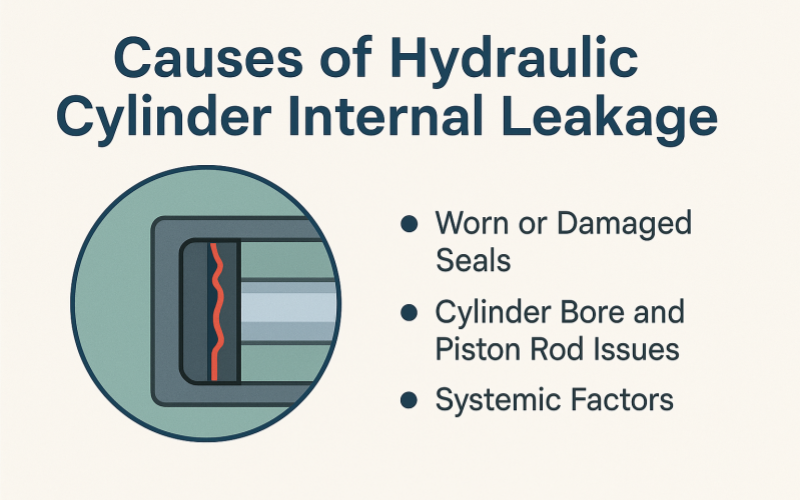
Primary Culprits: Worn or Damaged Seals
The most common reason for internal leakage is typically worn or damaged piston seals for hydraulic cylinders. These seals, even if high-quality, will degrade over time due to:
- Constant friction during operation
- Exposure to contaminants within the hydraulic fluid
- High operating temperatures
- Chemical incompatibility issues between the seal material and the hydraulic fluid
- Normal wear and tear from millions of operational cycles
Cylinder Bore and Piston Rod Issues
Damage to the cylinder’s internal components can also create pathways for fluid bypass:
- Scratches, gouges, or out-of-roundness on the cylinder bore (the inner surface)
- Damage to the piston rod surface
- A bent or misaligned piston rod, which can cause uneven and premature seal wear
Systemic Factors
Broader issues within the hydraulic system can also lead to internal leaks:
- High system pressure surges: Sudden, excessive pressure can stress and damage seals.
- Cavitation: The formation and collapse of vapor bubbles in the fluid can erode seal material and internal surfaces.
- Improper Hydraulic Fluid:
- Using the wrong type of hydraulic fluid not compatible with the seals.
- Fluid with excessive particulate contamination acts as an abrasive, damaging internal surfaces and seals, leading to inevitable cylinder leakdown.
Internal Leakage Test Conditions
Before attempting to diagnose how a hydraulic cylinder is leaking internally, ensuring the correct test conditions is paramount to obtaining accurate and reliable results. Preparing your system properly will prevent misleading readings and ensure efficient troubleshooting.
| Essential Test Conditions for Internal Leakage Detection | |
| Normal Operating Temperature: | 1. The hydraulic system must be at its normal operating temperature. |
| 2. Cold oil is thicker and behaves differently, which can potentially mask minor internal leaks. | |
| Stable System Pressure: | 1. The system pressure should be stable and within the cylinder’s rated working pressure. |
| 2. Fluctuating pressure can give misleading readings and make accurate diagnosis difficult. | |
| Representative Load Application | 1. The load applied to the cylinder during the test should be representative of its working conditions. |
| 2. Preferably, apply a significant portion of its maximum rated load, as internal leakage often becomes more pronounced under higher pressure. | |
| Rectify External Leaks First: | 1. Ensure all external leaks are rectified before beginning the test. |
| 2. External fluid loss can confuse the diagnosis and make it difficult to pinpoint internal issues. | |
| Control Valve Position: | 1. The control valve must be in a neutral or closed position. |
| 2. This prevents external factors from influencing the cylinder’s holding capacity during the internal leak test | |
Hydraulic Cylinder Internal Leakage Test Method
Accurately diagnosing hydraulic cylinder internal leakage requires specific testing methods.
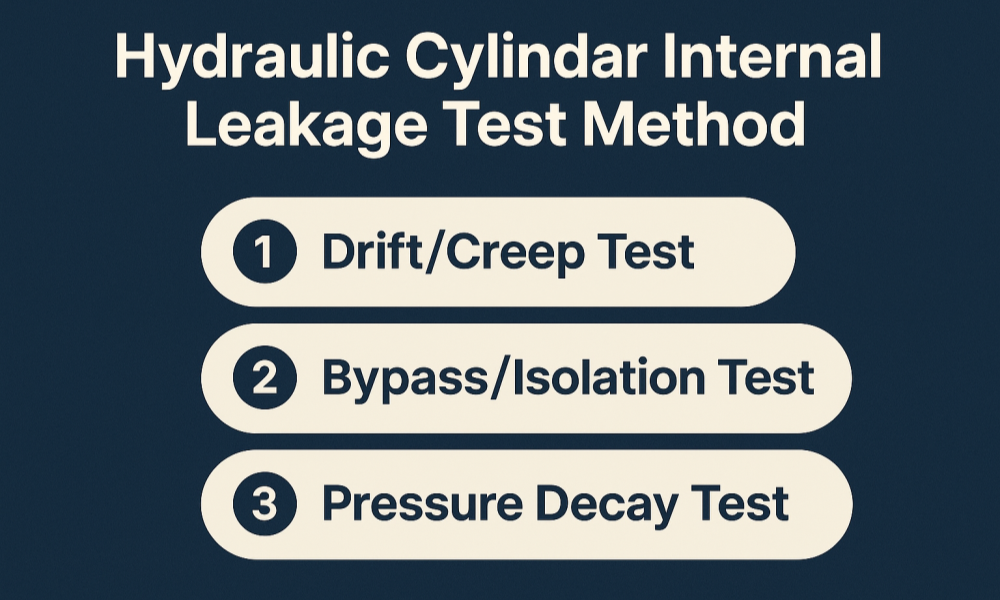
1. Drift/Creep Test
This is the simplest, preliminary test. Apply a load to the cylinder and place the control valve in the neutral position (if applicable, ensuring no external flow). Mark the cylinder rod’s position relative to the barrel. Monitor the rod’s movement over a set period (e.g., 5-15 minutes). Any significant movement indicates internal leakage. The rate of drift directly correlates with the severity of the cylinder leakdown. While easy, it’s not quantitative.
2. Bypass/Isolation Test
This method provides precise data on cylinder leakdown.
- Materials Needed: A flow meter (turbulent or positive displacement type, capable of handling hydraulic fluid), two hydraulic hoses with appropriate fittings, and caps or plugs.
- Procedure:
1. Fully retract the cylinder. 2. Disconnect the rod end hose from the cylinder port. Cap the line from the valve to prevent oil loss from the system, but leave the rod end port on the cylinder open. 3. Connect one end of a hose to the rod end port of the cylinder and the other end to the return line of the hydraulic reservoir (or to a bucket to measure volume over time). 4. Apply full pressure to the cap end of the cylinder using the system’s pump. 5. Observe the flow meter or measure the volume of oil collected from the rod end over a specific time. Any flow indicates an internal leak past the piston seal. 6. Repeat the process with the cylinder fully extended, testing the cap end. Disconnect the cap end hose, cap the line, and connect a hose from the cap end cylinder port to the return line. Apply pressure to the rod end. - Interpretation: A flow rate above the manufacturer’s specified tolerance for seals for hydraulic cylinders (often zero or very minimal for new cylinders) confirms internal leakage. This is a definitive way to identify if hydraulic-cylinder-is-leaking-internally and gauge its severity before deciding to repair hydraulic cylinder.
3. Pressure Decay Test
- Materials Needed: Two pressure gauges, appropriate fittings, and ball valves.
- Procedure:
1. Extend the cylinder to approximately mid-stroke.
2. Install pressure gauges on both the cap end and rod end ports.
3. Close the ball valves to isolate the cylinder, essentially trapping fluid on both sides.
4. Observe the pressure readings on both gauges over time. - Interpretation: If internal leakage is present, the pressure on the higher-pressure side will slowly decrease, while the pressure on the lower-pressure side will slowly increase as fluid bypasses the piston seal. A significant drop in pressure over a short period indicates severe cylinder leakdown.