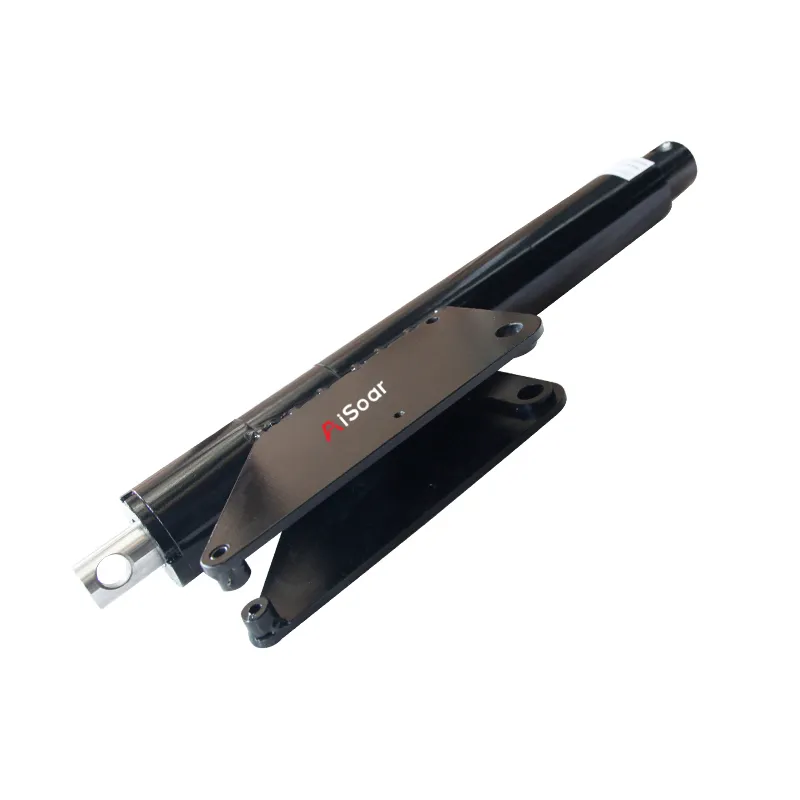
A position sensing hydraulic cylinder is a hydraulic cylinder designed with position feedback capability. Compared with a standard hydraulic cylinder, it not only provides linear force and movement, but also detects the actual position of the piston or rod during operation.
This type of cylinder is also commonly called a hydraulic cylinder with position sensor, position feedback hydraulic cylinder, or sensor-integrated hydraulic cylinder. It is widely used in equipment that requires accurate positioning, synchronized movement, automatic control, and real-time performance monitoring.
How Does a Position Sensing Hydraulic Cylinder Work?
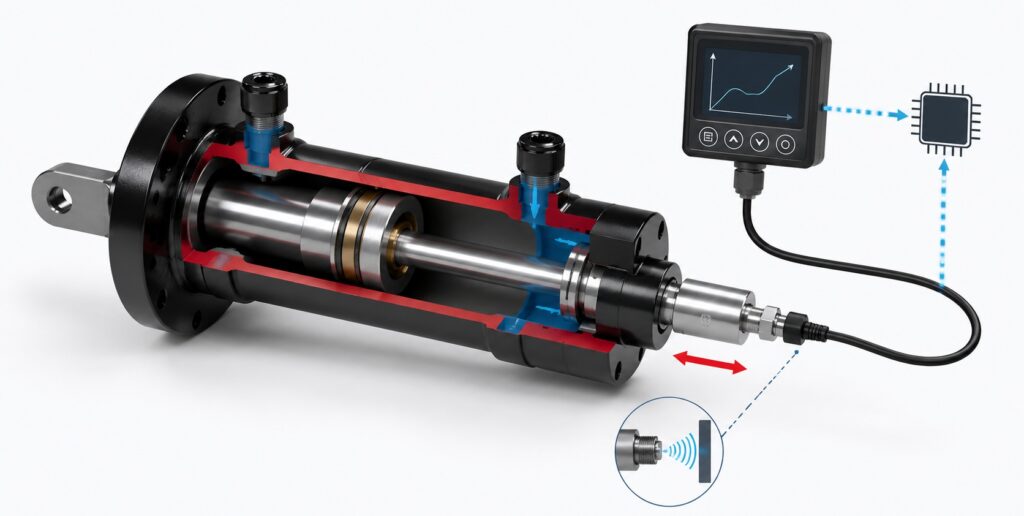
A standard hydraulic cylinder uses pressurized hydraulic oil to move a piston inside the cylinder barrel. When oil enters one side of the cylinder, the piston moves and the rod extends or retracts. This movement creates the linear force required by the machine.
A position sensing hydraulic cylinder adds a position sensor to this structure. The sensor detects the movement or stroke position of the piston or rod and converts it into an electrical signal. This signal can be sent to a PLC, controller, display unit, or data acquisition system.
With this feedback, the control system can know the actual position of the cylinder in real time. If the cylinder has not reached the target position, the system can continue adjusting the hydraulic valve or flow. If the cylinder is close to the required position, the system can slow down the movement to reduce shock and improve stability.
In simple terms, a position sensing hydraulic cylinder allows the machine to know where the cylinder is, not just whether it is extending or retracting.
Why Is Position Feedback Important?
In many hydraulic systems, cylinder movement is affected by load changes, oil temperature, friction, internal leakage, valve response, and pressure fluctuation. If the system only controls movement by time, pressure, or flow, the actual cylinder position may not always match the expected position.
Position feedback helps solve this problem. By detecting the real stroke position, the control system can make more accurate adjustments during operation. This improves motion accuracy, repeatability, safety, and overall machine performance.
For example, in a lifting system, the cylinder may need to stop at a specific height. In a multi-cylinder system, several cylinders may need to move at the same speed and reach the same position. In an automated production line, the cylinder may need to repeat the same movement accurately over many cycles.
In these applications, a standard hydraulic cylinder may not provide enough control information. A position sensing hydraulic cylinder gives the system the feedback it needs for more precise and reliable operation.
Common Position Sensor Types Used in Hydraulic Cylinders
Different position sensors can be used depending on the application, working environment, stroke length, accuracy requirement, and installation method.
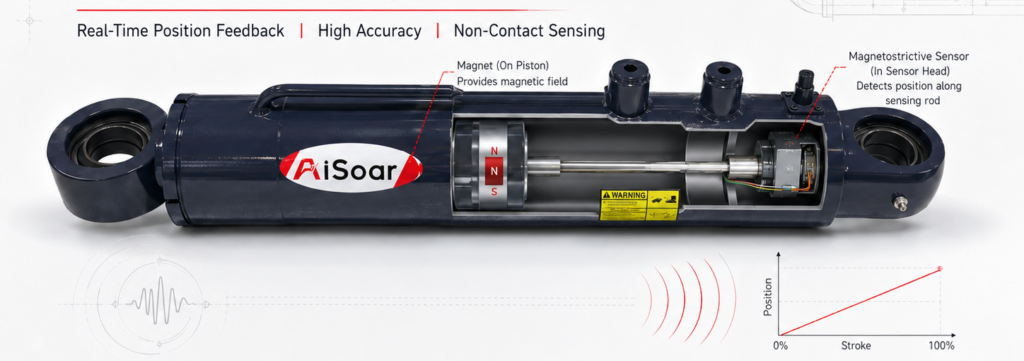
One common option is a magnetostrictive position sensor. This type of sensor is often built into the hydraulic cylinder. It provides non-contact position measurement, which means there is no mechanical wear during operation. It is suitable for heavy-duty equipment, long service life, and high-cycle applications.
Another option is an LVDT sensor, which is used for precise linear position measurement. LVDT sensors are often selected for industrial equipment, test systems, and applications that require stable and accurate position feedback.
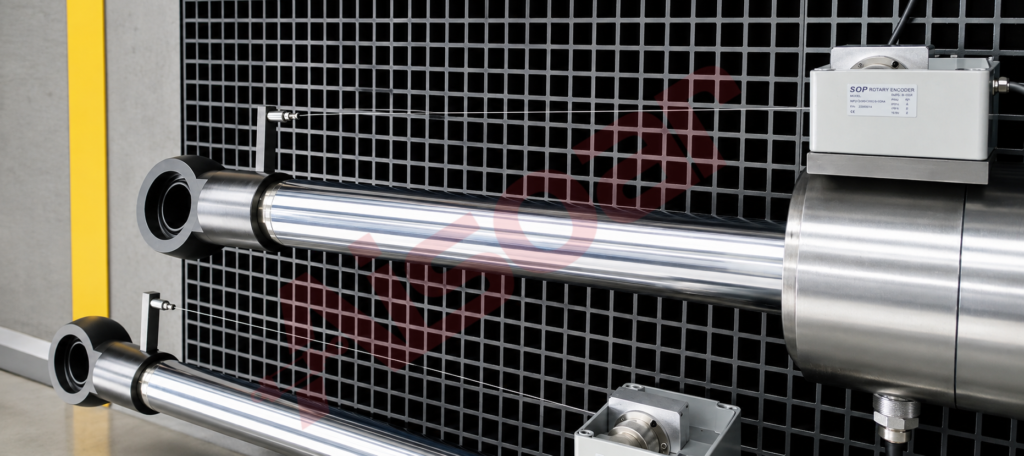
For some applications, an external draw-wire sensor can also be used. This sensor is installed outside the cylinder and connected to the moving part of the machine. It is easier to install and maintain, especially for equipment modification or testing applications. However, it usually needs additional protection against dust, vibration, impact, and moisture.
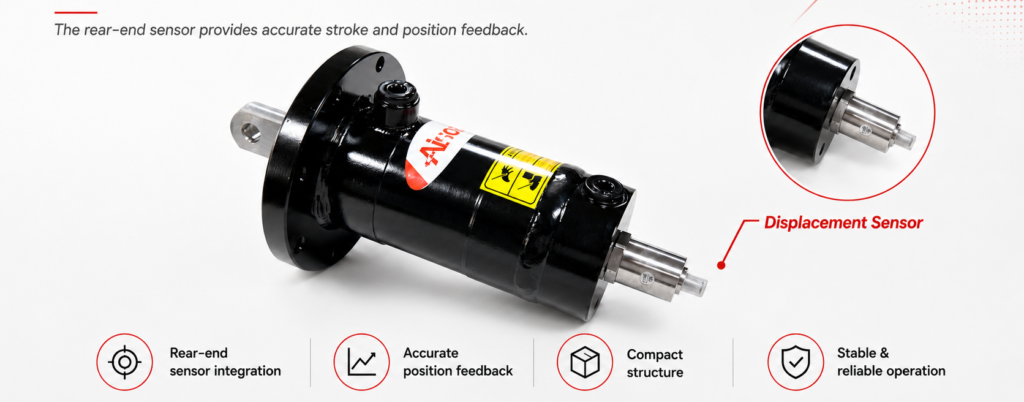
The right sensor type depends on the cylinder design, installation space, working pressure, control system, and environmental conditions.
Standard Hydraulic Cylinder vs Position Sensing Hydraulic Cylinder
| Item | Standard Hydraulic Cylinder | Position Sensing Hydraulic Cylinder |
|---|---|---|
| Main Function | Provides linear force and movement | Provides linear force and real-time position feedback |
| Position Feedback | Not available | Available through an integrated or external sensor |
| Control Method | Usually controlled by pressure, flow, or time | Can support closed-loop control |
| Accuracy | Depends on system setting and operating conditions | More accurate because the actual stroke position is detected |
| Typical Use | General lifting, pushing, pulling, and moving applications | Equipment requiring positioning, synchronization, automation, or monitoring |
Typical Applications of Position Sensing Hydraulic Cylinders
Position sensing hydraulic cylinders are used in equipment where accurate movement and reliable position feedback are important.
In construction machinery, they can be used for boom positioning, steering systems, lifting structures, and attachment control. In agricultural equipment, they can support implement adjustment, steering control, planter systems, and other hydraulic functions that require repeatable movement.
In material handling equipment, position feedback cylinders can be used for lifting platforms, forklifts, stackers, scissor lifts, and automated loading systems. In industrial automation, they are commonly used in presses, clamping systems, forming equipment, and production lines.
They are also useful in hydraulic test benches. During cylinder testing, position sensors can help measure stroke, movement speed, cushioning performance, and repeatability. This allows manufacturers to verify cylinder performance more accurately before delivery.
AiSoar Custom Position Sensing Hydraulic Cylinder Solutions
AiSoar Hydraulics can provide customized hydraulic cylinder solutions according to customer drawings, samples, installation dimensions, working pressure, stroke length, mounting style, and application requirements.
For equipment that requires position feedback, synchronized movement, automatic control, or stroke monitoring, AiSoar can help evaluate the cylinder structure and provide a suitable position sensing hydraulic cylinder solution.
Depending on the working conditions, AiSoar can support built-in or external position feedback designs. The cylinder can be customized according to sensor type, signal output, mounting space, sealing requirements, cable protection, and overall equipment structure.
AiSoar can also provide hydraulic systems and hydraulic test benches for related applications. Test functions can include pressure testing, leakage inspection, stroke testing, speed measurement, cushioning performance testing, data recording, and test report output.
Conclusion
A position sensing hydraulic cylinder combines hydraulic power with real-time position feedback. It allows the control system to monitor the actual movement of the cylinder and make more accurate adjustments during operation.
Compared with a standard hydraulic cylinder, it offers better positioning accuracy, smoother movement, improved synchronization, and stronger support for automation.
For OEMs and equipment manufacturers, choosing the right position sensing hydraulic cylinder can help improve machine performance, reduce control errors, and support smarter hydraulic system design.