
A hydraulic cylinder does more than generate linear force. It must also transfer that force safely into the machine structure. The cylinder mounting type determines how the cylinder is connected, whether it can pivot during operation and how effectively it handles alignment, vibration and changing load directions.
Selecting the wrong mounting style can create side loading on the piston rod, rod bearing and seals. Over time, this may result in uneven wear, seal leakage, bent rods, damaged pins or cracks around the mounting structure. Choosing the right hydraulic cylinder mount is therefore just as important as selecting the correct bore, stroke and operating pressure.
What are the main hydraulic cylinder mounting types?
The main hydraulic cylinder mounting types include clevis, cross-tube, tang, spherical bearing, trunnion, flange, foot and side-lug mounts. Fixed mounts are used for straight, guided motion, while pivot mounts allow the cylinder to rotate as a machine linkage moves through an arc.
What Is a Hydraulic Cylinder Mount?
A hydraulic cylinder mount is the mechanical connection between the cylinder and the equipment. Mounts may be welded directly to the cylinder body, machined into an end cap, bolted to the cylinder or threaded onto the piston rod.
The mount must transfer the cylinder’s push and pull forces into the machine frame while maintaining acceptable alignment. Some mounts hold the cylinder rigidly in one position, while others allow it to rotate as the machine linkage moves.
Hydraulic cylinder mounting types can generally be divided into two main categories:
- Fixed mounts, such as flange, foot and side-lug mounts
- Pivot mounts, such as clevis, cross-tube, tang, trunnion and spherical bearing mounts
The correct category depends mainly on whether the load travels in a straight line or follows an arc.
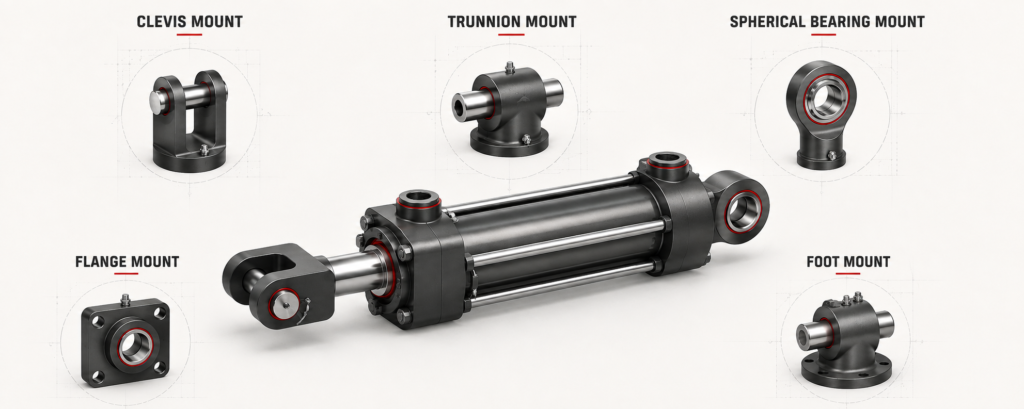
Fixed Mounts vs Pivot Mounts
Fixed mounts keep the cylinder body in a stable position relative to the machine frame. They are generally suitable when the piston rod and the driven component move along a straight and accurately guided path. Because fixed mounts allow little movement to compensate for installation error, frame rigidity and alignment are particularly important.
Pivot mounts allow the cylinder to rotate around a pin or bearing during extension and retraction. They are commonly used in mobile machinery, agricultural equipment, trailers and construction equipment, where the cylinder operates between moving linkage points.
| Mount category | Cylinder movement | Best suited for | Main concern |
|---|---|---|---|
| Fixed mount | Cylinder body remains stationary | Straight, guided motion | Precise alignment |
| Pivot mount | Cylinder rotates around a pin or bearing | Linkages moving through an arc | Correct pivot plane and pin support |
| Self-aligning pivot mount | Allows limited angular movement in multiple directions | Structures with minor angular variation | Bearing capacity and lubrication |
Neither category is universally better. The correct choice depends on the machine’s actual load path and movement geometry.
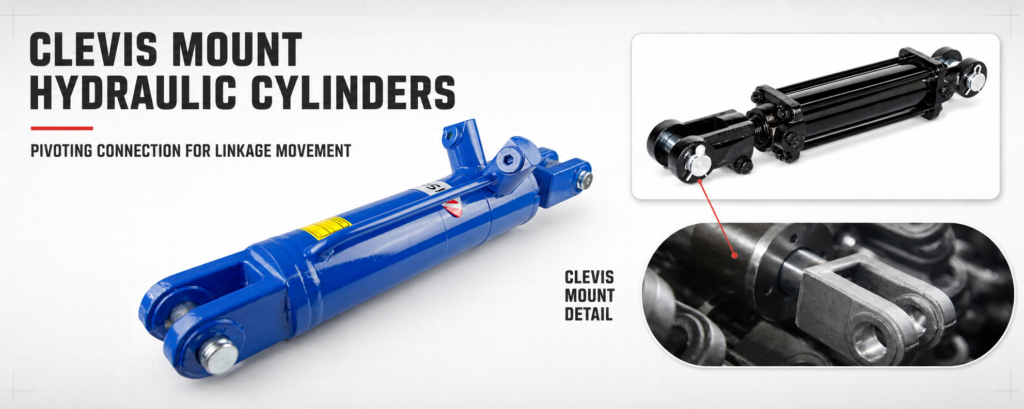
A clevis mount uses a fork-shaped connection and a pin to attach the cylinder to the equipment. The clevis can be located at the cylinder base, at the piston rod end or at both ends.
Because the pin creates a pivot point, the cylinder can rotate as the linkage travels through an arc. Clevis-mounted cylinders are widely used in agricultural implements, dump mechanisms, construction equipment, material-handling machinery and other mobile applications.
A clevis mount normally allows movement in one primary plane. The mounting pin should be positioned perpendicular to that plane, and the connected brackets should provide adequate support on both sides of the clevis. Excessive clearance between the pin and pin hole can cause impact loading, noise and accelerated wear.
Clevis mounts should not be expected to compensate for significant sideways offset. If the cylinder and linkage move in different planes, the resulting side load may still damage the rod bearing and seals.
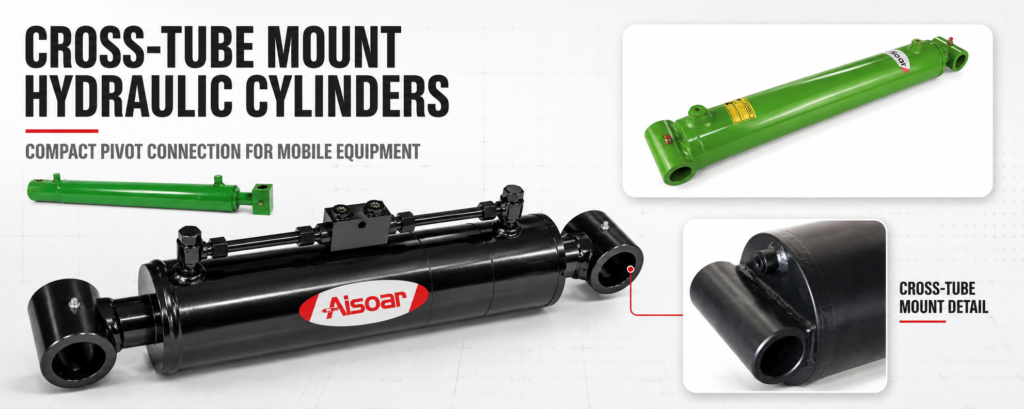
A cross-tube mount consists of a tube welded across the cylinder base or piston rod end. A mounting pin passes through the tube, allowing the cylinder to pivot during operation.
Cross-tube hydraulic cylinders are compact, strong and easy to integrate into welded machine frames. They are commonly found on loaders, backhoes, forklifts, trailers, agricultural machinery and waste-handling equipment.
Compared with an external clevis, a cross tube can provide a simple and space-efficient connection. Bushings or grease fittings may be incorporated to improve pin support and reduce wear. The cross tube, weld joint and pin diameter must all be designed for the expected load and duty cycle.
The mounting brackets should support the cross tube close to both ends. If the brackets are positioned too far apart, the pin may bend and place additional stress on the tube and welds.
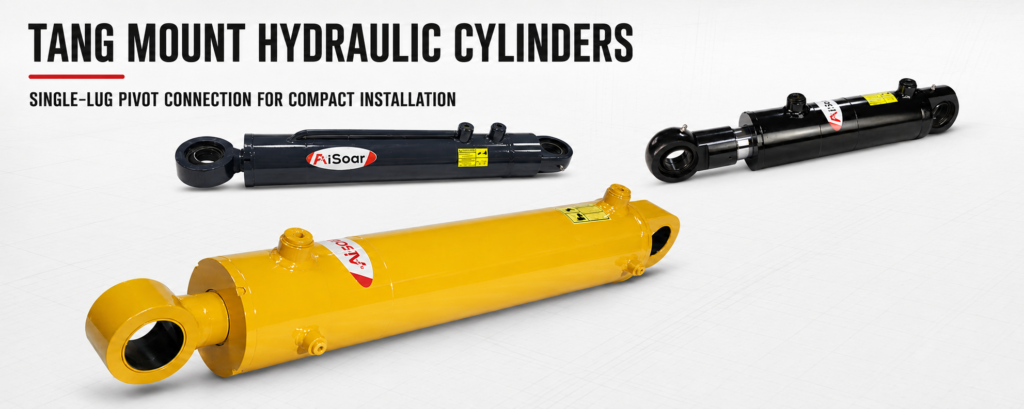
A tang mount uses a single flat lug or eye that fits between two brackets on the machine. A pin passes through the brackets and tang to form the pivot connection.
Tang mounts are useful where installation space is limited or where the machine already has a double-ear mounting bracket. They are used on agricultural equipment, construction machinery, waste-handling equipment and other welded hydraulic cylinder applications.
Because a tang is supported through a single central lug, its thickness, weld size and pin-hole strength must be matched to the cylinder force. The machine brackets should support the tang closely without restricting the required pivoting movement.
A tang mount and clevis mount can form a compatible joint: the tang provides the male connection, while the clevis or double bracket provides the female connection.
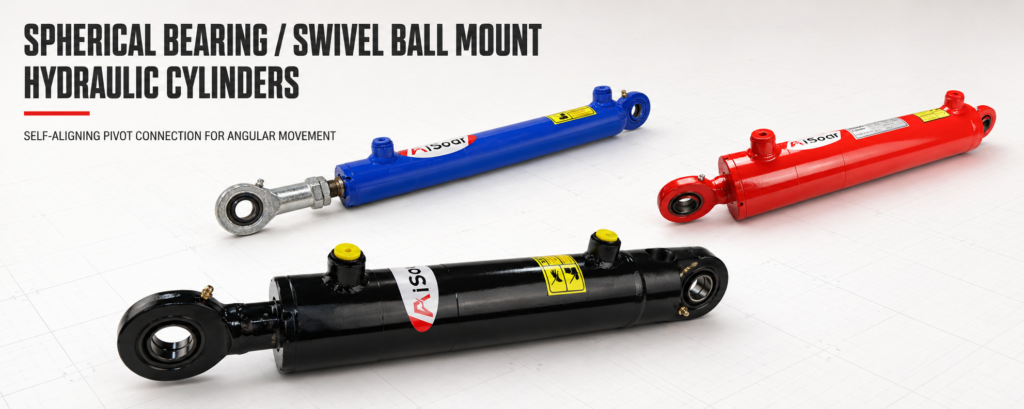
4. Spherical Bearing or Swivel Ball Mount
A spherical bearing mount contains a spherical plain bearing inside the cylinder eye. Unlike a conventional pin joint that primarily pivots in one plane, a spherical bearing permits limited angular movement in multiple directions.
This self-aligning capability is useful when the machine frame flexes slightly, the mounting points cannot remain perfectly parallel or the linkage changes angle during operation. Spherical bearing cylinders are often used in compact equipment, agricultural machinery, special vehicles and construction equipment.
However, a spherical bearing does not make the cylinder suitable for uncontrolled side loading. It accommodates limited angular misalignment at the connection, but the main cylinder force should still act close to the rod centerline.
Bearing size, allowable angle, lubrication method, pin hardness and dynamic load rating should be considered during selection. Where the bearing requires grease, the lubrication point must remain accessible after installation.
5. Trunnion Mount
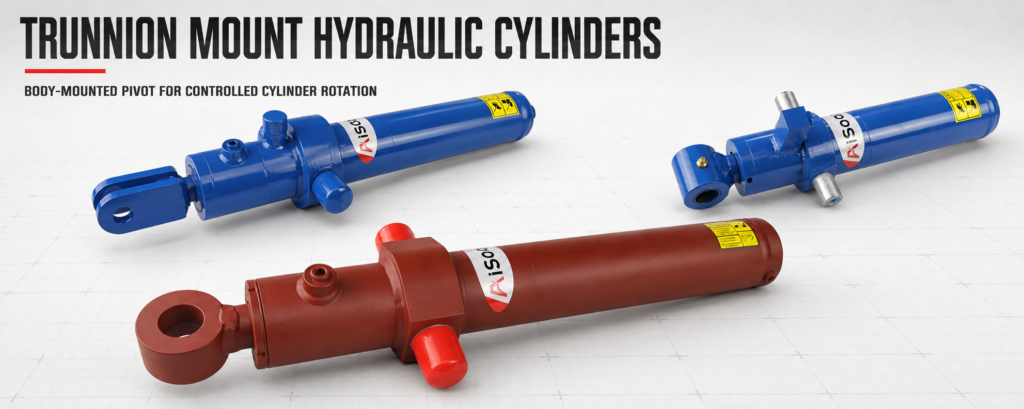
A trunnion-mounted cylinder has cylindrical pivot pins extending from both sides of the cylinder body. Depending on the design, the trunnions may be located near the head, near the cap or around the middle of the barrel.
The machine supports the trunnion pins with bearings or pillow blocks, allowing the complete cylinder to rotate as the piston rod follows the linkage. Trunnion mounts are used in lifting equipment, presses, material-handling machinery and large industrial or mobile mechanisms.
Trunnion pins are primarily intended to carry shear loads. Their supports should be positioned close to the trunnion shoulders to minimize bending stress. The two support bearings must also be accurately aligned so the cylinder can pivot without binding.
The location of the trunnion affects cylinder movement, installation space and piston rod column loading. Long-stroke or high-force applications should therefore be evaluated individually instead of selecting the trunnion position only from available space. Parker similarly recommends close trunnion support and cautions against bending loads on trunnion pins.
6. Flange Mount
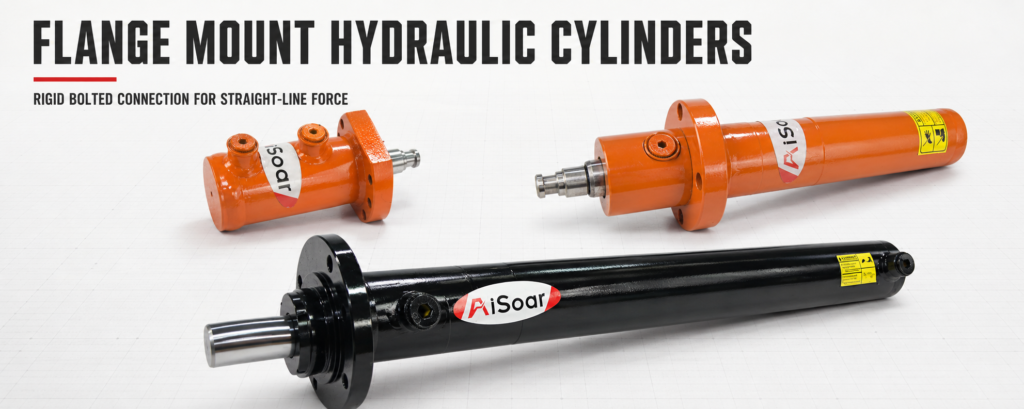
A flange mount rigidly bolts the cylinder head or cap to the machine structure. Because the mounting face is generally perpendicular to the cylinder centerline, the load can be transferred directly into a strong frame member.
Flange-mounted hydraulic cylinders are commonly used in hydraulic presses, clamping equipment, industrial machinery and other applications with straight, accurately guided movement. They provide a rigid connection and are well suited to high axial forces.
The mounting surface must be flat, strong and perpendicular to the intended direction of travel. A flange mount provides little ability to compensate for misalignment. If the load is not properly guided, the piston rod can be forced sideways even when the flange itself is securely attached.
Whether a head flange or cap flange is preferred depends on the primary force direction and the machine structure. The flange, fasteners and supporting plate must be evaluated as one load-bearing assembly rather than as separate components.
7. Foot or Side-Lug Mount
Foot-mounted cylinders are attached to a machine base through feet or side lugs located parallel to the cylinder barrel. They are convenient for horizontal industrial installations and can provide easy access for maintenance.
Unlike a centerline flange mount, a foot or side-lug mount transfers force through mounting points offset from the cylinder axis. This offset creates a turning moment when the cylinder pushes or pulls. The machine frame, mounting bolts and cylinder lugs must resist that moment.
The driven load should be externally guided, and the cylinder must be carefully aligned. Keys, dowels or positive stops may be required to prevent the cylinder from moving on its mounting surface under repeated load reversals.
Foot and side-lug mounts are most appropriate when the frame is sufficiently rigid and the load path remains straight. They should not be used as a substitute for a pivot mount when the driven mechanism moves through an arc.
Hydraulic Cylinder Mounting Types Comparison
| Mounting type | Fixed or pivoting | Alignment tolerance | Typical applications | Main design consideration |
|---|---|---|---|---|
| Clevis | Pivoting in one plane | Moderate | Agriculture, trailers, construction machinery | Pin and bracket alignment |
| Cross tube | Pivoting in one plane | Moderate | Loaders, backhoes, forklifts, trailers | Pin support and weld strength |
| Tang | Pivoting in one plane | Moderate | Compact mobile machinery | Lug thickness and bracket support |
| Spherical bearing | Pivoting in multiple directions | Relatively high | Flexible frames and complex linkages | Bearing angle and lubrication |
| Trunnion | Pivoting in one plane | Moderate | Lifting systems, presses and heavy machinery | Bearing position and pin bending |
| Flange | Fixed | Low | Presses, clamping and industrial machinery | Flat mounting face and axial alignment |
| Foot or side lug | Fixed | Low | Horizontal industrial installations | Turning moment and frame rigidity |
How to Choose the Right Hydraulic Cylinder Mounting Type
Begin by studying the movement of both cylinder connection points through the complete operating cycle. If the cylinder remains stationary and the load moves in a straight, externally guided path, a flange or foot mount may be appropriate. If either connection point follows an arc, a clevis, cross-tube, tang or trunnion mount is normally more suitable.
The next step is to identify the primary force direction. Determine whether the cylinder mainly pushes, pulls or works under substantial force in both directions. The mount, pin, bolts, welds and machine brackets must all withstand the maximum cylinder force, including shock and pressure peaks.
Installation space must also be considered. Mounting style affects the cylinder’s closed length, pivot location, port accessibility and the space required for hoses. A mechanically suitable mount may still create problems if it causes hose interference or prevents the cylinder from rotating freely.
For long-stroke cylinders operating in compression, piston rod buckling must be checked separately. Changing the mount or pivot position can change the effective unsupported rod length and therefore the rod’s resistance to buckling.
Why Side Loading Is a Major Concern
Hydraulic cylinders are designed primarily to produce axial force. When the applied load is not aligned with the cylinder centerline, part of that force acts sideways on the rod, gland, piston and seals.
For example, if a cylinder applies a total force FF at a misalignment angle θ\theta, the approximate side-force component is:
Fside = F × sin(θ)
Even a small angle can create a meaningful side force when total cylinder force is high. A 100 kN load acting at an angle of only 2° creates approximately 3.5 kN of lateral force.
This side force may cause uneven rod-bearing wear, damaged seals, scoring inside the barrel and bending of the piston rod. A pivot or spherical bearing mount can accommodate appropriate angular movement, but it cannot correct poor linkage geometry or an unsupported external load.
Common Hydraulic Cylinder Mounting Mistakes
Treating the Cylinder as a Structural Guide
A hydraulic cylinder should create motion and force; it should not normally be the only component guiding a heavy load. Rails, bearings, slides or linkage arms should control the load path so the cylinder is not exposed to avoidable lateral forces.
Using a Rigid Mount for an Arc-Shaped Movement
If the driven component rotates around a hinge, the cylinder angle changes during the stroke. Rigidly fixing the cylinder in this situation can force the piston rod sideways. A properly positioned pivot mount should be used.
Restricting the Pivot Joint
A clevis or cross-tube cylinder must be able to rotate freely around its pin. Brackets, hoses, fittings or nearby frame members must not obstruct this movement.
Using Unsupported or Undersized Pins
The mounting pin must fit the joint correctly and have sufficient shear and bending capacity. Excessive pin clearance produces impact loading, while poor bracket support allows the pin to deflect.
Ignoring Frame Deflection
A cylinder can be aligned correctly when the machine is unloaded but become misaligned after the frame deflects under working load. Mounting geometry should therefore be checked under realistic operating conditions.
Welding Near an Assembled Cylinder
Welding a mounting bracket while the cylinder is assembled can transfer heat or welding current through the rod, bearings and seals. Welding procedures should protect precision surfaces and internal components, and the cylinder manufacturer’s instructions should always be followed.
Hydraulic Cylinder Mounting Installation Checklist
Before commissioning the cylinder, verify that:
- The base and rod-end pivot axes are parallel where single-plane movement is required.
- The cylinder can complete its full stroke without mechanical interference.
- Mounting pins fit correctly and are securely retained.
- Pivot joints rotate freely without forcing the rod sideways.
- Fixed mounting faces are flat, rigid and properly aligned.
- Bolts are correctly specified and tightened to the required torque.
- Hoses have sufficient length and do not restrict cylinder movement.
- Grease points and service components remain accessible.
- The load is externally guided where necessary.
- Long-stroke piston rods have been checked for buckling.
Bosch Rexroth also emphasizes that mounting surfaces and mounting components—including spherical bearings, trunnions, feet and flanges—must be capable of carrying the forces generated during operation. Bosch Rexroth hydraulic-cylinder documentation
Can Hydraulic Cylinder Mounts Be Customized?
Yes. Welded hydraulic cylinders can be manufactured with customized clevises, cross tubes, tangs, pin eyes, spherical bearings, trunnions and mounting brackets. Dimensions such as pin diameter, mounting width, hole spacing, closed-center length and port orientation can be matched to the equipment.
However, the mounting configuration should not be copied only from an external photograph. To design or replace a cylinder correctly, the manufacturer normally requires drawings or verified dimensional information, operating pressure, maximum load, stroke, movement geometry and application conditions.
For replacement projects, it is particularly important to confirm pin-center dimensions in both the fully retracted and fully extended positions. Mounting dimensions must work together with bore, rod diameter and stroke—not be treated as an independent specification.


