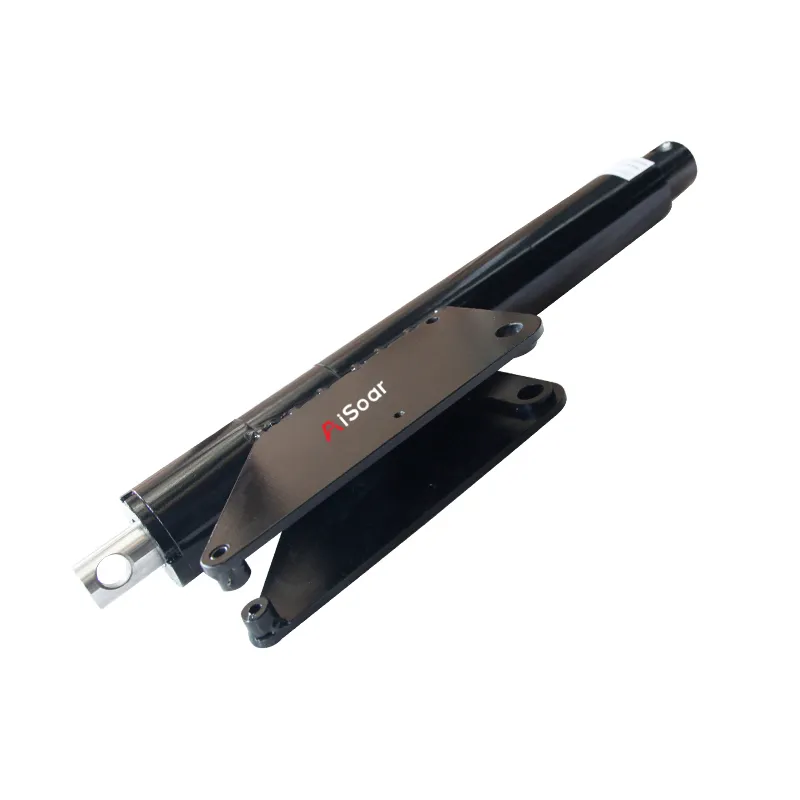
In modern industrial automation, automotive manufacturing, and precision assembly, scissor lifting platforms are critical components for vertical motion control. As engineering demands for system load capacity, positioning accuracy, and operational reliability intensify, traditional hydraulic actuation is increasingly being evaluated against modern electromechanical alternatives.
With significant advancements in high-capacity linear actuation, electric cylinders (servo linear actuators) are systematically replacing hydraulic cylinders. This article delivers a rigorous technical analysis of the kinematic principles, mechanical performance advantages, and design selection criteria of integrating electric cylinders into scissor lifting mechanisms.
How Do Electric Cylinders Drive Scissor Lifting Platforms?
-
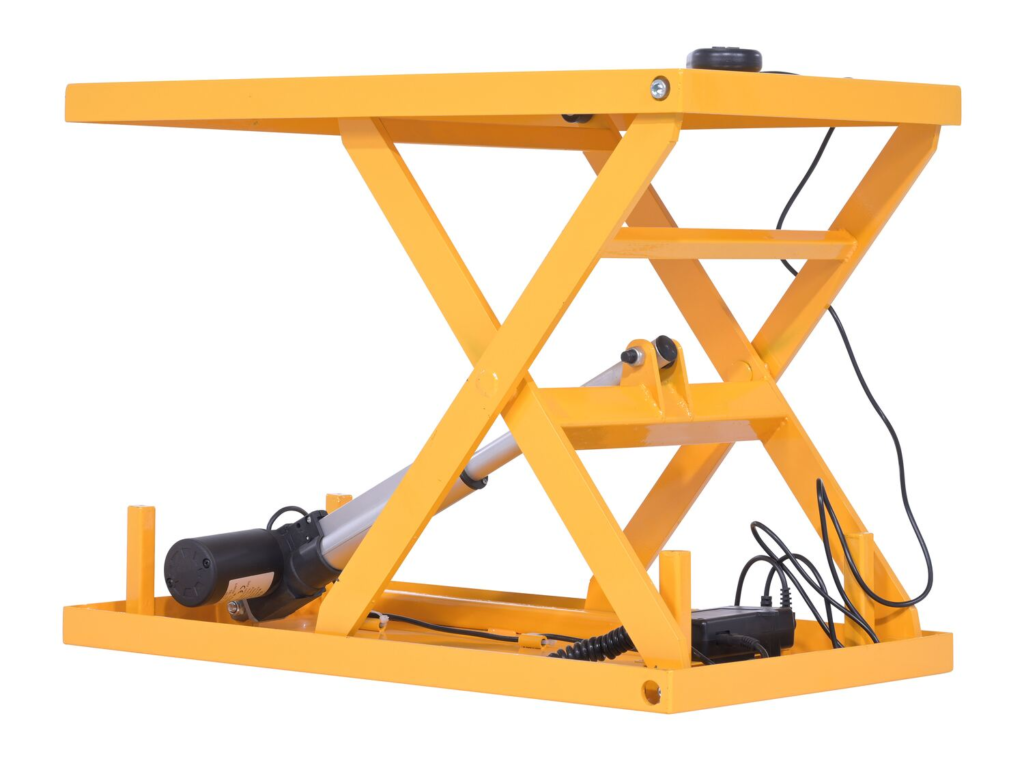
In a standard scissor linkage mechanism, the actuator serves as the force-transmitting element that converts linear displacement into vertical platform velocity. When utilizing an electric cylinder, the hydraulic pump station, valve blocks, and fluid conduits are completely eliminated.
-
The system operates via a closed-loop electromechanical train: a high-response servo motor delivers rotational torque, which is converted into linear stroke through an internal high-precision rolling element screw (either a ball screw or a planetary roller screw). The cylinder housing and rod are pivot-mounted between the inner and outer scissor structural links. By extending or retracting the actuator rod, the mechanical operating angle of the scissor arms is modified, precisely governing the vertical displacement, velocity, and acceleration of the platform.
Advantages of Electric Cylinders in Lifting Platform Applications
Replacing fluid power with electromechanical transmission provides quantifiable improvements across several critical engineering metrics:
Overcoming Mechanical Singularity (Initial Start Dead Center)
-
High Instantaneous Torque: When a scissor mechanism is fully collapsed (at its minimum structural height), the transmission angle between the actuator and the scissor arms is at its acute minimum. Kinematically, this represents a near-singularity configuration where the required initial horizontal thrust approaches its theoretical peak.
-
Heavy-Duty Capability: Electric cylinders equipped with planetary roller screws provide exceptional dynamic load ratings ($C_a$). Unlike hydraulic systems that may experience pressure lag or valve delays during startup, servo-driven electric cylinders can instantly output peak torque to deliver the massive initial linear force required to smoothly transition out of the structural dead center.
High Rigidity and Elimination of Position Drift
-
Mechanical Self-Locking & Rigidity: Hydraulic lifting platforms are subject to volumetric changes from fluid compressibility and micro-leakage across spool valves or piston seals, causing unpredictable “micro-drifting” or vertical settling under sustained static loads.
-
Zero-Drift Holding: Electric cylinders utilize a rigid mechanical drivetrain. When coupled with the servo motor’s electromagnetic holding brake, the actuator achieves an absolute mechanical lock. The vertical position remains entirely immutable regardless of load fluctuations or extended dwell times, eliminating the risk of uncommanded displacement.
Closed-Loop Synchronous Control for Multi-Actuator Systems
-
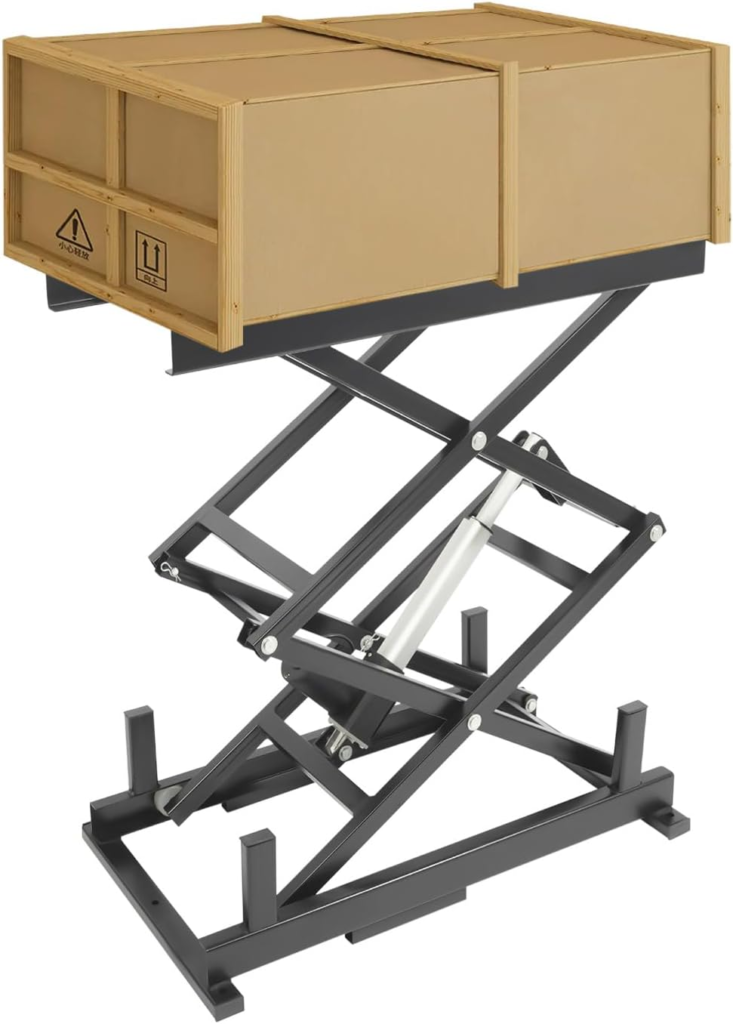
Pulse-Level Synchronization: Large-scale or non-uniformly loaded platforms frequently require multi-actuator configurations (e.g., 2-way or 4-way parallel lifting arrangements). In hydraulic circuits, achieving precise flow synchronization under asymmetrical loads requires complex proportional throttling, which is highly sensitive to fluid temperature and viscosity variations.
-
Deterministic Tracking: Electromechanical systems resolve this via multi-axis synchronization control loops. Utilizing high-resolution encoder feedback (absolute or incremental), the servo controllers execute real-time closed-loop adjustments down to the pulse level. This keeps synchronization errors within the micron range, ensuring the platform remains perfectly level under eccentric payloads.
Programmable Motion Profiling and Velocity Dynamics
-
Optimized Acceleration Curves: Electric cylinders allow for full software control over motion profiles (e.g., S-curve or trapezoidal acceleration/deceleration).
-
Impact Mitigation: When docking with automated assembly lines, the system can execute rapid long-stroke positioning followed by controlled deceleration to a micro-stepping velocity for final alignment. This smooth velocity deceleration prevents mechanical shock loads, minimizing structural resonance and protecting high-sensitivity payloads.
Selection Recommendations
When designing or sizing an electric cylinder for a scissor lifting application, the following mechanical parameters must be mathematically evaluated and specified:
Static and Dynamic Load Profiling
-
The structural geometry of a scissor lift dictates that the force acting on the electric cylinder is non-linear throughout the stroke. Actuator selection must be based on the peak force computed via a complete kinematic and static force analysis of the mechanism, rather than the nominal weight of the payload.
Fatigue Life and Duty Cycle
-
Scissor lifts in automated production environments often operate under high-frequency duty cycles. The internal screw assembly must be calculated using standard $L_{10}$ bearing life equations, selecting ball screws for high efficiency in light-to-medium applications, or planetary roller screws to handle high shock loads and extreme power densities.
Buckling Load Verification (Euler’s Critical Load)
-
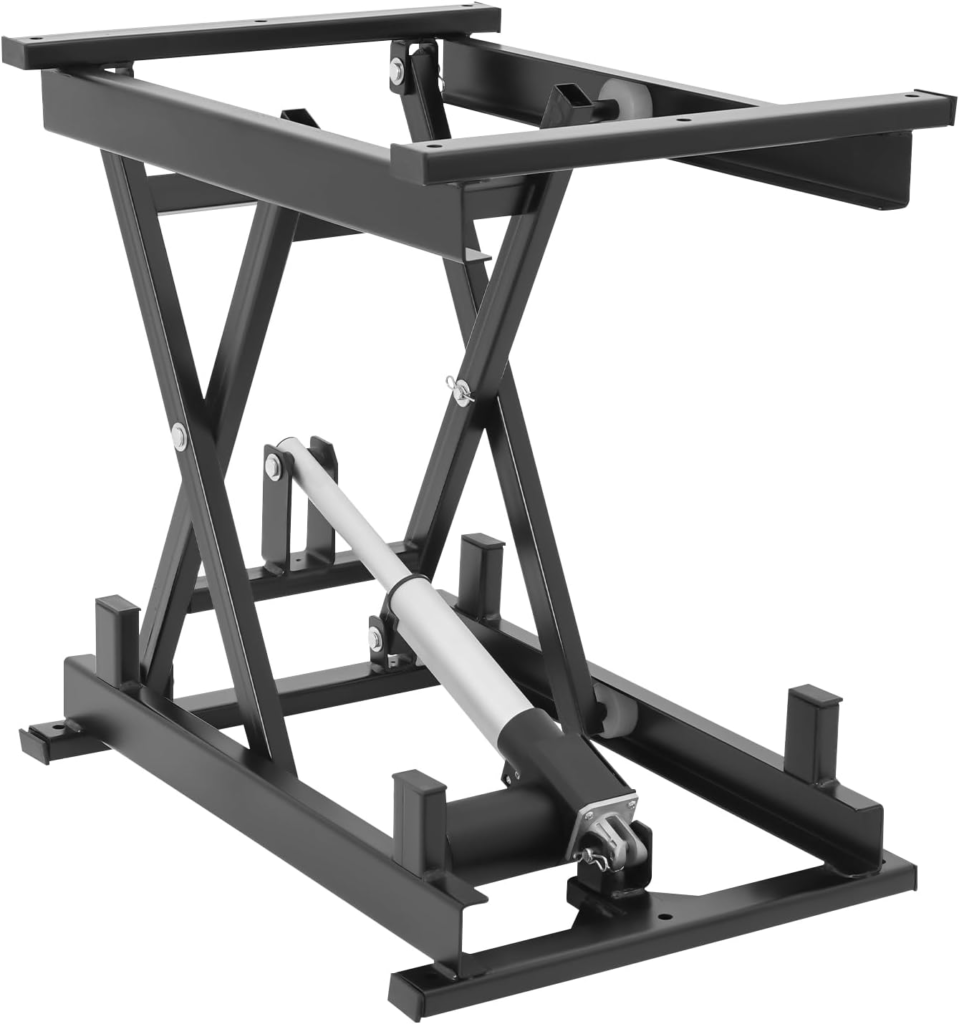
Because the electric cylinder primarily operates under compressive loads when deploying the scissor lift, the rod diameter and maximum stroke must be strictly verified against Euler’s buckling criteria under peak load conditions, accounting for the pinned-pinned or pinned-fixed mounting constraints.
Enclosure and Envelope Optimization
-
-
To satisfy minimal closed-height restrictions of the platform, the spatial arrangement of the motor must be optimized. Designing the actuator with a parallel (folded) motor configuration using a high-torque timing belt or gear reduction box minimizes the axial length of the assembly without compromising mechanical advantage.
-