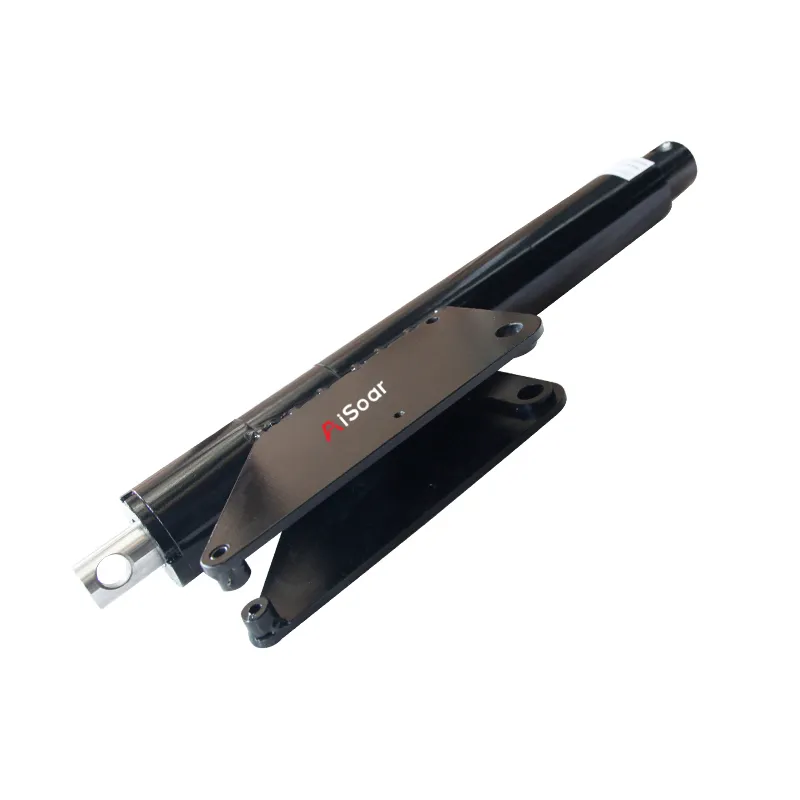
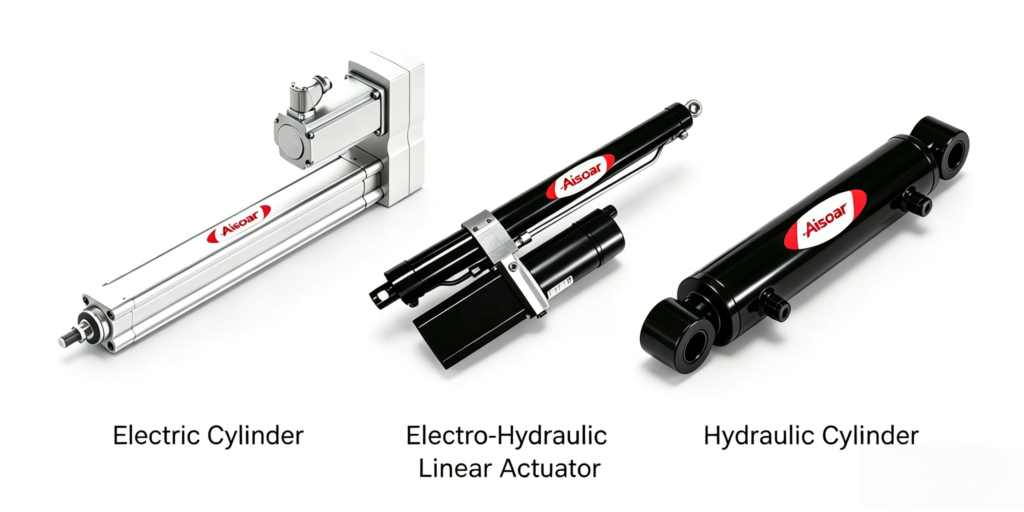
When you’re choosing a linear motion solution for an industrial or automation project, three names come up often: Electric Cylinder, Electro-Hydraulic Linear Actuator (EHLA) – sometimes called an electro-hydraulic push rod, and the traditional Hydraulic Cylinder.
But which one is right for your application?
Let’s break them down side‑by‑side.
First, what exactly is each one?
-
Electric cylinder: A servomotor or stepper motor drives a ballscrew or leadscrew. No hydraulics involved.
→ Clean, precise, electric-only. -
Electro‑hydraulic linear actuator (EHLA): A small electric motor drives a gear pump, which moves hydraulic oil inside a compact, self‑contained unit. No external power pack.
→ A hybrid – oil stays inside, but no separate hydraulic station. -
Hydraulic cylinder: Requires an external hydraulic power unit (HPU) – pump, tank, valves, hoses – to push oil into the cylinder.
→ Traditional, powerful, but system‑heavy.
Side‑by‑side comparison
| Feature | Electric Cylinder | Electro‑Hydraulic Actuator (EHLA) | Hydraulic Cylinder |
|---|---|---|---|
| Force range | Small to medium (typically ≤200 kN / 20 tons) | Medium (2–100 kN / 0.2–10 tons) | Very large (tons to 1000+ tons) |
| Speed range | Low to medium (a few mm/s – several hundred mm/s) | Slow to medium (best for moderate speeds) | Very wide (very slow to very fast) |
| Position accuracy | Highest (micrometer level, closed‑loop) | Medium (millimeter level, rarely closed‑loop) | Low (mm – cm) unless external sensors are added |
| Control simplicity | Very easy (electrical servo drive) | Fair (motor on/off or simple feedback) | Complex (requires HPU, valves, controls) |
| Cleanliness | Excellent – no oil | Fair – small internal oil volume, but can leak | Poor – external HPU, hoses, potential leaks |
| Overload tolerance | Low – can damage screw if crashed | Good – built‑in relief valve protects the unit | Excellent – naturally tolerant of shocks and overloads |
| Maintenance | Low (grease or no lubrication) | Medium (check oil level, small filter) | High (HPU oil changes, seals, hoses, filters) |
| Typical applications | 3C assembly, medical devices, lab equipment, small automation | Furnace doors, dump truck covers, livestock equipment, simple lifts | Presses, excavators, injection molding, heavy industrial lifts |
| Total installed cost | Small/medium force: moderate to high Large force: very high |
Low to moderate (self‑contained, fast installation) | Low to moderate (for large forces – but HPU adds cost) |
How to choose – a quick rule of thumb
✅ Choose the electric cylinder if
-
You need high positioning accuracy (micrometers)
-
The environment must be clean (no oil)
-
Force is under 5–10 tons
-
You want simple electrical control (EtherCAT, Pulse, etc.)
✅ Choose the electro‑hydraulic actuator if
-
You need medium force (a few tons)
-
You don’t have a hydraulic power unit (and don’t want one)
-
A little oil leakage is acceptable (minimal risk)
-
Cost is more important than precision
✅ Choose the traditional hydraulic cylinder if
-
Force is very high (>20–50 tons)
-
The environment is harsh (dust, shock, vibration)
-
You already have a hydraulic power unit on site
-
Initial equipment cost is the main driver (but ignore long‑term maintenance)
One hidden detail people miss
-
Electric cylinder: Force and speed are largely decoupled – you can have high force at low speed or moderate speed at lower force (limited by motor power).
-
Electro‑hydraulic actuator: Speed drops noticeably under high load – not ideal for constant‑speed, high‑force applications.
-
Hydraulic cylinder: With a properly sized HPU, you can have both high force and high speed – but efficiency is poor because the pump runs continuously.
Final takeaway
-
If you drew a simple decision flow:
-
Force > 20 tons? → Hydraulic cylinder
-
High precision (µm) needed? → Electric cylinder
-
Medium force, no HPU, budget matters? → Electro‑hydraulic actuator
Each technology has its home. The key is matching the application’s real constraints – force, speed, accuracy, cleanliness, and total cost of ownership – not just the first purchase price.
-