Some hydraulic machines can hold their position normally immediately after startup. However, after continuous operation and a rise in hydraulic oil temperature, the platform, boom, outrigger, or working attachment may begin to lower slowly.
This condition is commonly described as hydraulic cylinder drift, cylinder creep, or load sinking.
A machine that sinks after warming up does not necessarily have a damaged hydraulic cylinder. More commonly, higher oil temperature reduces hydraulic oil viscosity and increases leakage through existing clearances in the cylinder, directional control valve, hydraulic lock, or counterbalance valve.
Correct diagnosis is therefore important. Replacing the cylinder seals without checking the complete hydraulic circuit may not solve the problem.
Hot Hydraulic Oil Has Lower Viscosity
-1024x409.png)
Hydraulic oil becomes thinner as its temperature increases.
When the equipment is cold, the relatively high viscosity of the oil can help limit leakage through small internal clearances. Minor wear in a piston seal, valve spool, check valve, or load-holding valve may not cause noticeable movement.
After the system operates for some time, the oil becomes thinner and can pass more easily through:
- Piston seal clearances
- Directional valve spool clearances
- Check valve and hydraulic lock sealing surfaces
- Counterbalance valve seats
- Other internal hydraulic passages
As oil gradually leaves the load-bearing chamber, pressure decreases and the cylinder begins to move under the applied load.
This may appear as a lifting platform lowering, an outrigger retracting, a boom dropping, or an attachment gradually changing position.
Piston Seal Internal Leakage May Increase
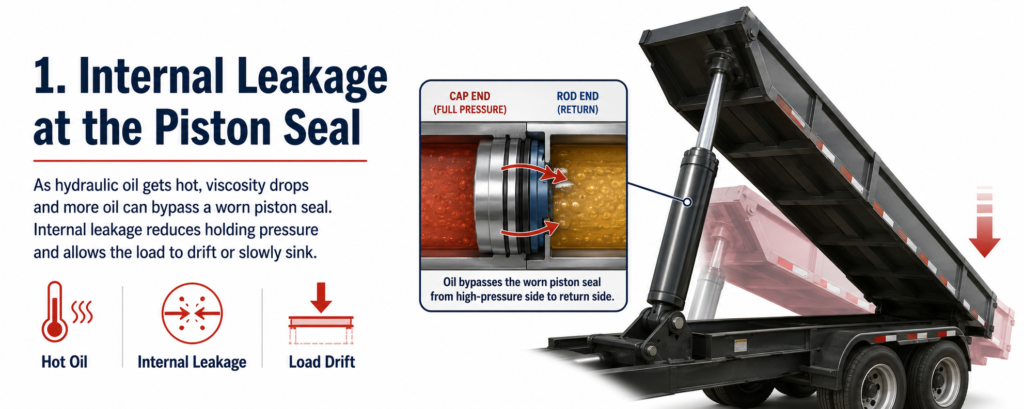
The piston seal separates the rod-side chamber from the cap-side chamber inside a hydraulic cylinder.
After long-term operation, the seal may become worn, hardened, cut, extruded, or permanently deformed. Leakage may remain limited when the oil is cold, but hot, low-viscosity oil can pass more easily across the damaged sealing area.
This changes the pressure balance between the two cylinder chambers and may allow the piston rod to move under load.
However, piston seal leakage alone does not always cause continuous cylinder movement. If both cylinder ports are completely blocked, displaced oil still requires a flow path.
For this reason, hot-state sinking should not automatically be blamed on the piston seal. The control valve and load-holding circuit must also be inspected.
Directional Control Valve Leakage May Be the Main Cause
In many hydraulic systems, the cylinder remains connected to the directional control valve after the operator releases the control lever.
The valve spool and valve body operate with small clearances. These clearances allow the spool to move, but they also create possible internal leakage paths.
When the oil becomes hot and thin, fluid from the load-bearing cylinder chamber may pass through the valve and return to the reservoir or enter another part of the circuit.
The cylinder may then drift even when the piston seal is still in acceptable condition.
The directional control valve should be suspected when:
- Several cylinders begin sinking after the system becomes hot
- The problem remains after the cylinder seals are replaced
- The cylinder holds its position after its ports are isolated
- The control valve area becomes unusually hot
- The drift rate changes when another hydraulic function is operated
Valve spool wear, contamination, internal scoring, or incomplete spool return can all increase leakage.
In many machines, control valve leakage is more common than serious piston seal leakage.
Hydraulic Locks and Counterbalance Valves May Leak
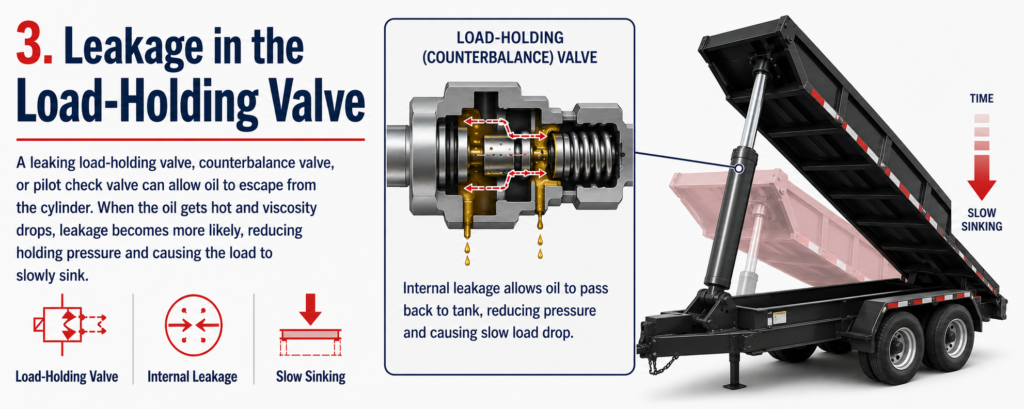
Lifting platforms, cranes, construction equipment booms, and hydraulic outriggers often use hydraulic locks, pilot-operated check valves, or counterbalance valves.
These valves are designed to trap oil inside the cylinder and prevent uncontrolled load movement.
If the valve seat, poppet, spool, or sealing surface is worn, scratched, or contaminated, the valve may not close completely. Hot, low-viscosity oil can then pass through the damaged sealing area more easily.
A load-holding valve may also remain slightly open because of:
- Residual pilot pressure
- Incorrect valve adjustment
- Excessive backpressure
- Contamination around the valve seat
- A restricted pilot passage
- Incorrect installation
In this situation, the cylinder may still be mechanically capable of carrying the load. The problem is that the valve responsible for locking the oil is not sealing correctly.
For safety-critical lifting equipment, a standard directional valve should not be the only component holding an elevated load.
High Temperature Can Affect Piston Seal Performance
Hydraulic seals are designed for specific temperature ranges.
When the actual oil temperature exceeds the suitable range, a seal may soften, swell, harden, shrink, or lose elasticity.
A softened piston seal may no longer maintain sufficient contact pressure against the cylinder bore. Under high pressure, the seal material may also extrude into the clearance between the piston and cylinder tube.
Long-term exposure to heat can cause permanent deformation. Once this occurs, the seal may continue leaking even after the machine cools down.
A cylinder that performs normally when cold but sinks when hot may therefore indicate that the seal material is unsuitable for the actual continuous oil temperature.
Internal Wear Can Create Larger Leakage Paths
Side loading, poor alignment, and worn mounting components can cause uneven wear inside a hydraulic cylinder.
When the wear rings or guide components become worn, the piston may tilt inside the cylinder bore. The piston seal then carries uneven pressure and may lose sealing contact on one side.
Cylinder bore scoring, excessive bore diameter, poor roundness, or abnormal surface roughness can also create internal leakage paths.
Hot oil passes through these worn areas more easily.
Replacing only the piston seal may temporarily reduce the drift rate. However, the problem can return if the cylinder bore, wear rings, pins, bushings, alignment, or external side-loading conditions are not corrected.
Air and Temperature Changes Can Cause Limited Movement
Air mixed with hydraulic oil can also affect cylinder position.
Unlike hydraulic oil, air is compressible. Under load, air bubbles inside the cylinder chamber may compress and allow the piston rod to move slightly.
Entrained air may also cause:
- Spongy cylinder movement
- Crawling
- Vibration
- Abnormal noise
- Pressure fluctuations
However, air usually causes limited movement or unstable positioning rather than continuous long-distance sinking.
Hydraulic oil and metal components also expand when heated and contract when cooled. If the cylinder ports are blocked, this temperature change may cause a small change in chamber pressure and cylinder position.
If a platform, boom, or outrigger continues lowering steadily, internal leakage is more likely than air compression or thermal expansion alone.
How Can You Determine Whether the Cylinder or Valve Is Leaking?
The equipment should be checked under both cold and hot operating conditions.
Record the hydraulic oil temperature, applied load, cylinder position, and sinking rate. A measured comparison is more reliable than a visual judgment.
A practical inspection sequence includes:
- Check the cylinder, hoses, fittings, and pipes for external leakage.
- Measure the sinking rate while the oil is cold.
- Repeat the measurement after the oil reaches its normal operating temperature.
- Inspect the directional valve, hydraulic lock, check valve, and counterbalance valve.
- Check for abnormal valve temperature, contamination, or residual pilot pressure.
- Isolate the cylinder ports under controlled conditions.
- Perform a pressure-holding or internal leakage test if required.
- Inspect the piston seal, wear rings, cylinder bore, mounting pins, and bushings.
If the cylinder stops moving after its ports are securely isolated, the leakage is more likely to be in the control valve or load-holding valve.
If the cylinder continues moving after correct isolation, the cylinder seals or internal mechanical condition require further inspection.
Any test involving a suspended or elevated load must be performed with suitable mechanical supports and approved safety procedures.
How Can Hot-State Load Sinking Be Reduced?
The first step is to control the operating temperature of the hydraulic system.
The reservoir capacity, oil cooler, airflow, oil level, and heat-dissipation conditions should match the equipment’s operating cycle. The hydraulic oil viscosity grade should also be suitable for both the ambient temperature and normal oil temperature.
Other preventive measures include:
- Selecting seals suitable for the actual oil temperature
- Using correctly sized hydraulic locks or counterbalance valves
- Keeping hydraulic oil clean
- Inspecting valve seats and spools for wear
- Checking pilot pressure and valve settings
- Reducing excessive return backpressure
- Replacing worn wear rings and guide components
- Correcting cylinder misalignment and side loading
- Testing load-holding performance after the oil becomes hot
Equipment supporting elevated loads should use a suitable load-holding valve or mechanical safety device. It should not depend only on a directional valve or piston seal to prevent movement.
Conclusion
Hydraulic equipment often begins to sink after warming up because higher oil temperature reduces hydraulic oil viscosity and increases existing internal leakage.
The leakage may occur across the piston seal, directional control valve, hydraulic lock, check valve, or counterbalance valve.
Load sinking therefore does not automatically mean that the hydraulic cylinder is damaged.
Correct diagnosis requires separating cylinder leakage from control valve and load-holding valve leakage. Oil temperature, oil viscosity, seal condition, valve condition, contamination, internal wear, and equipment loading should all be considered.
AiSoar Hydraulics provides customized hydraulic cylinder solutions for construction machinery, lifting equipment, agricultural machinery, waste-handling equipment, special vehicles, and industrial applications.