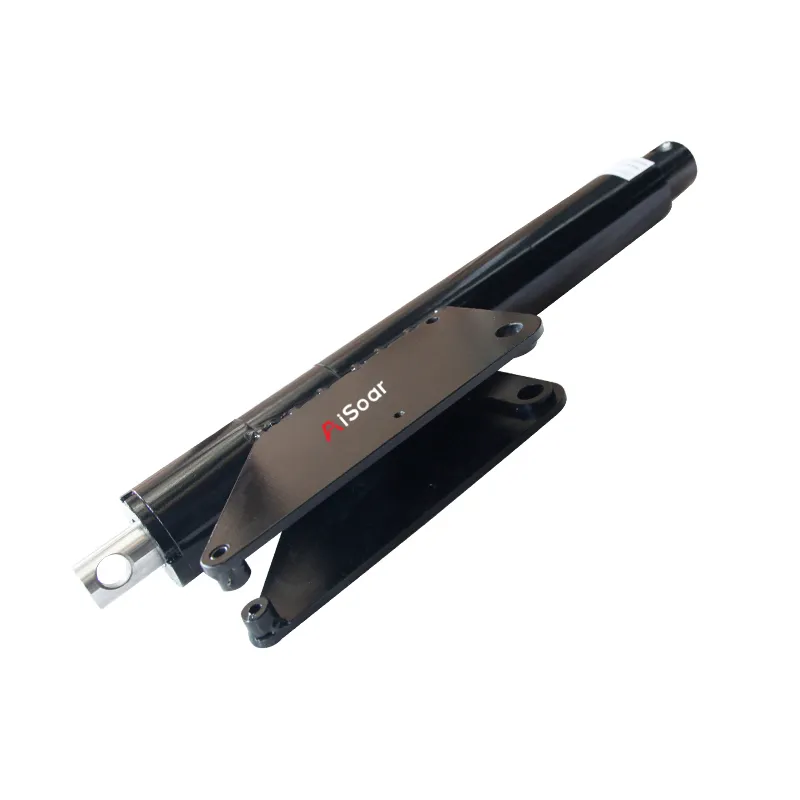
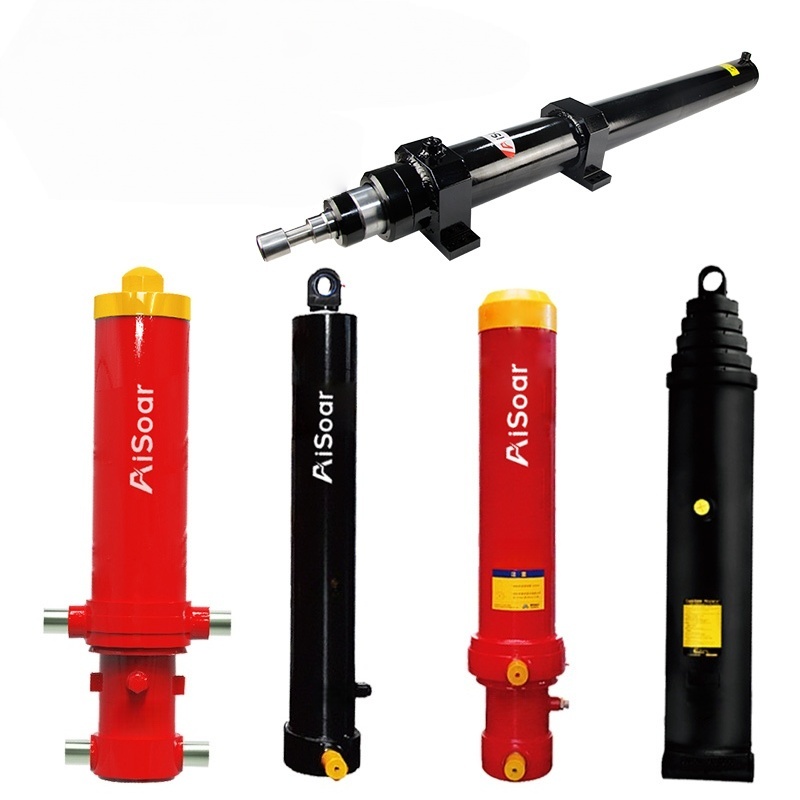
In construction machinery, agricultural equipment, material handling equipment, special vehicles, and industrial automation systems, hydraulic cylinders often need to extend and retract under heavy-load, high-frequency, or high-speed working conditions.
If a hydraulic cylinder does not have effective deceleration control at the end of its stroke, strong mechanical impact may occur between the piston and the end cap. This can lead to increased noise, vibration, seal wear, structural fatigue of connected components, and even reduced long-term service life of the whole machine.
Therefore, in applications that require smoother movement and higher reliability, cushion hydraulic cylinders become an important type of hydraulic actuator.
What Is a Cushion Hydraulic Cylinder?
A cushion hydraulic cylinder, also known as a hydraulic cylinder with a cushioning structure, is designed with a cushioning device at the end of the cylinder stroke. This allows the piston to gradually decelerate as it approaches the end position, reducing the impact between the piston and the cylinder bottom or cylinder head.
When a standard hydraulic cylinder reaches the end of its stroke, obvious end-stroke impact may occur if the load inertia is large. The function of a cushion hydraulic cylinder is not to change the basic extension and retraction function of the cylinder, but to add a “deceleration protection zone” at the end of the stroke, making the stopping process smoother.
How Does a Cushion Hydraulic Cylinder Work?
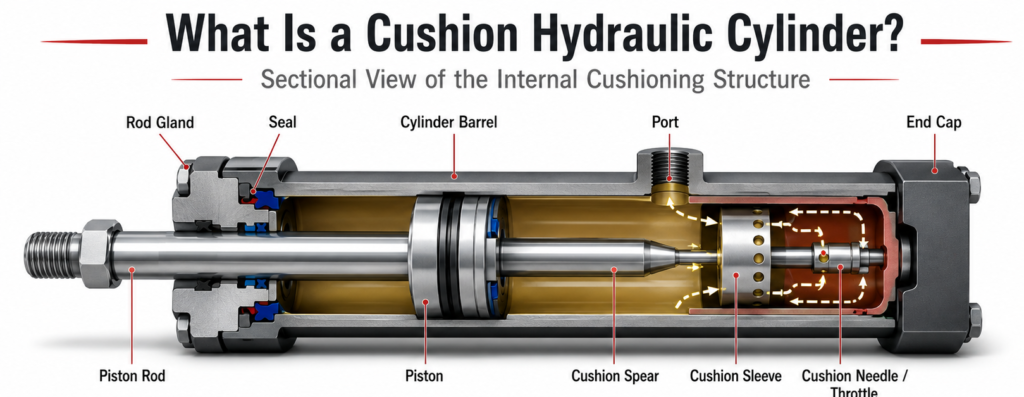
A cushion hydraulic cylinder is usually designed with a cushion sleeve, cushion plunger, cushion hole, throttle valve, or adjustable cushioning structure at the rod end or cylinder bottom end.
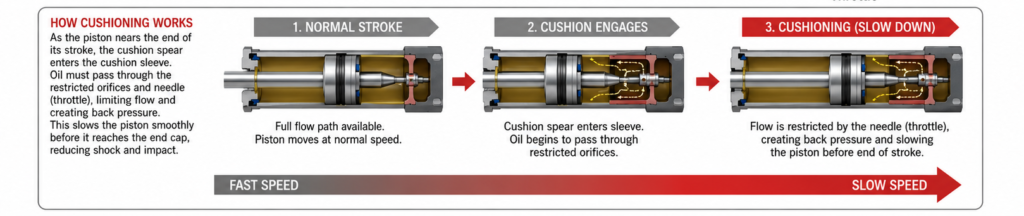
During normal cylinder operation, hydraulic oil can flow in and out of the cylinder through a larger passage, allowing the piston to move at a normal speed. When the piston approaches the end of the stroke, the cushion plunger enters the corresponding cushion chamber, and the main return oil passage is gradually closed or restricted. The oil can only flow out through a smaller throttling passage.
As the return oil passage becomes smaller, the oil flow is restricted, pressure rises inside the cushion chamber, and reverse resistance is generated. This slows down the piston movement. As a result, the cylinder does not suddenly impact the end cap, but gradually decelerates and reaches the final position smoothly.
Depending on different working conditions, the cushioning structure can be designed as fixed cushioning, adjustable cushioning, single-end cushioning, or double-end cushioning. If the equipment has obvious impact in only one direction, single-end cushioning can be used. If both extension and retraction require smooth stopping, double-end cushioning is a better option.
Why Do Some Equipment Applications Need Cushion Hydraulic Cylinders?
Not every hydraulic cylinder must use a cushioning structure. Cushion hydraulic cylinders are usually more suitable for the following working conditions:
- Large load inertia
- Fast cylinder operating speed
- Frequent starting, stopping, or reciprocating movement
- Requirements for noise and vibration control
- Need to protect pins, rod ends, brackets, and the overall machine structure
- Need to reduce future maintenance frequency
Especially for equipment that operates frequently every day, end-stroke impact may seem like a small issue at first. However, after long-term operation, repeated impact can affect the stability of the hydraulic cylinder, connected components, and the whole machine structure.
What Is the Difference Between a Cushion Cylinder and a Standard Cylinder?
A standard hydraulic cylinder is mainly used to provide linear pushing and pulling motion. Its structure is relatively simple and is suitable for low-speed, light-load applications where end-stroke impact is not a major concern.
A cushion hydraulic cylinder adds an end-stroke deceleration function based on the standard cylinder structure. Although the structure is more complex, it can effectively reduce end-stroke impact and is more suitable for equipment working under heavy-load, high-frequency, high-speed, or high-smoothness requirements.
A properly designed cushion hydraulic cylinder can bring several benefits:
- Reduced end-stroke mechanical impact
- Lower operating noise and vibration
- Better protection for seals and internal components
- Longer hydraulic cylinder service life
- Smoother overall machine movement
- Lower equipment maintenance costs
- Improved customer perception of equipment quality
For OEM equipment manufacturers, whether the hydraulic cylinder moves smoothly often directly affects the operating experience and the perceived quality of the whole machine.
AiSoar Custom Cushion Hydraulic Cylinder Solutions
AiSoar Hydraulics provides customized cushion hydraulic cylinder solutions according to the actual working conditions of customer equipment.
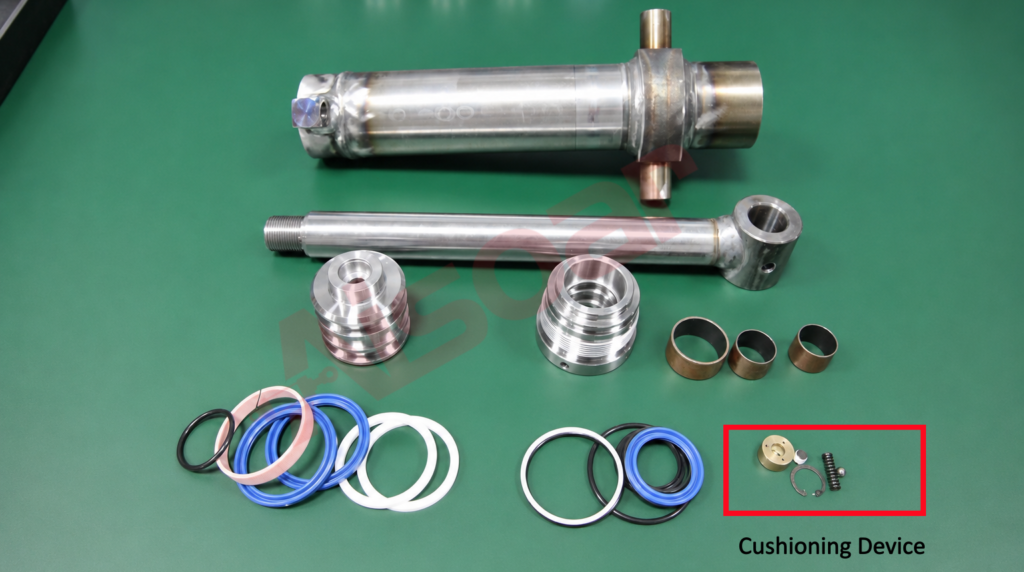
Based on drawings, samples, installation dimensions, or application requirements, our engineering team can evaluate the cylinder bore, rod diameter, stroke, working pressure, mounting method, operating speed, and cushioning direction to design a suitable cylinder structure.
For multi-cylinder applications, consistent cushioning performance is especially important. AiSoar can optimize the retraction cushioning design, including the cushion structure, throttling area, machining accuracy, and assembly consistency, to help each cylinder achieve more uniform cushioning time during the retraction process.
In addition, AiSoar is equipped with dedicated hydraulic cylinder test benches to carry out cushioning performance tests, helping verify the retraction cushioning effect, movement stability, and overall cylinder reliability before delivery.
We can support:
- Single-end cushion hydraulic cylinders
- Double-end cushion hydraulic cylinders
- Adjustable cushion hydraulic cylinders
- Heavy-duty cushion cylinders for construction machinery
- Cushion cylinders for agricultural equipment
- Cushion cylinders for material handling equipment
- Cushion hydraulic cylinders for special vehicles
- OEM customized replacement cylinders
From design, machining, welding, assembly, to final testing, AiSoar focuses on structural matching, sealing performance, dimensional accuracy, and long-term stability, helping equipment manufacturers obtain more reliable hydraulic actuators.
Conclusion
The core value of a cushion hydraulic cylinder is not only to reduce a single end-stroke impact, but also to help equipment maintain smoother, more reliable, and more durable operation over long-term use.
For construction machinery, agricultural equipment, material handling equipment, special vehicles, and industrial equipment manufacturers, choosing the right cushion hydraulic cylinder can effectively improve equipment performance, reduce maintenance costs, and enhance the end-user experience.