Basics of Top Link Hydraulic Cylinder
Top link cylinders are primarily used to connect tractors to implements, enabling operators to adjust the height, angle, or tilt of the equipment.
Top link cylinders are primarily used to connect tractors to implements, enabling operators to adjust the height, angle, or tilt of the equipment. They are essential for applications like plowing, where the depth of the implement in the soil is critical.
Types of Common Mounting Methods for Top Link Cylinders
Ball Joint on both ends
Structure description: Both ends of the cylinder are equipped with ball head (universal ball), allowing both ends to have a certain angle of activity space.
Functional features:
- 360°multi-angle rotation, self-adaptive ability.
- Can effectively compensate for equipment assembly errors and dynamic changes in three-point suspension operations.
- It can alleviate the influence brought by lateral force and reduce the wear of axle pin.
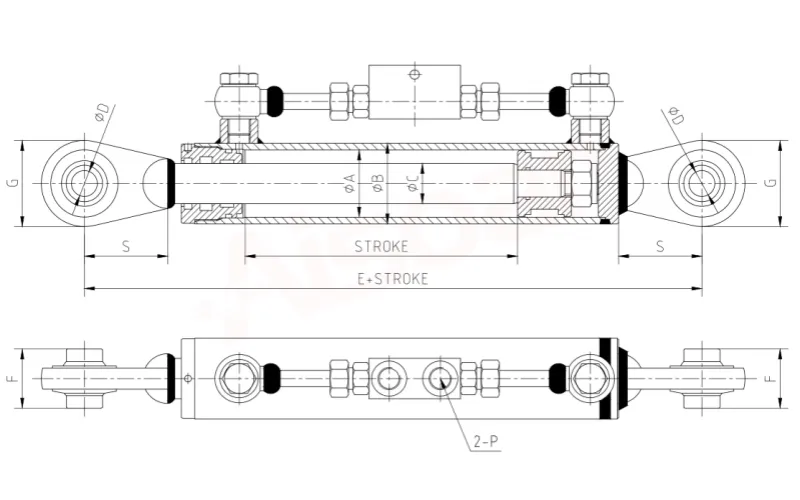
| ΦA(BORE) | E | ΦB | ΦC | ΦD | F | G | S | P |
| 50 | 250 | 60 | 30 | 19.3 | 44 | 62 | 62 | G3/8 |
| 50 | 270 | 60 | 30 | 25.4 | 51 | 75 | 65 | G3/8 |
| 60 | 280 | 70 | 35 | 25.4 | 51 | G3/8 | ||
| 80 | 310 | 95 | 40 | 25.4 | 51 | G3/8 |
Rapid Hook on one end, Knuckle on the other
Structure description: one end is a rapid hook (rapid hook) and the other end is a ball joint.
Functional features:
- The rapid hook end supports tool-free and quick installation and removal, which enhances work efficiency and is ideal for scenarios where implements are frequently changed.
- The ball end maintains angular adaptability to ensure connection stability and mechanical adaptability.
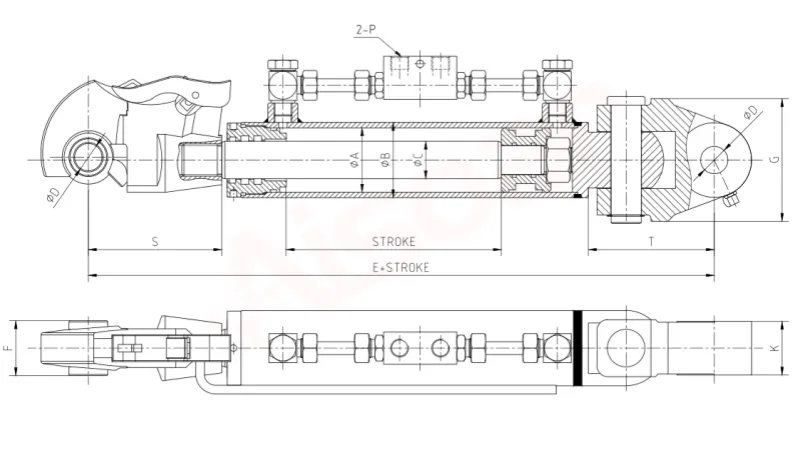
ΦA(BORE) ΦC E ΦB ΦD F S K G 60 35 395 70 25.4/28.4 51 124 50 115 70 35 395 80 51 124 50 80 40 325 95 51 128 50 90 40 425 105 51 128 50
Rapid Hook on one end, Ball joint on the other
Rapid Hook: Rapid Hook, focusing on quick loading and unloading of the tool end.
Ball Joint: (direct) ball joint end, realizes free swing at larger angle through spherical structure, absorbs larger installation or working angle deviation, usually more flexible than Knuckle.
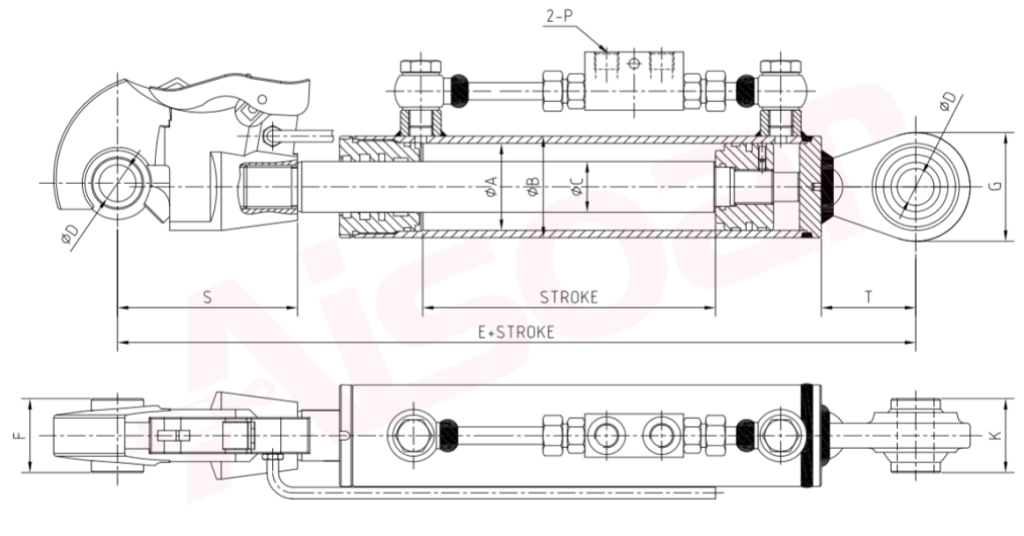
| ΦA | ΦB | ΦC | Stroke | E+Stroke | F | G | K |
| 60 | 70 | 35 | 200 | 550 | 51 | 62 | 44 |
| 250 | 600 | ||||||
| 70 | 80 | 200 | 550 | ||||
| 250 | 600 | ||||||
| 80 | 95 | 40 | 200 | 600 | 75 | 51 | |
| 250 | 650 | ||||||
| 90 | 105 | 200 | 600 | ||||
| 250 | 650 | ||||||
| 100 | 115 | 45 | 200 | 600 | 85 | 51 | |
| 250 | 650 |
different type applicable scene comparison
| Mounting Type | Angular Compensation | Stability | Application Scenario |
| Rapid Hook + Knuckle | Moderate | High | Standard agricultural machinery or construction equipment main end, where even loading and some flexibility are required |
| Rapid Hook + Ball Joint | Maximum | Lower | Tool ends or special adaptive applications in complex terrains, with frequent large-angle changes or quick swaps |
| Double Ball Joint | Very high | Medium | Tasks demanding extreme adaptability, such as overcoming uneven ground or large mounting misalignments |
Components of Hydraulic Cylinder Kits
Cylinder Body: The primary shell that houses the internal moving parts and retains pressurized hydraulic oil.
Piston: An internal, sliding member within the cylinder body that divides the internal chamber and converts hydraulic energy into linear force.
Rod: The shaft securely connected to the piston; it transmits the generated motion externally by extending and retracting per the piston’s travel.
Seals: Precision-fitted components designed to contain hydraulic fluid within the cylinder and keep contaminants out, ensuring system integrity and leak prevention.
Hydraulic Hoses: Flexible, high-pressure lines that convey hydraulic fluid between the pump, cylinder, and reservoir, maintaining system flow and pressure consistency.
End Fittings: Connector devices affixed to the cylinder ends, enabling secure attachment to equipment, frames, or implements for effective force transmission.
Conclusion
The top link hydraulic cylinder plays an essential role in modern agricultural and construction machinery by enabling efficient, precise, and flexible connections between tractors and various implements. By understanding the structural features, common mounting options, and key components—including double ball joints, rapid hooks, and knuckles—operators can select the optimal configuration to match their unique field requirements.
High-quality hydraulic cylinder kits not only deliver outstanding mechanical performance and smooth implement adjustment but also rely on advanced sealing technology to minimize hydraulic leakage and reduce maintenance downtime. Whether your work involves standard machinery or specialized environments that demand high angular compensation and adaptability, choosing the appropriate top link hydraulic cylinder design is vital for maximizing equipment efficiency, safety, and service life.
If you need professional selection guidance or a customized hydraulic cylinder solution, our technical experts are ready to assist. Contact us today to discover how our hydraulic cylinder kits can support your agricultural or construction operations and boost your productivity.