
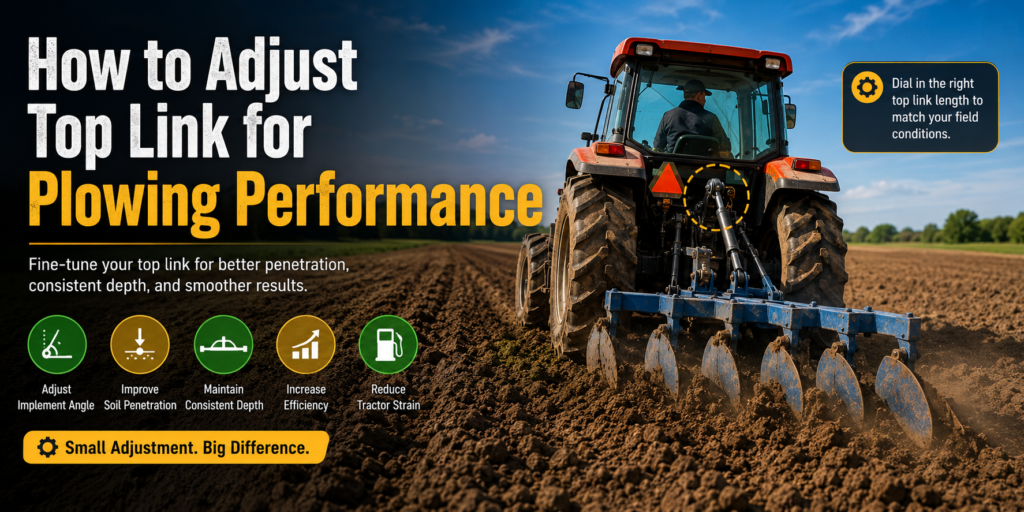
Proper top link adjustment is one of the most important factors in achieving efficient and consistent plowing results. Whether you are using a moldboard plow, box blade, rear blade, cultivator, or other 3-point hitch implement, the top link directly affects the working angle, penetration depth, and overall performance of the attachment.
Many tractor operators focus on horsepower and implement size, but overlook the impact of top link settings. A simple adjustment can significantly improve soil penetration, reduce tractor strain, and create a smoother finish.
In this guide, we’ll explain how top link adjustment affects plowing performance and how a hydraulic top link cylinder can make the process faster and more efficient.
Understanding the Role of the Top Link Hydraulic Cylinder
The top link is the upper connection point of a tractor’s 3-point hitch system. Together with the two lower lift arms, it forms a stable triangular connection between the tractor and the implement.
The length of the top link determines the implement’s pitch angle:
- Shorter top link = implement tilts forward
- Longer top link = implement tilts backward
Even small changes can dramatically affect how the implement engages with the soil.
Why Top Link Adjustment Matters During Plowing
Proper adjustment helps:
- Improve soil penetration
- Maintain consistent working depth
- Reduce wheel slip
- Improve fuel efficiency
- Reduce implement bouncing
- Produce a smoother field surface
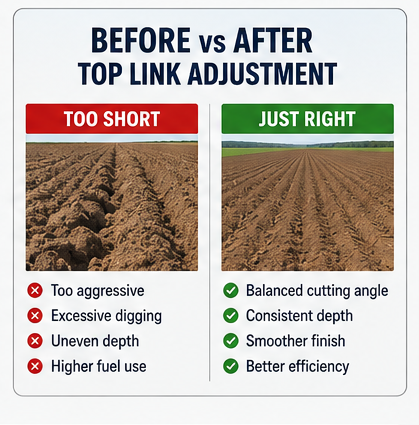
An incorrectly adjusted top link can cause:
- Poor penetration
- Uneven furrows
- Excessive draft load
- Increased tire wear
- Higher fuel consumption
Shortening the Top Link Hydraulic cylinder
When the top link is shortened, the front portion of the implement rotates downward.
Effects of a Shorter Top Link
| Result | Impact |
|---|---|
| More aggressive cutting angle | Better penetration |
| Increased front blade engagement | Removes high spots effectively |
| Greater soil disturbance | Faster ground breaking |
| Higher draft load | Tractor works harder |
Best Situations for a Shortened Top Link
- Breaking compacted soil
- Initial field preparation
- Cutting hard ground
- Deep plowing operations
- Removing ridges and high spots
Operators should avoid excessive shortening, as it can overload the implement and create uneven working depth.
Lengthening the Top Link
When the top link is extended, the implement rotates backward.
Effects of a Longer Top Link
| Result | Impact |
| Reduced cutting aggressiveness | Easier pulling |
| More even soil flow | Better finishing |
| Lower draft force | Reduced tractor load |
| Smoother operation | Improved field finish |
Best Situations for a Lengthened Top Link
- Finishing passes
- Light cultivation
- Seedbed preparation
- Smoothing previously worked soil
- Reducing excessive soil disturbance
How to Adjust the Top Link for Different Implements
Moldboard Plow
The plow should run level when operating at the desired depth.
Adjust the top link until:
- The plow enters the soil smoothly
- Furrow depth remains consistent
- The tractor pulls evenly
If the plow struggles to penetrate, shorten the top link slightly.
Box Blade
For aggressive cutting:
- Shorten the top link
For grading and smoothing:
- Lengthen the top link
This adjustment changes whether the front or rear cutting edge does most of the work.
Rear Blade
For cutting and ditching:
- Shorten the top link
For spreading gravel and finishing:
- Lengthen the top link
Cultivators and Tillers
Most cultivators perform best when kept level.
Adjust the top link so the implement sits parallel to the ground during operation.
Quick Top Link Adjustment Reference
| Goal | Top Link Adjustment |
| Break hard ground | Shorten |
| Increase penetration | Shorten |
| Remove high spots | Shorten |
| Reduce draft load | Lengthen |
| Finish grading | Lengthen |
| Spread soil evenly | Lengthen |
| Smooth seedbed | Lengthen |

Conclusion
Correct top link adjustment can dramatically improve plowing performance, reduce tractor workload, and produce better field results. Shortening the top link increases aggressiveness and penetration, while lengthening it improves leveling and finishing quality.
For operators who frequently switch between tasks or work in varying soil conditions, a hydraulic top link cylinder provides the flexibility to make instant adjustments without leaving the tractor seat. This simple upgrade can save time, improve efficiency, and help achieve more professional results in the field.


