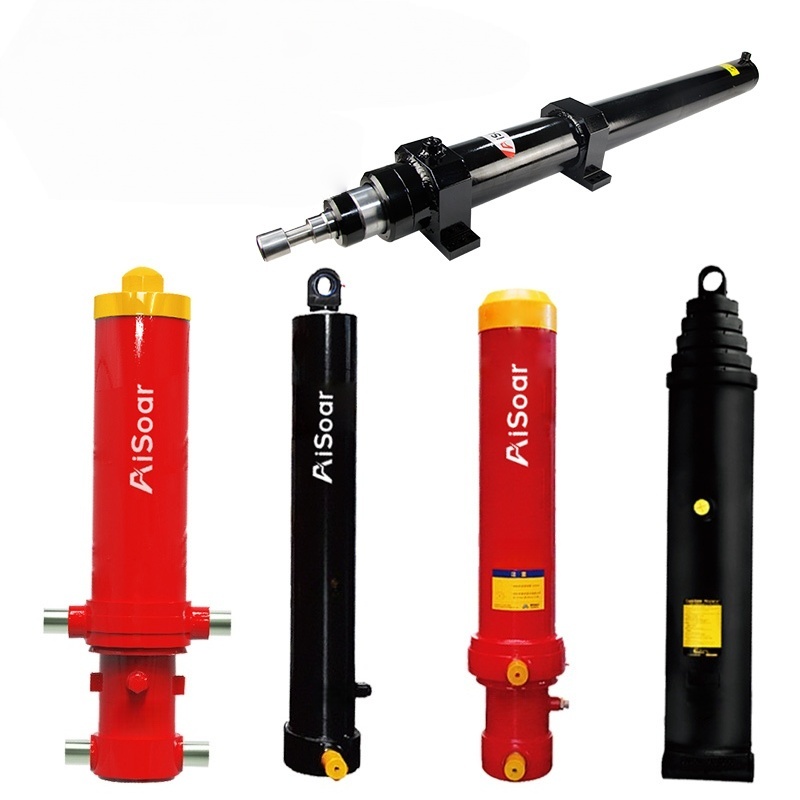
Hydraulic cylinders are widely used in agricultural machinery, construction equipment, industrial machines, and mobile equipment to generate powerful linear movement. But how does a hydraulic cylinder actually work? The basic principle is simple: hydraulic pressure acts on a piston inside the cylinder, converting hydraulic energy into linear force and motion.
A hydraulic cylinder converts hydraulic energy into mechanical movement by applying pressurized hydraulic fluid to the effective area of a piston. The resulting force moves the piston and piston rod in a straight line. In simple terms, pressure and piston area determine theoretical cylinder force, while hydraulic flow and effective area determine cylinder speed.
Understanding these relationships helps explain not only how a cylinder extends and retracts, but also why bore size, rod diameter, system pressure, and flow rate directly affect cylinder performance.
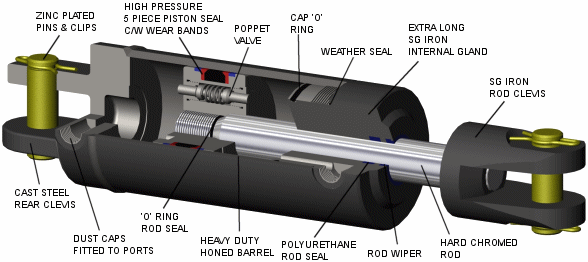
What is a Hydraulic Cylinder?
A hydraulic cylinder is a critical component in hydraulic systems used to produce linear force and motion. It mainly consists of a cylindrical barrel, a piston, and a piston rod. Hydraulic fluid enters the cylinder and acts on the piston, causing the piston and piston rod to extend or retract.
The basic working principle of a hydraulic cylinder is based on Pascal’s Law. When pressure is applied to a confined hydraulic fluid, the pressure is transmitted through the fluid and acts on the effective surface area of the piston.
The basic relationship between hydraulic pressure and cylinder force can be expressed as:
Force = Pressure × Effective Area
F = P × A
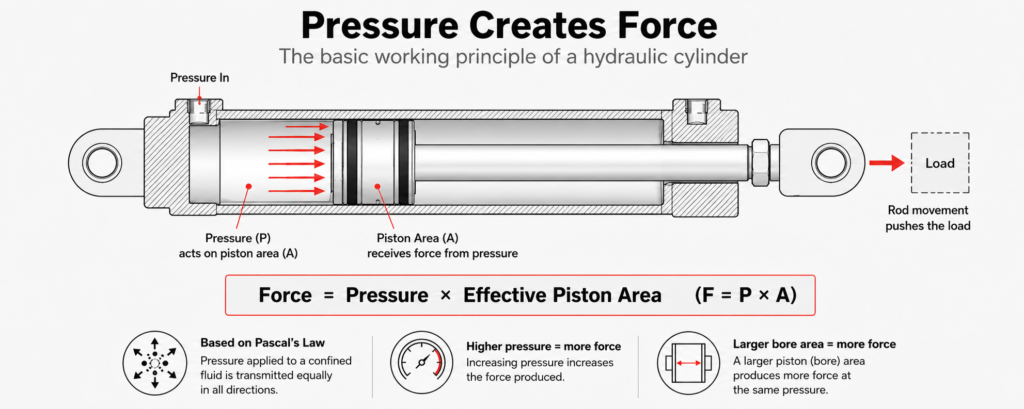
Where:
F = theoretical cylinder force
P = hydraulic pressure
A = effective hydraulic area
This means that the force generated by a hydraulic cylinder is mainly determined by the hydraulic pressure and the effective piston area. At the same operating pressure, a cylinder with a larger bore can generally generate more force.At the same operating pressure, a cylinder with a larger bore has a larger piston area and can therefore generate greater theoretical force.
However, this equation represents theoretical hydraulic force. Actual force available at the machine may be lower because of seal friction, pressure losses, back pressure, mechanical geometry, and other operating conditions.
Components of Hydraulic Cylinder
A hydraulic cylinder contains several components that work together to convert hydraulic energy into controlled linear movement.
| Cylinder Part | Description | Common Materials |
| Cylinder Barrel | Main body that houses the piston and fluid. | Steel (Seamless or Honed Tubes), Cast Iron |
| Piston | Divides the cylinder and moves under pressure. | Steel, Cast Iron, Aluminum |
| Piston Rod | Transfers force from the piston to the load. | Chrome-Plated Steel, Stainless Steel |
| End Caps (Cylinder Heads) | Seals the ends of the cylinder. | Cast Iron, Steel, Aluminum |
| Rod Gland | Supports and guides the piston rod and houses the rod seal, wiper, and guiding components. | Steel, Aluminum, Brass |
| Seals and O-Rings | Prevent leaks and maintain pressure. | Nitrile Rubber (NBR), Polyurethane, Fluorocarbon (Viton) |
| Wear Rings / Bearings | Guide the piston and rod while preventing metal-to-metal contact and reducing friction. | Bronze, Composite Materials, Nylon |
| Hydraulic Fluid | Transfers energy and lubricates components. | Hydraulic Oil (Mineral or Synthetic) |
| Hydraulic Port | Entry/exit point for fluid. | Steel or Stainless Steel Fittings |
| Cushioning Device | Reduces impact at the end of the piston stroke. | Steel, Bronze |
Good sealing, correct material selection, precise machining, and proper component clearances are important for maintaining smooth cylinder movement and reducing leakage, wear, and premature failure.
How Hydraulic Cylinders Work?
To understand how hydraulics work, imagine a syringe filled with liquid. Moving the plunger displaces the liquid and creates movement. A hydraulic cylinder operates on a similar principle, but hydraulic oil, a pump, control valves, and pressure are used to generate much greater force.
In a hydraulic system, the pump supplies hydraulic fluid flow. A directional control valve directs the oil into the appropriate side of the cylinder. When the flow encounters resistance from the load, pressure develops and acts on the piston, generating the force required to move the load.
Here is a simplified step-by-step explanation of how hydraulic cylinders work:
- Hydraulic Fluid Entry: The hydraulic pump supplies oil flow, and a control valve directs the fluid into one side of the cylinder.
- Piston Movement: Hydraulic pressure acts on the piston surface, causing the piston and piston rod to move in the required direction.
- Linear Force Generation: Movement of the piston converts hydraulic energy into linear force and motion for lifting, pushing, pulling, or positioning a load.
- Fluid Return: As the piston moves, hydraulic fluid from the opposite side of the cylinder leaves through the return circuit.
Hydraulic cylinders rely on high-quality seals, accurate internal surfaces, and proper hydraulic system control to minimize leakage and provide reliable movement under demanding operating conditions.
Double Acting Hydraulic Cylinder :
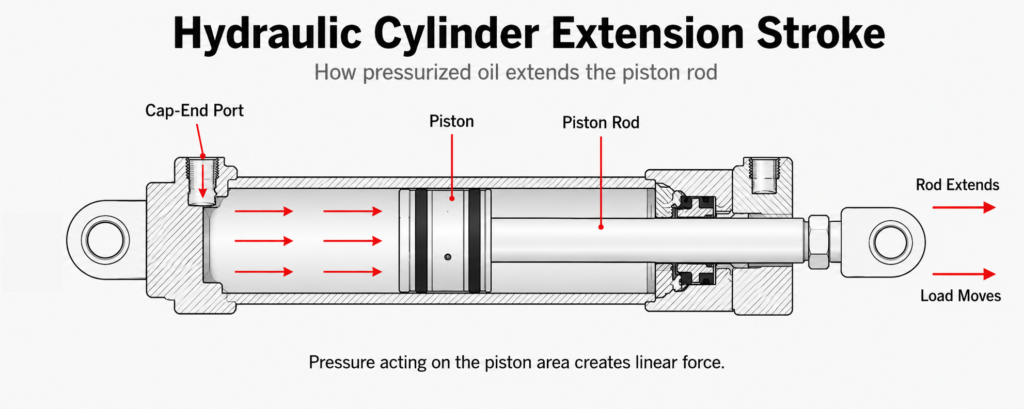
Step 1: Extension Stroke
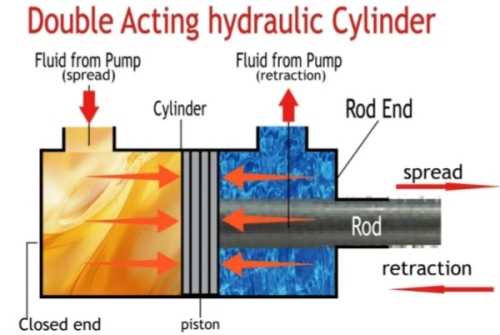
When hydraulic fluid is applied to the cylinder’s base, it forces the piston and rod to move outward. The hydraulic pressure pushes the piston up the bore, extending the rod for tasks requiring a pushing force.
Step 2: Retraction Stroke
When the fluid flow is reversed, it enters the rod end, moving the piston back towards the base. The fluid in the cap end is expelled, and the rod retracts, providing a pulling force, controlled in speed and pressure like the extension stroke.
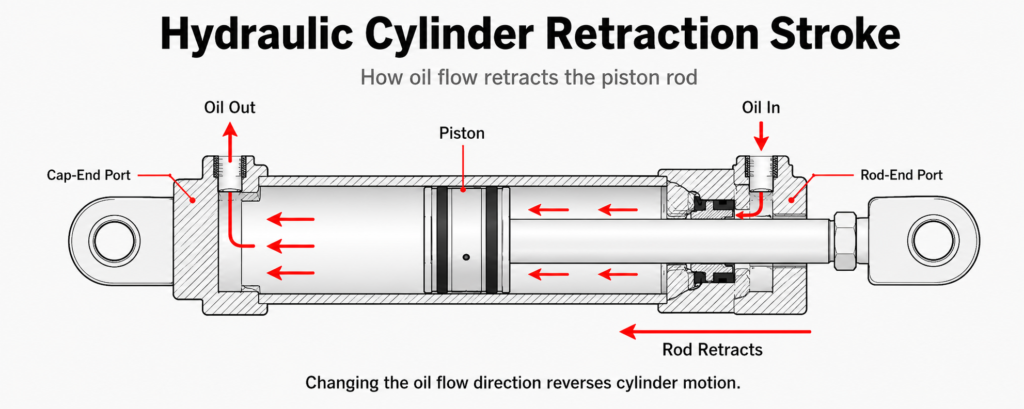
Because the piston rod occupies part of the piston area on the rod side, the effective hydraulic area during retraction is smaller than during extension. Therefore, at the same operating pressure, a typical single-rod double acting cylinder produces greater force during extension than during retraction. At the same flow rate, retraction is also typically faster than extension.
Single Acting Hydraulic Cylinder:
Step 1: Hydraulic Pressure for Extension
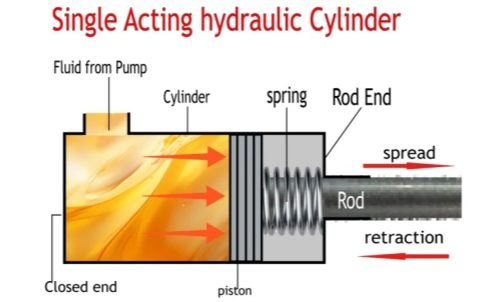
In a single-acting cylinder, hydraulic fluid enters through one port, applying pressure to the piston. This pressure forces the piston to move, extending the piston rod to lift a load or push an object.
Step 2: Retraction Mechanism
Unlike double-acting cylinders, a single-acting cylinder uses hydraulic pressure primarily in one direction. Retraction is achieved by gravity, the weight of the load, an external mechanical force, or a return spring, depending on the cylinder design and application.
What Determines Hydraulic Cylinder Force and Speed?
Force and speed are two of the most important performance characteristics of a hydraulic cylinder, but they are controlled by different hydraulic variables.
Hydraulic Pressure and Piston Area Determine Force
The simplified theoretical relationship is:
Cylinder Force = Pressure × Effective Area
Increasing operating pressure increases theoretical force if the effective area remains unchanged.
Increasing cylinder bore also increases piston area and therefore increases theoretical force at the same pressure.
However, pressure should not simply be increased to compensate for an undersized cylinder. The cylinder, hoses, valves, fittings, and other system components must all be suitable for the operating pressure.
Hydraulic Flow and Effective Area Determine Speed
Cylinder speed can be expressed in simplified form as:
Cylinder Speed = Flow Rate ÷ Effective Area
Increasing hydraulic flow generally increases movement speed.
At the same flow rate, increasing cylinder bore generally reduces speed because the larger piston area requires more oil volume to move through the same stroke.
This creates an important engineering relationship:
A larger bore may provide more force, but it also requires more oil to achieve the same movement speed.
Cylinder bore, working pressure, required force, flow rate, and desired speed should therefore be considered together rather than selected independently.
Rod diameter also influences cylinder behavior, particularly during retraction, because it changes the effective annular area on the rod side.
Types of Hydraulic Cylinders
Hydraulic cylinders come in various designs tailored for different applications. The most common types include:
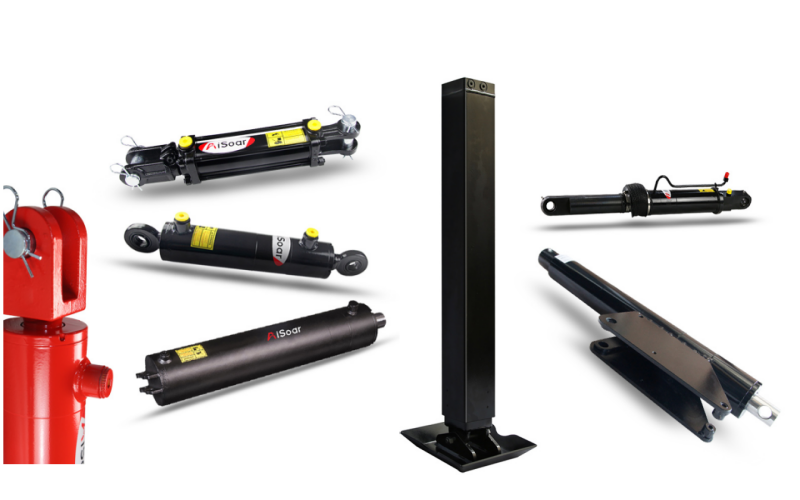
Tie-Rod Cylinders: These cylinders use external tie rods to hold the cylinder head, barrel, and cap together. Their serviceable construction makes them widely used in industrial machinery and applications where standardized dimensions and easy maintenance are important.
Welded Cylinders: Built with a compact welded-body construction, these cylinders are widely used in agricultural machinery, construction equipment, mobile equipment, and other heavy-duty applications.
Double-Acting Cylinders: These cylinders use hydraulic pressure for both extension and retraction, providing controlled force and movement in both directions.
Single-Acting Cylinders: These cylinders use hydraulic pressure mainly in one direction and rely on gravity, an external load, a spring, or another force for the return movement.
Telescopic Cylinders: Telescopic cylinders use multiple nested stages to achieve a long stroke from a relatively short retracted length. They are commonly used in dump trucks, dump trailers, lifting equipment, and other applications where installation space is limited.
Each type of hydraulic cylinder has its own advantages, making it important to choose the right design according to the application, load, required movement, installation space, and operating environment.
How to Choose a Hydraulic Actuator?
Choosing the right hydraulic cylinder can significantly impact the performance and reliability of your machinery. Here’s what to consider:
| Selection Factor | Description | Key Considerations |
| Load Requirements | The amount of force the actuator needs to generate. | Match cylinder force with load needs. |
| Stroke Length | The distance the piston rod needs to extend or retract. | Ensure sufficient piston movement. |
| Operating Pressure | The hydraulic pressure the actuator must handle. | Match the cylinder’s pressure rating with your hydraulic system (e.g., 1500 PSI, 3000 PSI). |
| Cylinder Type | The specific design suited for the application. | Choose based on application (e.g., tie-rod, welded). |
| Application Environment | Conditions where the cylinder will operate. | Consider temperature, humidity, exposure to dirt, dust, water, or chemicals. |
| Mounting Style | How the cylinder will be mounted to the machine. | Select from clevis, flange, trunnion, or other mounting styles |
| Seal Material | The material used for seals to prevent fluid leaks. | Choose seal materials (e.g., NBR, Viton, Polyurethane) based on operating temperature, pressure. |
| Space Constraints | Available space for cylinder installation. | Consider compact cylinders (e.g., telescopic) if installation space is limited. |
What Are Hydraulic Cylinders Used For?
Hydraulic cylinders are versatile components used in a wide range of applications.
Agriculture: Hydraulic cylinders are used on tractors, plows, harvesters, loaders, trailers, and other agricultural machinery for lifting, folding, steering, tilting, and positioning.
Construction: Excavators, loaders, bulldozers, cranes, and other construction equipment rely on hydraulic cylinders for boom, bucket, lifting, steering, and positioning functions.
Manufacturing: Hydraulic cylinders are commonly used in presses, stamping equipment, molding machines, clamping systems, and automated production machinery.
Automotive and Special Vehicles: Hydraulic cylinders are used in vehicle lifts, dump trucks, dump trailers, tail lifts, municipal vehicles, and other specialized vehicles for lifting, tipping, and stabilizing operations.
Marine: Marine and offshore equipment uses hydraulic cylinders in deck machinery, steering systems, cranes, lifting equipment, and other demanding applications.
Their ability to generate high linear force with controlled movement makes hydraulic cylinders an essential component across many industries.


Their ability to deliver immense force with precision makes hydraulic cylinders indispensable across industries.