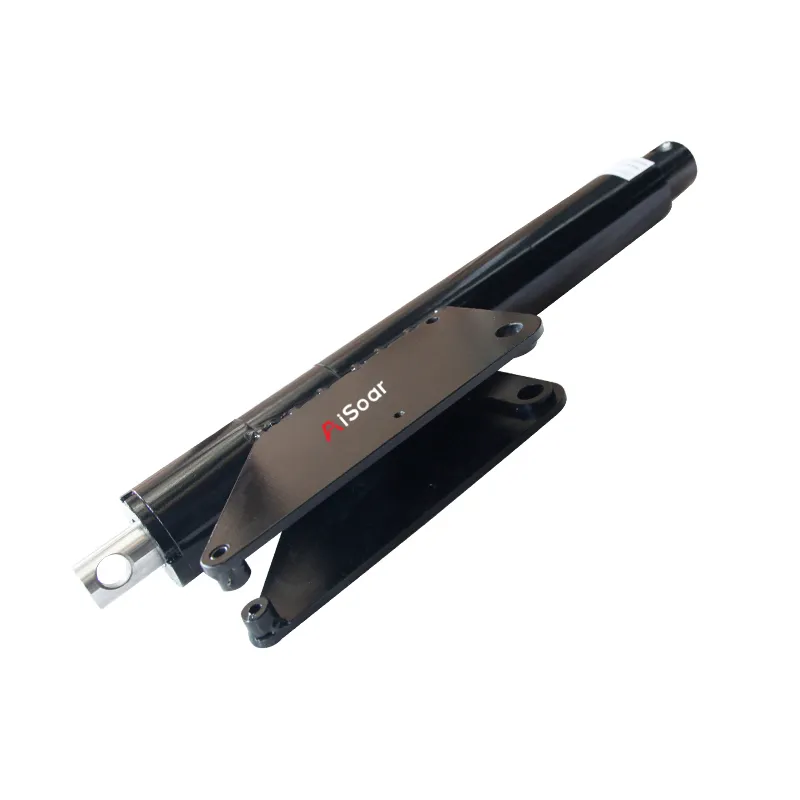
When hydraulic cylinders repeatedly suffer from seal failure, cylinder bore scoring, piston rod corrosion, or unstable movement in high-temperature conditions, heat may not be the only problem.
Air, water, and solid contaminants can enter the hydraulic oil and circulate through the cylinder. They continuously affect piston seals, rod seals, wear rings, cylinder bores, piston rods, and valve components.
High temperature does not create contamination by itself. However, it accelerates oil oxidation, reduces oil viscosity, and weakens the lubricating film. As a result, a minor contamination problem can develop more quickly into wear, corrosion, leakage, and component damage.
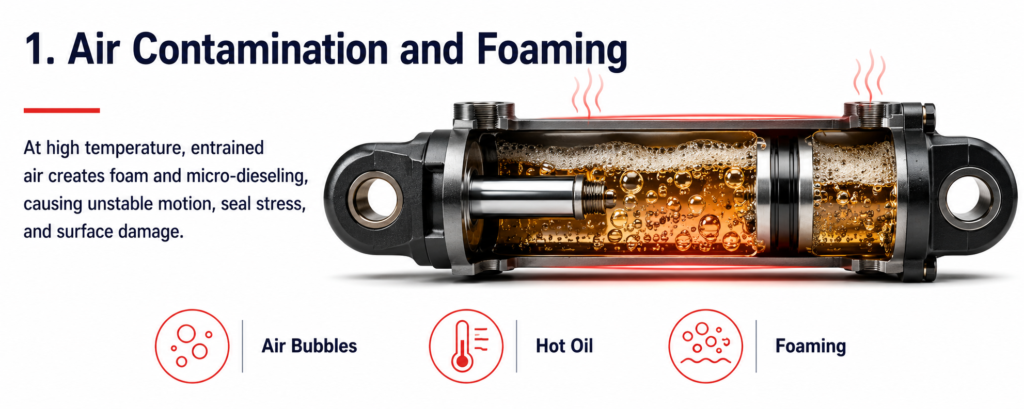
Entrained Air Causes Foaming and Unstable Movement
Air may enter a hydraulic system through leaking suction lines, loose fittings, low reservoir oil levels, poor return-line design, or incomplete bleeding after maintenance.
Hydraulic oil may also contain small air bubbles that are not immediately visible.
Unlike hydraulic oil, air is compressible. When aerated oil enters a hydraulic cylinder, part of the applied pressure is used to compress the air bubbles before the cylinder begins to move.
This may cause:
- Delayed cylinder response
- Weak or spongy movement
- Low-speed crawling
- Position instability
- Pressure fluctuations
- Foam in the reservoir
Air bubbles can also interrupt the lubricating film around piston seals, rod seals, wear rings, and guide components. Repeated cylinder movement may then produce local dry friction, additional heat, and faster seal wear.
Water and Condensation Can Enter the Hydraulic System
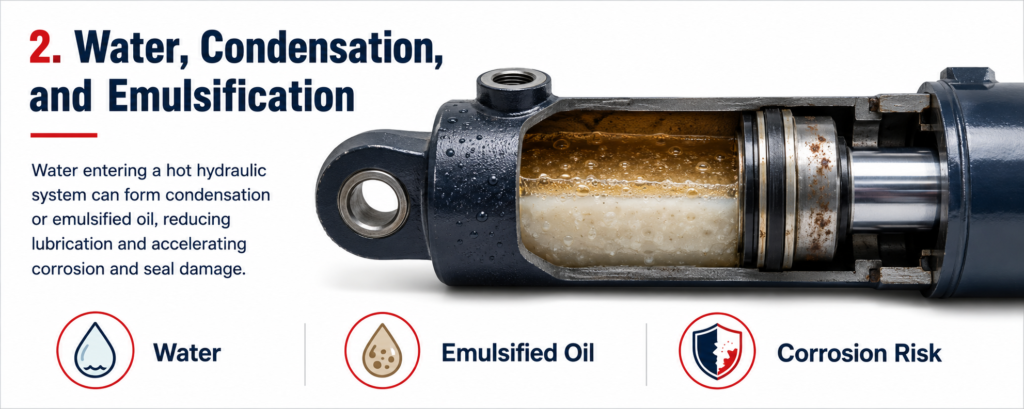
Water may enter hydraulic oil through humid air, equipment washing, rain, leaking coolers, contaminated new oil, damaged breathers, or open reservoirs.
Condensation is another common source.
After equipment operates at high temperature and then shuts down, the air inside the reservoir and piping cools. Moisture in the incoming air may condense and collect inside the system.
Water may exist in hydraulic oil in three forms:
- Dissolved water: Usually invisible to the eye
- Emulsified water: Makes the oil appear cloudy or milky
- Free water: Collects at the bottom of the reservoir or other low points
A system may therefore contain harmful moisture even when the oil does not look obviously contaminated.
Water Reduces Lubrication and Causes Oil Emulsification
Water weakens the lubricating performance of hydraulic oil and may react with oil additives.
When the oil becomes emulsified, the lubricating film between the piston, wear rings, cylinder bore, guide components, and piston rod becomes unstable.
This increases the possibility of direct contact between surfaces and can accelerate:
- Piston and cylinder bore wear
- Wear-ring damage
- Rod and guide-bushing wear
- Seal-lip damage
- Internal leakage
Water also promotes sludge formation and speeds up oil oxidation. When high temperature, moisture, and pressure are present at the same time, hydraulic oil may deteriorate much faster.
Moisture Causes Cylinder Bore and Piston Rod Corrosion
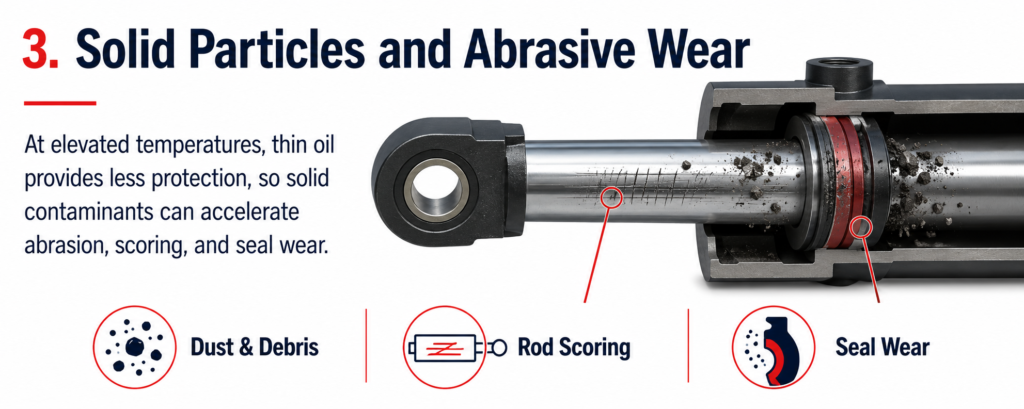
Water remaining inside a hydraulic cylinder may corrode the cylinder bore, piston, hydraulic ports, seal grooves, and other metal surfaces.
Rust spots and pitting on the cylinder bore create a rough surface that repeatedly damages the piston seal.
Corrosion or plating damage on the piston rod can also scratch the rod seal and wiper every time the cylinder moves. This eventually leads to external leakage and allows more contaminants to enter the cylinder.
Rust particles may then circulate with the oil and enter other clearances in the hydraulic system.
Water contamination therefore causes both direct corrosion and additional solid contamination.
Solid Particles Cause Abrasive Wear
Common solid contaminants include:
- Dust and sand
- Metal wear particles
- Welding debris
- Fibres
- Paint fragments
- Rust particles
- Pieces of deteriorated seals
When these particles enter a hydraulic cylinder, they may become trapped between the rod seal and piston rod or between the piston, wear rings, and cylinder bore.
The result may include:
- Piston rod scratches
- Cylinder bore scoring
- Cut or damaged seal lips
- Accelerated wear-ring damage
- Increased piston seal leakage
Wear caused by contamination creates additional metal particles. This produces a cycle:
Contamination → component wear → new particles → further contamination and wear
High-temperature oil has lower viscosity and provides a thinner lubricating film. Particles can therefore contact metal and sealing surfaces more directly, causing damage more quickly.
High Temperature Accelerates Oil Oxidation, Sludge, and Varnish
Hydraulic oil oxidizes more quickly when it remains at high temperature.
As the oil and its additives deteriorate, sludge, deposits, and varnish may form.
These soft contaminants may not immediately scratch the cylinder bore, but they can stick to pistons, seal grooves, cushion passages, ports, and valve surfaces.
Deposits may prevent seals from moving freely or restrict small oil passages.
Possible symptoms include:
- Increased starting resistance
- Low-speed crawling
- Abnormal cushioning
- Increased internal leakage
- Slow or unstable cylinder movement
Water, air, high pressure, and excessive temperature can accelerate this chemical degradation.
Cavitation Can Cause Pitting Damage
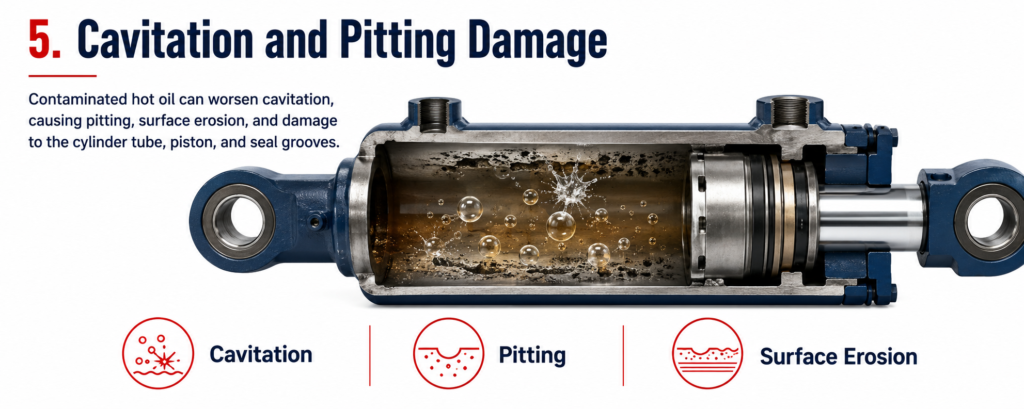
Cavitation occurs when local pressure falls low enough for vapour cavities or bubbles to form in the hydraulic oil.
When these cavities enter a higher-pressure area, they collapse rapidly and produce repeated local impacts.
Over time, cavitation may create small pits on:
- Hydraulic ports
- Cylinder bore surfaces
- Pistons
- Valve components
- Seal grooves
As the surface becomes rougher, internal leakage increases and seals may be scratched or cut.
Air entrainment, the diesel effect, and cavitation should not be treated as exactly the same problem:
- Air entrainment mainly causes compressibility, foaming, and unstable movement.
- The diesel effect is caused by rapid compression of air bubbles and local heat generation.
- Cavitation involves the formation and collapse of vapour cavities in low-pressure areas.
These conditions may occur together, but their causes and damage mechanisms are different.
How Do Air, Water, and Particles Create a Chain of Damage?
Under high-temperature conditions, contamination problems often reinforce one another:
Air and water enter the system
→ oil oxidation and lubrication performance deteriorate
→ seals and metal surfaces begin to wear
→ additional particles and leakage paths are produced
→ friction and internal leakage increase
→ system temperature continues to rise
The final result may be repeated seal failure, rod scoring, cylinder bore pitting, unstable movement, corrosion, and poor pressure-holding performance.
Warning Signs of Hydraulic Oil Contamination
Air, water, and solid contamination should be investigated when:
- Hydraulic oil continuously foams in the reservoir
- The oil becomes milky, cloudy, or unusually dark
- The cylinder crawls, vibrates, or produces abnormal noise
- The piston rod shows rust, scratches, or plating damage
- New seals begin leaking again after a short operating period
- Black deposits or metal particles appear in the oil
- Pitting is found on the bore, piston, ports, or seal grooves
- Cylinder performance becomes less stable after the oil warms up
These symptoms should not be addressed only by replacing the cylinder seals.
How Can Contamination Damage Be Reduced?
To reduce air entry, inspect suction lines, fittings, pump inlet connections, and reservoir oil levels. Avoid return oil discharging directly above the oil surface, and bleed the system properly after cylinder replacement or maintenance.
To control moisture, use a suitable reservoir breather, protect the system from rain and high-pressure washing, and inspect the reservoir, cooler, and hydraulic oil for water contamination.
To control particles, use appropriate return, pressure, or offline filtration. New hydraulic oil should also be filtered before entering the system.
Cylinders, pipes, hoses, manifolds, and valves should be thoroughly cleaned before assembly. Filtration performance, breather condition, and oil cleanliness should be checked regularly.
Conclusion
High temperature alone does not cause every hydraulic cylinder failure, but it significantly increases the damage caused by air, water, and contaminants.
Air can cause foaming, unstable movement, and local diesel-effect heating. Water can cause emulsification, corrosion, and reduced lubrication. Solid particles can scratch seals, piston rods, and cylinder bores. Oil oxidation products and cavitation can create deposits, restrictions, and pitting damage.
When a hydraulic cylinder repeatedly leaks or wears under high-temperature conditions, the solution should include more than seal replacement.
The hydraulic oil’s air content, moisture level, cleanliness, filtration system, reservoir breather, and overall contamination-control process should all be inspected.
AiSoar Hydraulics provides customized hydraulic cylinder solutions for high-temperature, heavy-duty, and contaminated working environments.