
A DeltaForce hydraulic cylinder problem often appears during planter preparation or in the middle of a short planting window. One row may respond differently, lose ground contact, or show hydraulic oil around the cylinder. However, these symptoms do not automatically mean that the cylinder itself has failed.
A DeltaForce system combines hydraulic cylinders, integrated valves, load sensors, hydraulic supply, electrical connections, and 20|20 control. Repair should therefore begin with diagnosis, not immediate cylinder removal. This guide helps growers, dealers, and repair companies identify the likely fault and decide whether to repair or replace the cylinder.
Start With the Complete Downforce System
Before disconnecting a hydraulic line, determine whether the problem affects one row or several rows.
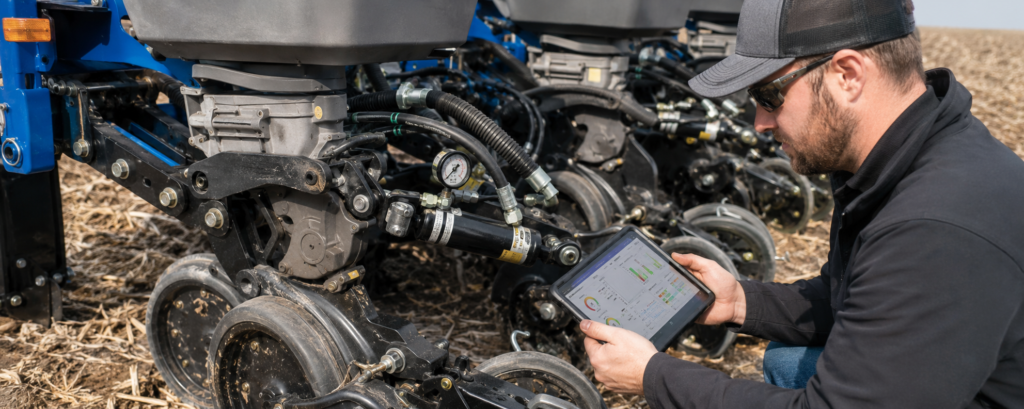
When several rows show low force or delayed response, investigate the common hydraulic supply, system pressure, electrical power, or control settings first. A single weak row is more likely to involve a local hose, connector, load cell, solenoid valve, mechanical linkage, or cylinder.
Begin with a visual inspection:
- Park the planter safely and release stored hydraulic pressure.
- Clean dirt and old oil from the cylinder, valve area, hoses, and fittings.
- Identify where fresh oil first appears.
- Check whether the piston rod is bent, corroded, scored, or contaminated.
- Inspect mounting pins, brackets, and row-unit linkage for binding or damage.
- Compare the affected row with a normally operating row.
Never work beneath a raised planter or place hands near row units while an automated force test is running.
Use the 20|20 Diagnostics Before Removing the Cylinder
The diagnostic screen can help separate a cylinder problem from a sensor, electrical, or system-pressure problem. Row-by-row information may include load-cell readings, solenoid voltage, commanded pressure, commanded force, and net applied downforce.
Supply pressure is also shown at the system level. Precision Planting states that the supply pressure should be above 2,250 psi for optimal DeltaForce performance.
| Diagnostic observation | Investigate next |
|---|---|
| No solenoid voltage on one row | Wiring, connectors, communication, or configuration |
| Voltage is present, but the row does not move | Valve, hose restriction, mechanical binding, air, or cylinder |
| Commanded pressure changes, but row response remains abnormal | Load cell, linkage, internal leakage, cylinder, or valve |
| Several rows respond poorly | Supply pressure, manifold, oil supply, or common electrical problem |
| One row differs from adjacent rows | Local sensor, solenoid, hose, mounting, valve, or cylinder |
The monitor should support the diagnosis, but it should not be the only evidence. A faulty load cell or mechanical resistance can make a healthy cylinder appear defective.
Purge Air After Opening Hydraulic Lines
Air may enter after installation, hose replacement, cylinder removal, or any repair that opens a hydraulic line. It can cause delayed, uneven, or jerky movement.
After opening the circuit, run the applicable DeltaForce air-purge procedure. The official health-check process cycles pressure to each cylinder and may need to be repeated.
Precision Planting recommends performing the air-purge test after installation and whenever hydraulic lines have been opened.
Do not condemn a cylinder immediately after repair if the system has not been correctly purged. Air trapped in the circuit can produce symptoms similar to internal leakage, valve response problems, or unstable cylinder movement.
Find the Actual Source of an External Leak
Oil around the cylinder does not always come from the rod seal. Clean the area, operate the system briefly under controlled conditions, and observe where fresh oil begins.
Check the following locations:
- Hose crimps
- Fittings and adapters
- Port seals
- Valve-to-cylinder connections
- Piston-rod sealing area
- Welded or impact-damaged sections
Oil forming around the rod as it moves may indicate rod-seal wear, piston-rod damage, contamination, or excessive side loading.
Oil beginning at a fitting should first be treated as a connection problem. Check the adapter, thread, sealing surface, and port condition before assuming that the complete cylinder requires repair.
Avoid repeatedly tightening a fitting without confirming its connection type and correct installation procedure. Over-tightening can damage the port or sealing surface and create a more serious leak.
How to Suspect Internal Leakage
Internal leakage is harder to identify because oil bypasses an internal sealing element instead of escaping outside.
Possible indications include:
- The affected row cannot maintain the commanded force.
- Cylinder movement becomes weak under load.
- The row gradually loses force without a visible external leak.
- Performance deteriorates as the hydraulic oil warms.
- The affected row responds differently from neighboring rows.
These symptoms do not prove that the piston seal has failed. An integrated valve that does not seal correctly, inadequate supply pressure, a hydraulic restriction, incorrect sensor feedback, or mechanical binding can produce similar behavior.
A qualified technician can compare the affected row with a known-good row and perform controlled pressure or drift testing. The test method must account for the integrated valve and circuit arrangement.
Blocking hydraulic ports or applying pressure without understanding the circuit can trap hydraulic energy or damage components. Internal leakage testing should therefore be performed with suitable equipment and an understanding of the cylinder’s hydraulic function.
Can the DeltaForce Cylinder Be Repaired?
Repair may be practical when the fault is limited to replaceable seals and the critical metal parts remain serviceable.
Before rebuilding, inspect:
- Piston-rod surface condition
- Cylinder bore condition
- Bearing and guiding areas
- Valve interfaces
- Hydraulic ports
- Welded sections
- Mounting holes and pins
Replacement is usually more dependable when:
- The rod is bent, deeply scored, pitted, or badly worn.
- The bore has serious scoring or dimensional wear.
- Mounting or structural parts are distorted.
- The valve body or cylinder has cracking or impact damage.
- Correct seals, repair data, or test equipment are unavailable.
- A previous repair has failed repeatedly.
Installing new seals without correcting rod damage, contamination, side loading, or bore wear often leads to another leak.
The availability of a seal kit does not necessarily mean that rebuilding is the most economical solution. The complete condition of the cylinder must be considered.
Test the Row After Repair or Replacement
A repaired or replacement cylinder should be tested before the planter returns to field operation.
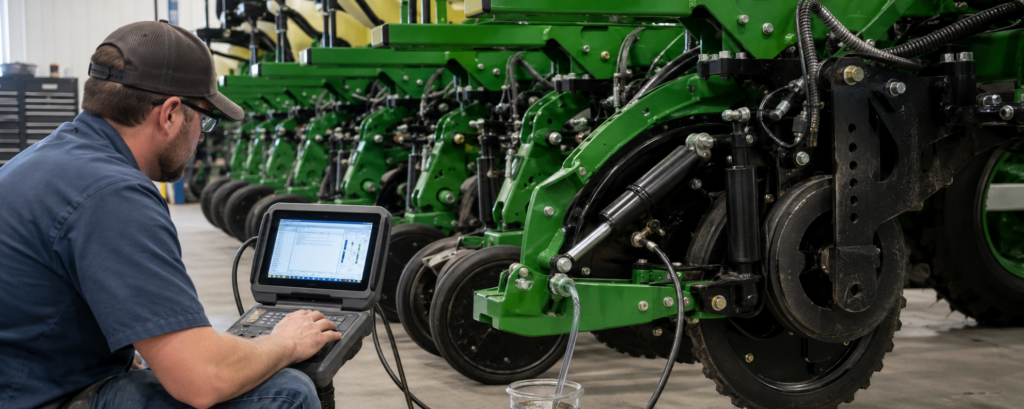
Recommended checks include:
- Confirm that the hoses, ports, pins, retainers, and electrical connectors are installed correctly.
- Purge air using the applicable DeltaForce health-check procedure.
- Observe cylinder extension and retraction for smooth movement.
- Inspect the connections and piston-rod area for fresh leakage.
- Run the applied-force or advanced applied-force test.
- Compare the repaired row with adjacent rows on the diagnostic screen.
- Reinspect the mounting and hoses after a short operating period.
The DeltaForce health-check process includes air-purge and applied-force testing. Precision Planting also recommends checking the system after installation and at the beginning of each planting season.
Testing is especially important after a seal replacement. A cylinder that operates without an external leak may still have excessive internal bypass, incorrect valve response, trapped air, or an installation problem.
Repair or Replace: Consider the Real Cost
The decision should consider more than the price of a seal kit.
Important factors include:
- Planting-season downtime
- Technician availability
- Cylinder and piston-rod condition
- Availability of correct repair components
- Ability to test the completed repair
- Risk of repeated failure
- Cost of removing and reinstalling the cylinder
Replacement is often more practical when important metal parts or the integrated valve area are damaged, when repair specifications cannot be verified, or when dependable turnaround is more important than another rebuild attempt.
For an accurate replacement assessment, provide:
- Original part number
- Planter make and model
- Clear cylinder and hydraulic-port photos
- Leak location
- Mounting dimensions
- 20|20 diagnostic readings
- Required quantity
AiSoar provides replacement solutions for applications using the Precision Planting 729602 reference, including cross-reference applications associated with AGCO ACW0814940 and Massey Ferguson ACW0585380.
Compatibility should always be confirmed for the specific planter before ordering.
Need Help Identifying the Problem?
If you are unsure whether the fault is in the hydraulic cylinder, integrated valve, load sensor, electrical system, or hydraulic supply, send AiSoar the planter model, original part number, cylinder photos, monitor readings, and a short video showing the affected row.
Our engineering team can review the available information and help determine whether further troubleshooting, professional repair, or a correctly matched replacement cylinder is the most practical next step.
Frequently Asked Questions
Q: Can a DeltaForce hydraulic cylinder be rebuilt?
A DeltaForce hydraulic cylinder may be rebuilt when the problem is limited to worn seals and the piston rod, cylinder bore, valve interface, and mounting structure remain in good condition. If major metal parts are damaged, replacement is usually more reliable.
Q: Why is only one planter row losing downforce?
A single-row downforce problem may be caused by the hydraulic cylinder, solenoid valve, load cell, hose, electrical connection, or mechanical linkage. Check the diagnostic data and compare the affected row with adjacent rows before removing the cylinder.
Q: Can trapped air cause a DeltaForce cylinder to work incorrectly?
Yes. Air entering the hydraulic circuit after installation, hose replacement, or cylinder removal may cause delayed, jerky, or uneven movement. The system should be properly purged before the cylinder is considered faulty.
Q: When should a DeltaForce hydraulic cylinder be replaced?
Replacement should be considered when the piston rod is bent or deeply scored, the cylinder bore is damaged, the valve area is defective, previous repairs have failed, or correct repair parts and testing procedures are unavailable.


