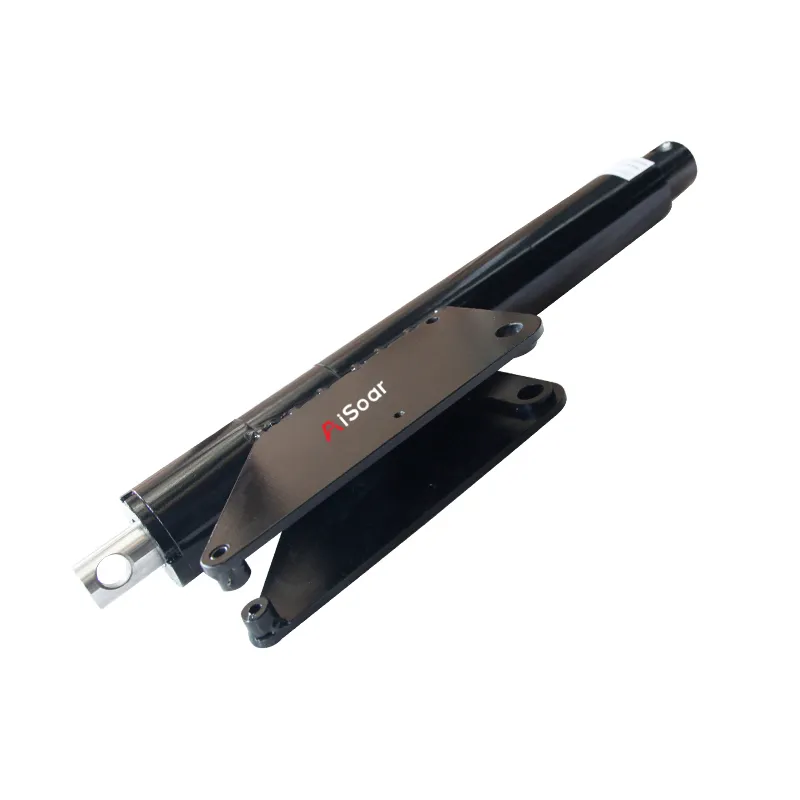
Hydraulic cylinders are widely used in construction machinery, agricultural equipment, waste-handling equipment, lifting platforms, special vehicles, and industrial production lines.
During summer, higher ambient temperatures, long operating hours, frequent cycling, and heavy loads can cause hydraulic oil temperature to rise quickly. High temperature does not usually damage a hydraulic cylinder immediately, but it can reduce oil viscosity, affect seals, alter internal clearances, and accelerate oil degradation.
If a hydraulic system continues operating at excessive temperatures, the cylinder may gradually develop leakage, drift, unstable movement, reduced efficiency, and faster wear.
Hydraulic Oil Viscosity Decreases
Hydraulic oil becomes thinner as temperature increases.
When viscosity drops below the recommended range, oil can pass more easily through piston seals, guide clearances, and control valves. This increases internal leakage and may reduce cylinder force, pressure-holding performance, and efficiency.
For lifting platforms, hydraulic outriggers, trailer jacks, and other load-holding equipment, low-viscosity oil may also cause the piston rod to retract slowly under load.
External Leakage Becomes More Likely
High temperature can change the hardness and elasticity of hydraulic seals.
If seals are worn, aged, or unsuitable for the actual operating temperature, heat and pressure may cause sealing lips to soften, deform, or extrude.
Leakage may then appear around the rod seal, cylinder head, static seals, ports, or fittings. Some cylinders remain dry when cold but begin leaking after the oil reaches operating temperature.
Pressure-Holding Performance May Decrease
A hydraulic cylinder can drift even when there is no visible oil leakage.
As the oil becomes thinner, it may pass across the piston seal or through internal valve clearances. Pressure gradually transfers from one side of the cylinder to the other, allowing the piston rod to move slowly under load.
Cylinder drift is not always caused by the cylinder itself. Directional valves, check valves, counterbalance valves, and load-holding manifolds may also leak internally. Both the cylinder and control circuit should be checked before seals are replaced.
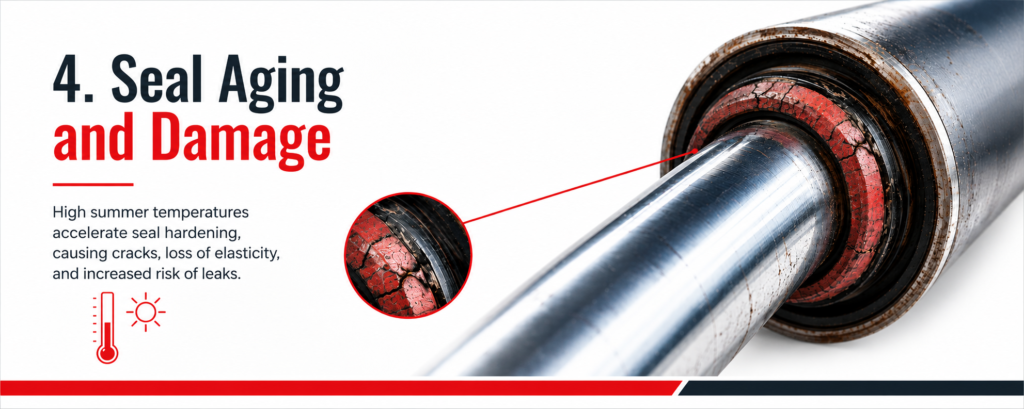
Seal Aging Accelerates
Long-term exposure to hot hydraulic oil can shorten seal life.
Depending on the material, oil type, pressure, and temperature, seals may harden, soften, swell, crack, shrink, or become permanently deformed. A seal may continue working even after its elasticity and sealing performance have started to decline.
For high-temperature hydraulic cylinders, seal selection should consider continuous operating temperature, short-term peak temperature, oil compatibility, and cycle frequency.
Lubrication Becomes Less Effective
Hydraulic oil transmits pressure, lubricates moving parts, and helps remove heat.
When viscosity becomes too low, the lubricating film between the piston, wear rings, cylinder bore, guide components, and piston rod becomes thinner. This increases the risk of direct surface contact.
If the oil also contains dust, metal particles, or other contaminants, high temperature may accelerate bore scoring, rod scratching, guide wear, and repeated seal damage.
Replacing seals alone may not solve the problem if the rod surface, bore, or guide clearance has already deteriorated.
Hydraulic Oil Oxidation and Contamination Increase
High temperature accelerates hydraulic oil oxidation.
As the oil deteriorates, it may become darker and develop sludge, varnish, deposits, or an unusual smell. These contaminants can collect in seal grooves, ports, valve passages, and internal cylinder surfaces.
When air or water is present, high temperature can also contribute to foaming, emulsification, corrosion, and unstable movement. Repeated heating and cooling may create condensation, especially in outdoor equipment or humid environments.
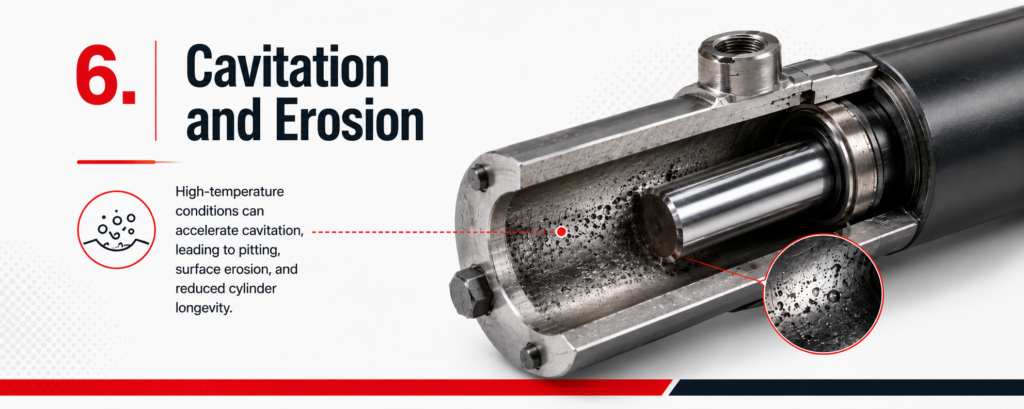
Cavitation and Aeration May Cause Damage
Hot hydraulic oil may release dissolved air more easily and form small bubbles.
The risk increases when the oil level is low, suction lines are restricted, air enters the pump inlet, or local flow velocity is too high.
When bubbles move into a higher-pressure area, they may collapse rapidly and create local pressure impacts. Over time, cavitation can cause pitting on the cylinder bore, piston, ports, or seal grooves.
Typical warning signs include abnormal noise, vibration, foaming oil, and unstable movement.
Rod Plating and External Protection May Deteriorate
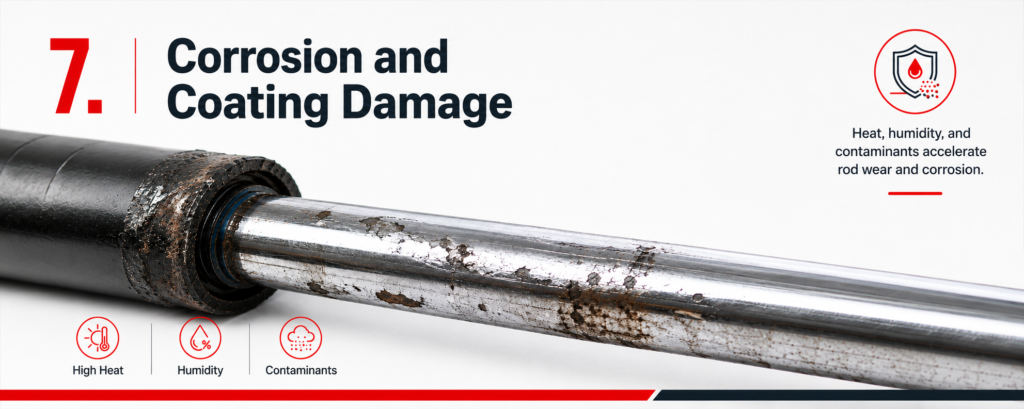
Summer conditions also affect the external surfaces of a hydraulic cylinder.
Piston rods are exposed to dust, rain, humidity, sunlight, and repeated movement through the rod seal and wiper. Contaminants trapped around the wiper may scratch the rod plating and damage the sealing lips.
Once the rod surface is damaged, corrosion and external leakage become more likely.
High temperature and sunlight may also accelerate paint fading, cracking, or peeling. In humid, coastal, salt-spray, or chemically corrosive environments, exposed metal can rust more quickly.
Thermal Expansion Changes Internal Clearances
Cylinder tubes, pistons, piston rods, guide bushings, wear rings, and seals all expand as temperature increases.
Because these components may use different materials, they do not always expand at the same rate.
If internal clearances are too small, high temperature may cause increased friction, stick-slip movement, local overheating, or seizure. If clearances become too large, internal leakage may increase.
High-temperature cylinder design should therefore consider materials, machining tolerances, seal structure, wear-ring material, and actual operating temperature.
Cylinder Speed and Stability May Change
A hydraulic cylinder may behave differently after the oil becomes hot.
In systems using fixed orifices, throttle valves, or simple flow controls, lower viscosity may change the actual flow. The cylinder may move faster, start more abruptly, stop less smoothly, or show speed fluctuations.
Frequently cycling cylinders also generate friction and throttling heat. This can create a cycle:
Oil temperature rises → leakage increases → efficiency decreases → operating time increases → more heat is generated.
Without sufficient cooling or system optimization, cylinder performance may become increasingly unstable.
Warning Signs During Summer Operation
Operators and maintenance teams should watch for:
- Leakage that becomes more obvious after warm-up
- Slow piston rod retraction under load
- Different cylinder speeds when cold and hot
- Poor pressure-holding performance
- Dark, foamy, or unusual-smelling hydraulic oil
- Abnormal noise or vibration
- Damage to rod plating or cylinder paint
These symptoms do not always mean that the cylinder itself is defective.
High oil temperature may also be related to unsuitable oil viscosity, internal valve leakage, inadequate reservoir capacity, poor cooler performance, excessive backpressure, restricted oil flow, or continuous relief-valve operation.
The complete hydraulic system should therefore be inspected before the cylinder seals are replaced.
Conclusion
The effects of summer heat on hydraulic cylinders usually develop gradually.
A system may first show only a higher oil temperature or minor seepage. Over time, this can develop into internal leakage, cylinder drift, seal failure, unstable movement, corrosion, cavitation, and accelerated wear.
For high-temperature, heavy-load, or frequent-cycle equipment, cylinder design and maintenance should consider oil viscosity, seal materials, internal clearances, surface protection, contamination control, cooling capacity, and the actual working cycle.
Most importantly, the hydraulic cylinder should always be evaluated as part of the complete hydraulic system.
AiSoar Hydraulics provides customized hydraulic cylinder solutions for construction machinery, agricultural equipment, waste-handling equipment, lifting platforms, special vehicles, and industrial applications.