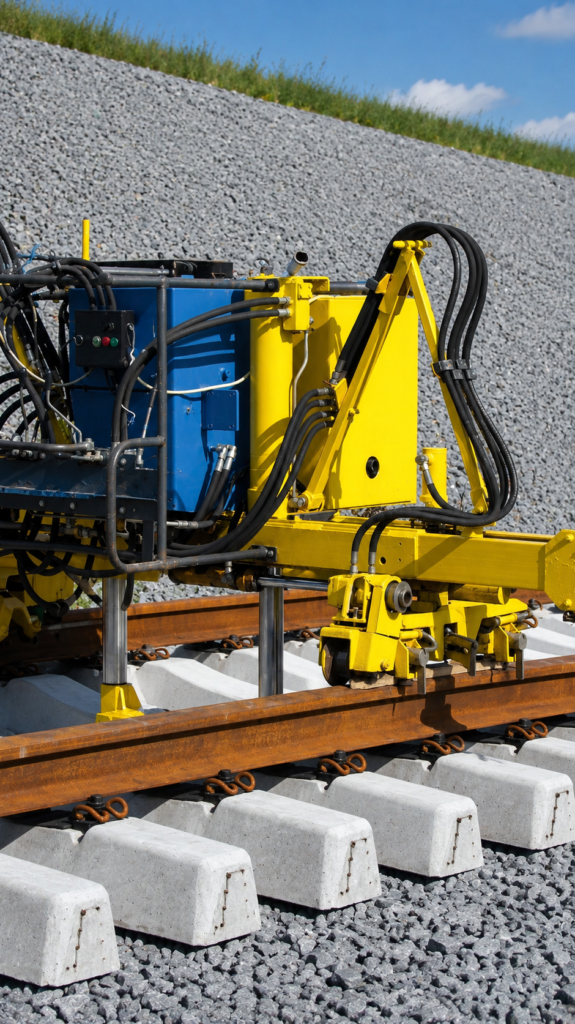
Hydraulic cylinders perform many of the movements that agricultural equipment depends on every day—from opening a grapple and adjusting a tillage frame to positioning a spray boom or operating auxiliary mechanisms on a baler.
For many of these applications, tie rod hydraulic cylinders provide a practical combination of reliable linear movement, clevis mounting, dimensional flexibility and serviceable construction.
Rather than choosing a hydraulic cylinder only by bore and stroke, however, the cylinder should be matched to the actual function of the machine. A cylinder controlling a grapple attachment operates under very different conditions from one positioning a sprayer boom or adjusting tillage equipment.
AISOAR supplies standard and customized tie rod hydraulic cylinders for agricultural machinery, OEM equipment and replacement applications. Below are several typical agricultural applications and the role the hydraulic cylinder performs on each machine.
Where Are Tie Rod Hydraulic Cylinders Used in Agricultural Equipment?
Tie rod cylinders are typically used where agricultural machinery needs controlled pushing, pulling, lifting, folding, gripping or positioning.
Typical applications include:
| Agricultural Equipment | Typical Cylinder Function | Typical Movement |
|---|---|---|
| Balers | Auxiliary lifting and positioning | Raise, lower, open or reposition mechanisms |
| Grapple Attachments | Grapple actuation | Open and close grapple arms |
| Agricultural Sprayers | Boom positioning | Lift, lower and fold spray booms |
| Tillage Equipment | Frame and depth control | Lift, adjust, level or fold sections |
| Grain Carts | Auger and discharge control | Fold auger, position auger, open/close gate |
| Fertilizer Spreaders | Section and discharge control | Fold, position and regulate discharge |
Although these machines can all use hydraulic cylinders, their load, stroke, mounting geometry and operating environment are different. The cylinder configuration therefore needs to be selected around the equipment rather than treated as a universal component.
Tie Rod Hydraulic Cylinder Applications in Agricultural Equipment
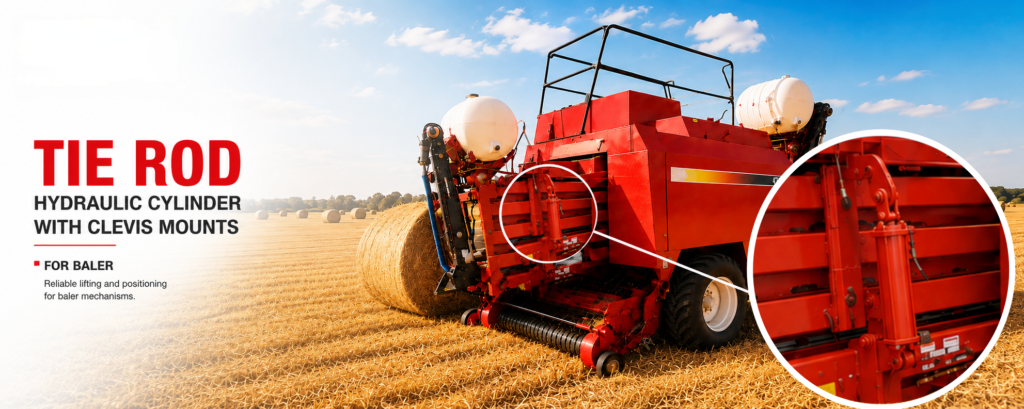
Tie Rod Hydraulic Cylinders for Balers
Agricultural balers contain several moving mechanisms that may require hydraulic actuation. Depending on the baler design, hydraulic cylinders can be used for lifting, positioning, opening or closing different parts of the machine.
A tie rod cylinder may be installed between the baler frame and a moving linkage. As the cylinder extends or retracts, it transfers hydraulic force into controlled mechanical movement. This can be used for auxiliary mechanisms such as pickup positioning, adjustment systems or other movable sections.
Clevis mounts are especially useful in this type of linkage because the cylinder does not always remain at one fixed angle. As the machine mechanism moves, the cylinder must pivot around its mounting pins.
For a replacement baler cylinder, bore and stroke are only part of the specification. Retracted length, extended length, pin diameter, clevis width and port orientation also need to correspond to the original machine.
Baler environments should also be considered during cylinder selection. Straw, crop debris and dust can accumulate around exposed components, making rod surface quality, wiper performance and sealing reliability important for long-term operation.
Tie Rod Hydraulic Cylinders for Grapple Attachments
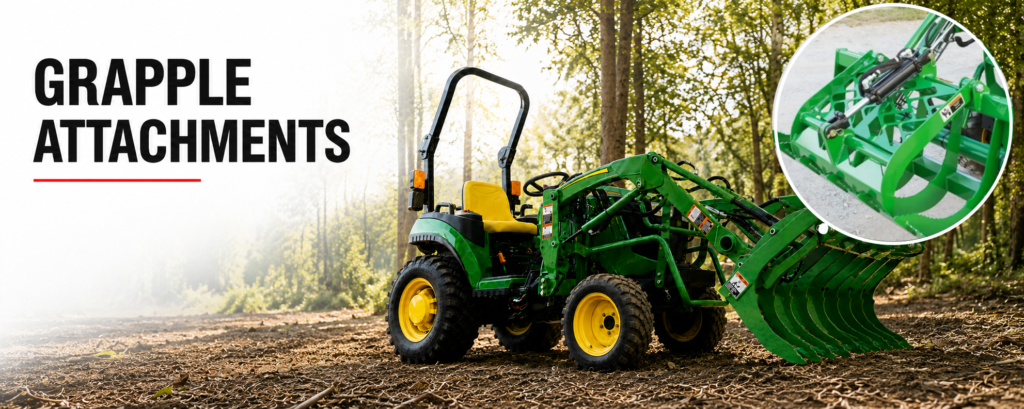
Grapple attachments are one of the clearest examples of how a hydraulic cylinder converts linear movement into machine action.
The hydraulic cylinder is normally connected between the grapple frame and the moving grapple arm or jaw. When hydraulic oil enters one side of the cylinder, the piston rod moves and rotates the grapple through its linkage.
The result is the opening or closing movement required to grip materials such as brush, branches, logs, hay or other agricultural materials.
In this application, cylinder stroke directly affects the opening range of the grapple, while bore size and operating pressure influence the available gripping force.
The mounting geometry is equally important.
Because the grapple rotates through an arc, the distance and angle between the mounting points change continuously during movement. Clevis mounts at both ends allow the hydraulic cylinder to pivot around the mounting pins instead of being subjected to unnecessary rigid side loading.
When developing a cylinder for a grapple attachment, the following dimensions should therefore be considered together:
- Bore and rod diameter
- Stroke
- Closed center-to-center length
- Clevis width and pin diameter
- Maximum opening and closing position
- Hydraulic port size and orientation
A cylinder with the correct bore and stroke but the wrong closed length can change the entire geometry of the grapple and prevent it from fully opening or closing.
Tie Rod Hydraulic Cylinders for Agricultural Sprayers
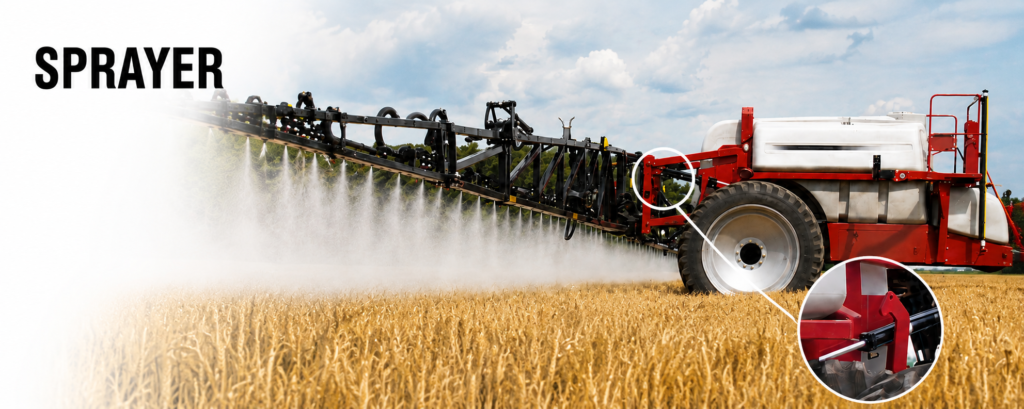
Agricultural sprayers use hydraulic cylinders to control large boom structures and other positioning mechanisms.
Depending on the sprayer design, hydraulic cylinders may be used to raise and lower the spray boom, fold boom sections for transport or position individual boom structures during field operation.
A typical boom cylinder is connected between the sprayer frame and the boom linkage. As the cylinder extends or retracts, the boom rotates around its pivot point.
The load acting on the cylinder can change significantly throughout this movement. When the boom is extended horizontally, its long structure creates a different mechanical leverage than when it is partially or fully folded.
For this reason, sprayer cylinder selection should not be based on cylinder force alone.
The complete movement geometry should be reviewed to determine the required stroke, mounting position and force throughout the operating range.
Port position is another practical consideration. Hydraulic hoses should have sufficient clearance during the complete folding movement without being stretched, pinched or forced against the machine structure.
For replacement projects, matching the original pin-to-pin dimensions and port orientation can be just as important as matching bore and stroke.
Tie Rod Hydraulic Cylinders for Tillage Equipment
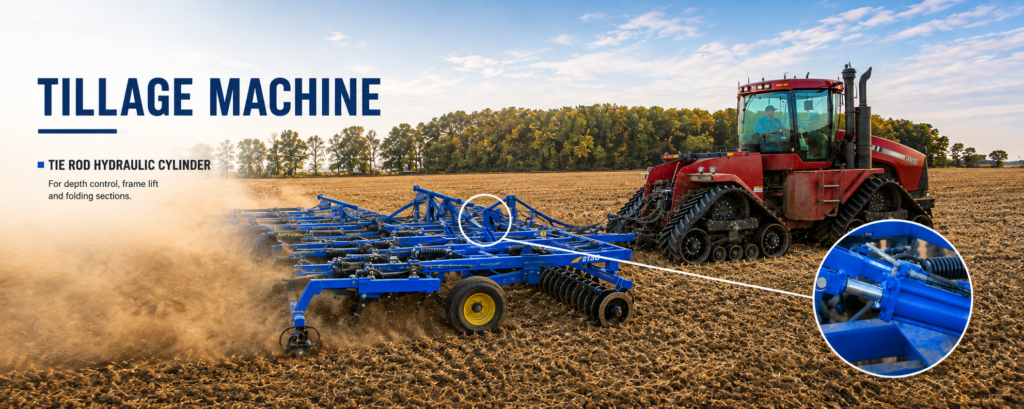
Tillage equipment is another major agricultural application for tie rod hydraulic cylinders.
Disc harrows, cultivators, plows and other tillage implements use hydraulic cylinders to control functions such as frame lifting, working-depth adjustment, leveling and folding.
One common arrangement places the cylinder between the implement frame and a wheel or axle linkage. When the cylinder extends or retracts, the relative position between the frame and the wheels changes.
This allows the operator to raise the implement for transport or lower it to the required working depth in the field.
On wider tillage machines, hydraulic cylinders can also be installed between the center frame and folding wing sections. These cylinders move the wings between the wide field-working configuration and the narrower transport position.
Tillage equipment presents a demanding working environment because cylinders operate close to soil, crop residue, dust and moisture. Appropriate sealing, rod surface protection and correct mounting alignment therefore become particularly important.
The mounting pins and clevises should allow the cylinder to move naturally with the linkage. Poor alignment can introduce side load into the piston rod and gland, accelerating wear even when hydraulic pressure remains within the cylinder rating.
Working Depth and Cylinder Geometry
For depth-control applications, small changes in cylinder position can produce noticeable changes in implement depth.
This means repeatable positioning and correct cylinder dimensions are important. The cylinder must provide the required stroke while maintaining the correct minimum and maximum linkage positions.
For equipment using multiple cylinders, hydraulic volume and synchronization may also need to be considered so that different sections of the machine move consistently.
Tie Rod Hydraulic Cylinder for Grain Cart
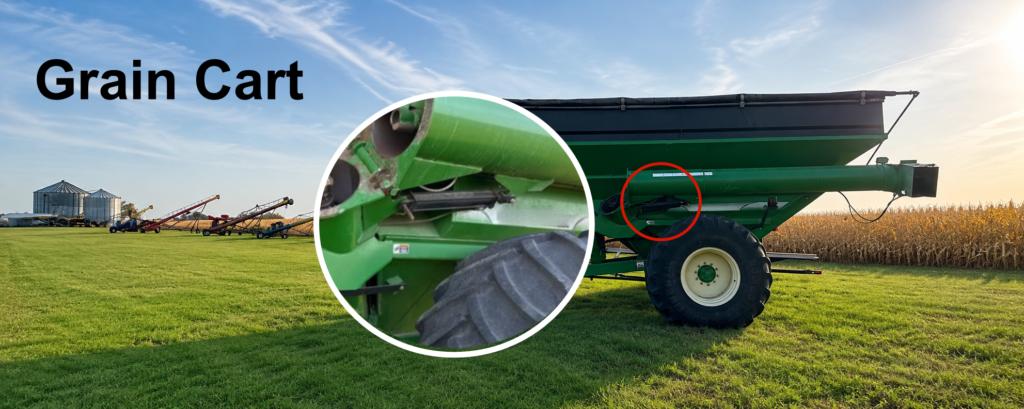
Grain carts use hydraulic cylinders to control several moving mechanisms involved in grain unloading and transport. Depending on the equipment design, tie rod hydraulic cylinders can be used for auger folding and positioning, discharge gate control, and other auxiliary adjustment functions.
For auger systems, the hydraulic cylinder is typically connected between the grain cart frame and the auger linkage. As the cylinder extends or retracts, it moves the unloading auger between its working and transport positions. Clevis mounts at both ends allow the cylinder to pivot with the linkage as the auger moves through its operating angle.
Tie rod cylinders can also be used to open and close grain discharge gates. In this application, the cylinder provides controlled linear movement to regulate the opening position of the gate and therefore helps control grain flow during unloading.
For grain cart applications, stroke, retracted center-to-center length, mounting pin dimensions and available installation space should all be matched to the machine geometry. When the cylinder is used for auger folding, the weight of the auger and the changing mechanical leverage throughout the folding movement should also be considered when determining the required cylinder force.
Because grain carts operate in environments exposed to dust, crop residue and outdoor weather conditions, suitable rod surface protection, sealing and corrosion resistance are also important for reliable long-term operation.
Tie Rod Hydraulic Cylinder for Fertilizer Spreaders
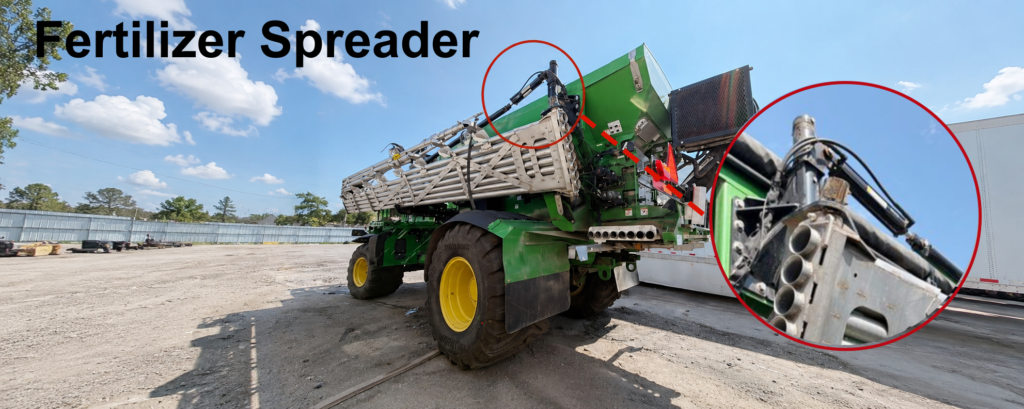
Fertilizer spreaders use hydraulic cylinders to control different moving mechanisms involved in material distribution, adjustment and transport. Depending on the spreader design, tie rod hydraulic cylinders can be used for folding or positioning spreading sections, controlling discharge mechanisms, and adjusting auxiliary linkages.
On fertilizer spreaders equipped with folding sections or booms, the hydraulic cylinder is typically connected between the main frame and the moving section. As the cylinder extends or retracts, it moves the section between its working and transport positions. Clevis mounts at both ends allow the cylinder to pivot with the linkage throughout this movement.
Hydraulic cylinders may also be used around the hopper or discharge system to operate gates or other mechanisms that regulate fertilizer flow. In these applications, controlled cylinder movement helps open, close or reposition the discharge mechanism according to the machine design.
For fertilizer spreader applications, stroke, retracted center-to-center length, mounting pin dimensions, operating pressure and port orientation should be matched to the equipment geometry. Where the cylinder controls a folding section, the changing load and leverage throughout the movement should also be considered when determining the required cylinder force.
Because fertilizer spreaders operate around dust, granular material, moisture and potentially corrosive fertilizer residue, rod surface protection, sealing performance and corrosion resistance are particularly important for long-term cylinder reliability.
Why Use Tie Rod Cylinders on Agricultural Implements?
A tie rod hydraulic cylinder uses high-strength threaded rods to hold the cylinder end caps and barrel assembly together. This construction allows the cylinder to be disassembled for servicing.
For agricultural machinery that may remain in operation for many seasons, this is an important advantage. Seals, wipers and other wear components can be inspected or replaced without necessarily replacing the complete cylinder.
Tie rod construction also provides flexibility when different machine models require similar cylinder designs with different bore, stroke or mounting dimensions.
For OEM manufacturers, this makes it possible to develop a family of cylinders around several equipment configurations. For distributors and repair companies, it can simplify replacement when the original cylinder is no longer readily available.
However, tie rod cylinders should not automatically be considered the best design for every hydraulic function.
Applications involving very severe impact, extreme side loading or heavy mobile-equipment shock may require a different cylinder construction. The correct choice should always be based on the actual equipment, mounting arrangement and operating load.
How to Select a Tie Rod Hydraulic Cylinder for Agricultural Equipment
A replacement or OEM agricultural cylinder should be evaluated as part of the complete machine mechanism.
Bore size determines the effective piston area and therefore influences cylinder force.
Rod diameter affects rod strength, pull-side area and resistance to buckling.
Stroke determines how far the mechanism can move.
But these hydraulic dimensions are only part of the selection process.
The retracted center-to-center length determines the starting position of the linkage, while the extended length determines its maximum travel position. Pin diameter and clevis dimensions determine whether the cylinder can physically connect to the existing brackets.
Port type and orientation must also match the hydraulic system and available hose routing.
That is why two cylinders with the same bore and stroke are not necessarily interchangeable.
For agricultural replacement projects, the complete mounting geometry should be confirmed before production.
Standard and Custom Tie Rod Hydraulic Cylinder Solutions
AISOAR’s TR Tie Rod Hydraulic Cylinders are designed with clevis mounting at the rod end and base end, making them suitable for agricultural mechanisms that require pivoting movement around mounting pins.
The standard TR range includes:
| Specification | AISOAR TR Series |
| Bore Size | 2–5 in |
| Stroke | 4–48 in |
| Working Pressure | 2500 / 3000 PSI |
| Mounting | Clevis mounts |
| Application | Agricultural machinery |
| Customization | Available |
Standard dimensions can be used where they match the machine requirements, while customized versions can be developed when the application requires different mounting geometry or hydraulic specifications. For OEM agricultural equipment, customization can include bore size, rod diameter, stroke, closed length, clevis dimensions, ports, seals and surface treatment.
AISOAR supports both customized tie rod hydraulic cylinder development and volume production for agricultural equipment manufacturers and distributors. With a monthly production capacity of up to 30,000 hydraulic cylinders, we can support both small-batch customized projects and volume production requirements.
For OEM projects, drawing confirmation, dimensional control, quality inspection and batch consistency can be managed according to the customer’s annual demand and delivery schedule.
Replacement Tie Rod Cylinders for Existing Agricultural Machinery
Agricultural equipment often remains in service long after the original cylinder model becomes difficult to obtain.
In these situations, a replacement cylinder can be developed from an existing drawing, original cylinder sample, equipment information or complete dimensional measurements.
A successful replacement should reproduce not only the hydraulic performance but also the mechanical relationship between the cylinder and the equipment.
For this reason, AISOAR evaluates the complete application, including mounting distance, travel, hydraulic pressure and installation space, before confirming the replacement design.
Where an existing standard TR cylinder matches the machine, a standard model can provide a straightforward replacement. When dimensions or mounting details are different, a customized tie rod cylinder can be manufactured around the original application.
Tie Rod Cylinder Solutions Built Around the Machine
A baler, grapple attachment, agricultural sprayer, tillage machine, grain cart and fertilizer spreader may all use tie rod hydraulic cylinders, but the cylinder performs a different function on each machine.
On a baler, it can control auxiliary lifting and positioning mechanisms.
On a grapple attachment, it creates the opening and closing movement required for gripping.
On a sprayer, it helps position, lift or fold the boom.
On tillage equipment, it can control working depth, frame height or folding sections.
On a grain cart, it can operate auger positioning and discharge mechanisms.
On a fertilizer spreader it can control folding sections and material discharge.
Understanding these differences is the key to selecting the correct hydraulic cylinder.
AISOAR supplies standard and customized tie rod hydraulic cylinders for agricultural equipment manufacturers, distributors and replacement markets. Whether the requirement is a standard clevis-mounted cylinder or a cylinder developed around an existing machine, the design can be matched to the required force, stroke, mounting geometry and hydraulic system.
Need a tie rod hydraulic cylinder for your agricultural equipment? Send us your existing cylinder drawing, product dimensions or machine application. Our engineering team can help evaluate a suitable standard or customized cylinder solution.