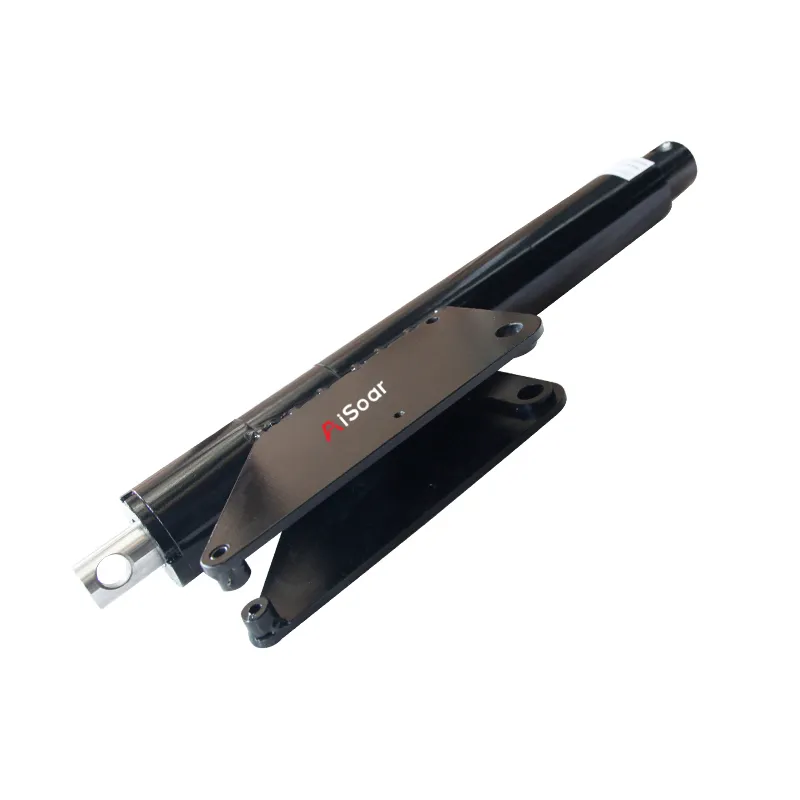
Single-rod and double-rod hydraulic cylinders both convert fluid pressure into linear force and motion. Their main difference is the piston-rod arrangement: a single-rod cylinder has a rod extending from one side of the piston, while a double-rod cylinder has a rod extending from both ends.
This structural difference changes the cylinder’s effective area, extension and retraction forces, operating speed, oil-volume requirements and installation envelope. A single-rod cylinder is usually the more compact and economical choice, while a double-rod cylinder is useful when similar force and speed are required in both directions or when the mechanism needs a rod connection on both sides.
It is also important not to confuse rod arrangement with actuation type. Single-rod and double-rod describe the number of rod extensions, while single-acting and double-acting describe how hydraulic pressure drives the cylinder. A single-rod cylinder may be single-acting or double-acting, and a double-rod cylinder is usually—but not necessarily—double-acting.
What is the difference between a single-rod and double-rod hydraulic cylinder?
A single-rod hydraulic cylinder has a piston rod extending from one end, creating different effective areas, forces and speeds during extension and retraction. A double-rod cylinder has rods extending from both ends. When both rods have the same diameter, it provides approximately equal force and speed in both directions.
What Are Single-Rod and Double-Rod Hydraulic Cylinders?
What Is a Single-Rod Hydraulic Cylinder?
A single-rod hydraulic cylinder has one piston rod connected to the piston and extending through one cylinder head. The opposite end of the cylinder is closed by a cap.
In a double-acting single-rod cylinder, hydraulic oil can be directed to either side of the piston. Pressurizing the cap end causes the piston rod to extend, while pressurizing the rod end causes it to retract.
Because the rod occupies part of the piston area on the rod side, the two effective areas are different. The full piston area is available during extension, but only the annular area around the rod is available during retraction.
This unequal-area design causes a single-rod cylinder to produce different forces and speeds in the two directions when the same pressure and flow are supplied.
What Is a Double-Rod Hydraulic Cylinder?
A double-rod hydraulic cylinder has a piston rod extending through both cylinder heads. In a conventional equal-rod design, the two rod sections have the same diameter and are connected through the piston along the same centerline.
Because an equal-diameter rod occupies the same amount of piston area on both sides, the effective pressure areas are equal. At the same pressure and flow, the cylinder can therefore produce approximately equal theoretical force and speed in either direction.
A double-rod cylinder is sometimes called a double-ended hydraulic cylinder or an equal-area cylinder. However, “equal-area” is accurate only when the rods on both sides have the same diameter. Special double-rod cylinders with different rod diameters will still have unequal effective areas.
Bosch Rexroth, for example, offers configurable tie-rod cylinders with piston rods on both sides, confirming that double-rod construction is an available industrial-cylinder configuration rather than a separate actuation principle. Bosch Rexroth double-rod cylinder configuration
Single-Rod vs Double-Rod Hydraulic Cylinders: Main Differences
| Comparison item | Single-rod cylinder | Equal double-rod cylinder |
|---|---|---|
| Rod arrangement | Rod extends from one end | Rod extends from both ends |
| Effective piston areas | Different on the two sides | Equal on both sides |
| Force at equal pressure | Higher extension force than retraction force | Similar force in both directions |
| Speed at equal flow | Retraction is faster than extension | Similar speed in both directions |
| Oil volume per stroke | Different for extension and retraction | Similar in both directions |
| Installation length | More compact | Requires space at both ends |
| Number of rod seals | Normally one | Normally two |
| Rod-end connection | One external rod connection | Two external rod connections |
| Hydraulic circuit behavior | Differential flow and force | More balanced flow and force |
| Typical availability | Very common | Usually application-specific |
| Relative cost | Generally lower | Generally higher |
| Common applications | Lifting, pushing, clamping and mobile machinery | Positioning, steering, testing and symmetrical mechanisms |
How Rod Arrangement Affects Cylinder Force and Speed
The theoretical force generated by a hydraulic cylinder is determined by:
F=P×A
where:
- = theoretical cylinder force
- P = hydraulic pressure
- A = effective pressure area
Actual output force will be slightly lower because of seal friction, pressure loss and mechanical resistance.
Single-Rod Cylinder Extension Force
During extension, hydraulic pressure acts on the full piston area:
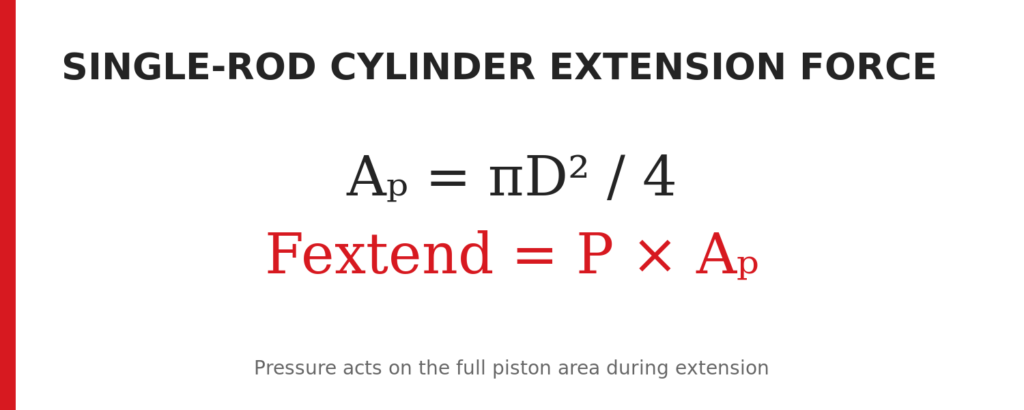
where D is the cylinder bore diameter.
Single-Rod Cylinder Retraction Force
During retraction, the piston rod occupies part of the pressure area:
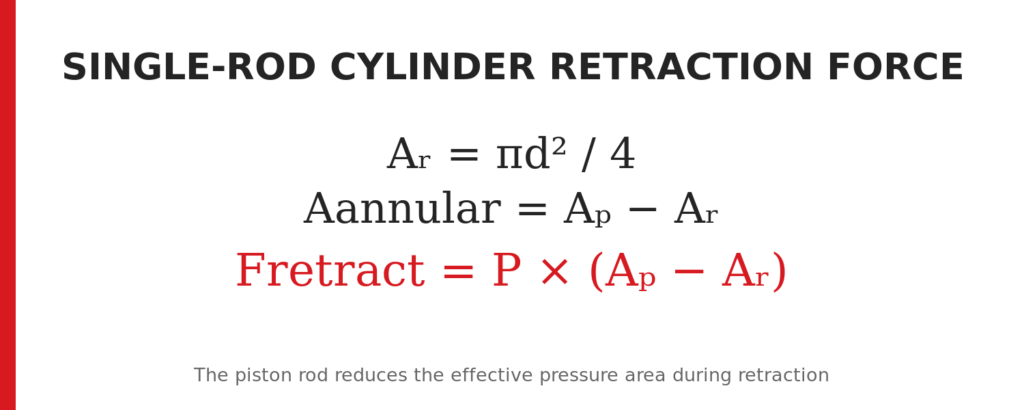
where d is the piston-rod diameter.
Because the annular area is smaller than the full piston area, a conventional single-rod cylinder produces less theoretical force during retraction than during extension at the same pressure.
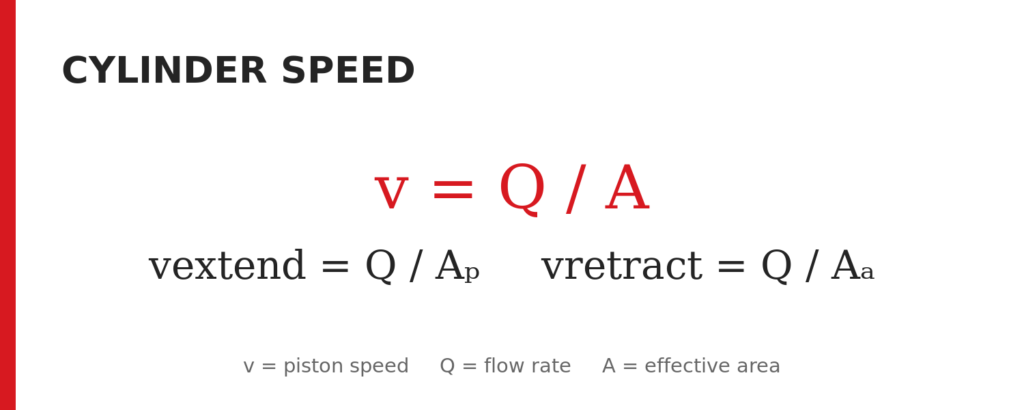
Single-Rod Cylinder Speed
At the same pump flow, the single-rod cylinder retracts faster than it extends because the rod-side annular area is smaller than the cap-end piston area.
Double-Rod Cylinder Force
For an equal double-rod cylinder, both sides have the same annular area:
Aeffective = Ap− Ar
The theoretical forces are therefore:
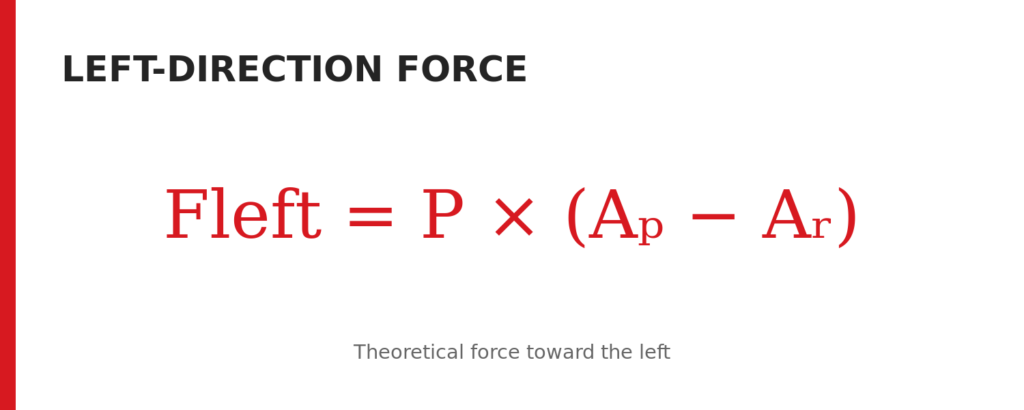
If the rod diameters and hydraulic pressures are equal, the theoretical force is the same in both directions.
However, an equal double-rod cylinder generally produces less force in either direction than a single-rod cylinder of the same bore operating on its full cap-end area.
Double-Rod Cylinder Speed
In an equal double-rod cylinder, the effective area is the same on both sides:
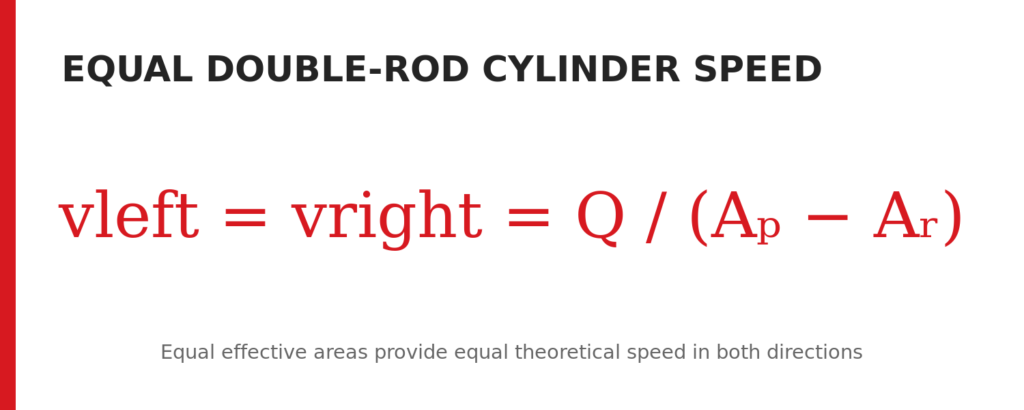
Therefore, equal flow produces approximately equal speed in both directions. This is one of the main reasons double-rod cylinders are used in positioning, testing and reciprocating systems.
Example Force Comparison
Consider two cylinders with the following dimensions:
- Bore diameter: 80 mm
- Rod diameter: 40 mm
- Operating pressure: 160 bar
The piston area is approximately:
Ap=5,027 m㎡
The rod area is approximately:
Ar=1,257 m㎡
The annular area is:
Ap−Ar=3,770m㎡
Ignoring losses, the approximate theoretical forces are:
| Cylinder movement | Effective area | Theoretical force |
|---|---|---|
| Single-rod extension | 5,027 mm² | 80.4 kN |
| Single-rod retraction | 3,770 mm² | 60.3 kN |
| Equal double-rod movement—either direction | 3,770 mm² | 60.3 kN |
The single-rod cylinder provides approximately 33% more theoretical force during extension than during retraction. The equal double-rod cylinder provides approximately the same 60.3 kN in both directions.
These values are theoretical. A practical design must account for friction, pressure losses, load direction, pressure peaks and required safety margin.
Oil Volume and Hydraulic Circuit Behavior
A single-rod cylinder requires different oil volumes for extension and retraction. The cap end receives or discharges more oil per unit of stroke than the rod end.
This volume difference affects valve flow, return-line flow, reservoir behavior and cylinder speed. In some regenerative circuits, oil discharged from the rod side can be directed to the cap side to increase extension speed, although the available extension force is reduced.
An equal double-rod cylinder has approximately equal chamber volumes for the same stroke on both sides. The volume entering one chamber is therefore close to the volume leaving the other chamber, simplifying flow balancing in applications that require symmetrical reciprocating motion.
“Equal flow” does not automatically guarantee perfect real-world speed matching. Seal friction, load direction, hose pressure loss, valve characteristics and external mechanical resistance can still produce small differences.
Single/Double-Rod Hydraulic Cylinders Advantages and Limitations
Advantages of Single-Rod Hydraulic Cylinders
Single-rod cylinders are the standard choice for many mobile and industrial systems because they provide a useful combination of high extension force, compact dimensions and relatively simple construction.
Their main practical advantage is that only one side requires clearance for the moving piston rod. This makes them easier to install in loaders, agricultural equipment, lifting systems, trailers, presses and material-handling machinery.
A single-rod cylinder also uses the full piston area for extension. For applications where the primary working stroke is a push or lifting movement, this allows more force to be obtained from a given bore size.
Standard single-rod cylinders are widely available in welded and tie-rod construction, with many bore, stroke, pressure and mounting combinations. This usually makes replacement, customization and maintenance more straightforward.
Limitations of Single-Rod Hydraulic Cylinders
The unequal effective areas create different force and speed characteristics in the two directions. If the application requires identical motion in both directions, the hydraulic circuit may need flow controls, proportional valves, position feedback or other compensation.
The difference in chamber volume also means that return flow can be higher than pump flow during certain movements. Valves, hoses and return lines must be sized for the actual circuit flow rather than only the nominal pump output.
In long-stroke compression applications, piston-rod buckling must be checked carefully. Rod diameter, unsupported length, mounting arrangement, load alignment and safety factor all influence buckling resistance.
Advantages of Double-Rod Hydraulic Cylinders
An equal double-rod cylinder can provide similar force and speed in both directions when supplied with equal pressure and flow. This balanced behavior is valuable in machines that perform repetitive bidirectional motion.
The rod extending from both ends can also improve mechanical guidance or allow the cylinder to connect to two moving components. One rod end may drive the load while the other operates a sensor, mechanical stop, linkage or position-indicating mechanism.
Because the chamber volumes are approximately equal, double-rod cylinders are useful in hydraulic systems where balanced flow simplifies control. Typical examples include testing machines, positioning systems, steering mechanisms, machine-tool feeds and specialized valve actuation.
AISOAR has also used a customized double-rod cylinder in a water-fluid control project requiring stable movement and a special end-to-end connection arrangement. AISOAR water-fluid hydraulic cylinder project
Limitations of Double-Rod Hydraulic Cylinders
A double-rod cylinder requires clearance for rod movement on both sides. Its total operating envelope may therefore be considerably longer than that of an equivalent single-rod cylinder.
The cylinder also has an additional rod opening, rod bearing, wiper and sealing system. This increases component count and creates a second external rod surface that must be protected from corrosion, contamination and impact damage.
Because the effective area on both sides is an annular area, a double-rod cylinder of the same bore and pressure normally produces less maximum force than a single-rod cylinder operating on its cap end. A larger bore or higher operating pressure may be required to meet the same force requirement.
Double-rod cylinders are also less commonly stocked as standard mobile-equipment cylinders. Many are designed for a specific machine, installation length, rod-end interface or motion-control requirement.
Typical Applications
Single-Rod Cylinder Applications
Single-rod cylinders are widely used wherever one principal push, pull, lifting or positioning movement is required. Typical applications include agricultural machinery, loaders, excavators, dump trailers, industrial presses, clamps, tail lifts and waste-handling equipment.
They are particularly suitable when the machine has limited installation space or when the working stroke requires more force in one direction than the return stroke.
Double-Rod Cylinder Applications
Double-rod cylinders are more common in equipment requiring symmetrical bidirectional movement, two mechanical rod connections or similar hydraulic volume on both sides.
Typical applications include:
- Hydraulic steering systems
- Material-positioning equipment
- Reciprocating industrial machinery
- Hydraulic test equipment
- Machine-tool feed systems
- Large valve actuators
- Water-control and gate systems
- Servo-hydraulic and fatigue-testing equipment
The actual suitability depends on required force, stroke, speed, cycle rate, side-load control and available installation space.
How to Choose Between a Single-Rod and Double-Rod Cylinder
Begin with the required force and speed in both directions. If the main working stroke requires higher force and the return stroke can be faster and weaker, a single-rod cylinder is generally the more efficient choice. If similar force and speed are required in both directions, an equal double-rod cylinder may simplify the mechanical and hydraulic design.
Installation space is equally important. A double-rod cylinder needs space for rod travel at both ends, including clearance for rod-end attachments and guarding. A single-rod cylinder normally fits more easily into compact mobile equipment.
The final selection should consider the complete machine rather than only the cylinder:
- Required push and pull force
- Extension and retraction speed
- Available pump flow and pressure
- Stroke and overall installation length
- Rod buckling and tensile loading
- Mounting and load alignment
- Required synchronization or positioning accuracy
- Corrosion and contamination exposure
- Maintenance access and seal replacement
- Position sensors, cushions and control valves
For unusual applications, the cylinder manufacturer should review the machine geometry, operating cycle, maximum load and hydraulic circuit before final dimensions are approved.
Can Single-Rod and Double-Rod Cylinders Be Customized?
Yes. Both types can be manufactured in welded, tie-rod or mill-duty configurations, depending on operating pressure, bore, stroke, duty cycle and maintenance requirements.
Customizable items may include bore diameter, rod diameter, stroke, mounting style, port type, seal material, cushioning, surface treatment and position sensing. A double-rod cylinder also requires confirmation of both rod-end dimensions, exposed rod lengths and whether the rod diameters are equal.
AISOAR manufactures custom welded hydraulic cylinders and custom tie-rod hydraulic cylinders according to drawings, samples and verified application requirements.