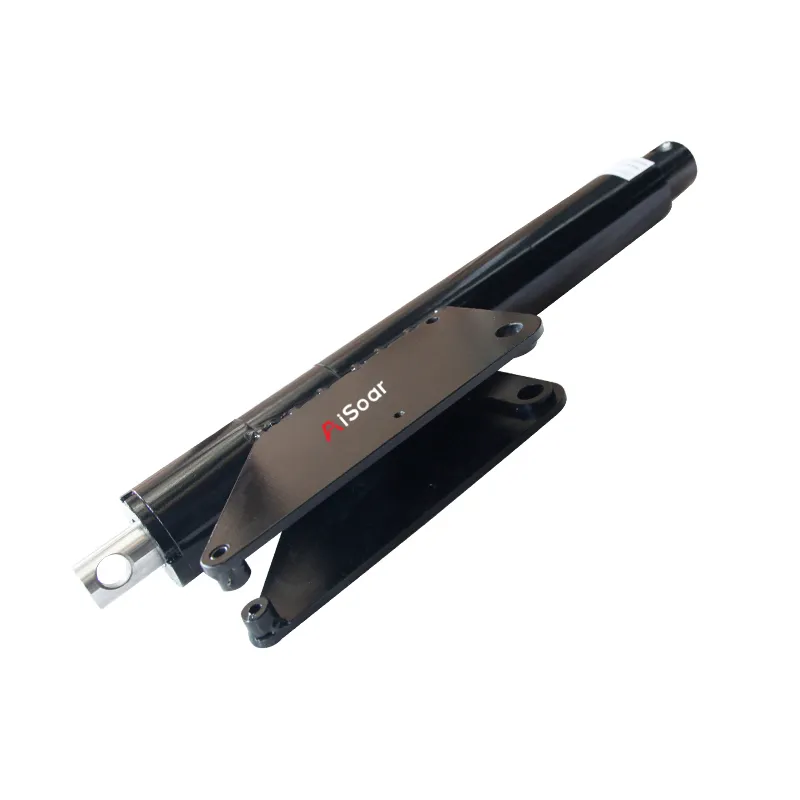
A hydraulic cylinder piston rod can fail even when the cylinder is operating below its rated pressure if the extended rod is too slender for the compressive load and mounting condition. This risk becomes especially important in long-stroke cylinders, where the rod behaves increasingly like a compression column as it extends. Rod buckling can be prevented by selecting an adequate rod diameter, limiting the effective unsupported length, keeping the load aligned with the cylinder axis, choosing the correct mounting arrangement, and checking the rod against the expected maximum compressive load with an appropriate design margin.
What Is Hydraulic Cylinder Rod Buckling?
Rod buckling is a structural instability that can occur when a long, slender piston rod is subjected to compression. Instead of simply compressing along its centerline, the rod begins to deflect sideways and may suddenly bend as the compressive load approaches its critical buckling capacity.
This is different from ordinary rod bending caused by an external side load or impact. A piston rod may be perfectly straight and axially loaded but still become unstable if it is too long and slender for the applied compression.
Research notes that column failure or rod buckling can occur when cylinder stroke becomes too long relative to rod diameter. Its cylinder design guidance therefore treats piston rod diameter, stroke and mounting condition together rather than selecting the rod only from hydraulic force.
Buckling is mainly a push-stroke problem. When the piston rod is carrying load in tension, it does not buckle in the same way, although tensile strength, threads, rod-end connections and mounting components still need to withstand the load.
Why Do Long-Stroke Cylinders Have a Higher Buckling Risk?
As a hydraulic cylinder extends, more of the piston rod becomes unsupported outside the cylinder. The longer this unsupported section becomes, the easier it is for the rod to deflect sideways under compression.
The classical Euler buckling relationship helps explain this:
Critical Buckling Load ∝ EI / (KL)²
where E represents material stiffness, I represents the rod section’s moment of inertia, L is the effective unsupported length, and K reflects the way the rod and cylinder ends are supported.
The important practical point is that buckling capacity decreases rapidly as effective length increases. If the effective unsupported length doubles, the theoretical Euler critical load falls substantially. Bosch Rexroth’s cylinder design methodology similarly considers mounting style, slenderness, compressive stress, bending stress and rod deflection when evaluating piston rod buckling.
Rod diameter has the opposite effect. For a solid round rod, the section property associated with buckling increases strongly with diameter, so increasing rod diameter can significantly increase column stability.
This is why a rod diameter that is completely adequate for a short-stroke cylinder may not be suitable for a much longer cylinder producing the same hydraulic force.
What Factors Increase Piston Rod Buckling Risk?
Rod diameter and stroke are important, but they are not the only factors. In an actual hydraulic cylinder, buckling risk depends on the complete mechanical system.
| Factor | Effect on Buckling Risk |
|---|---|
| Smaller rod diameter | Reduces column stiffness |
| Longer unsupported length | Greatly increases buckling risk |
| Higher compressive force | Increases load on the rod |
| Unfavorable mounting condition | Can increase effective buckling length |
| Poor load alignment | Adds bending stress to compression |
| Side loading | Forces the rod away from its centerline |
| Flexible machine structure | Can create misalignment under load |
| Long stroke at full extension | Usually represents the most critical condition |
Rod Diameter
An undersized rod has lower bending stiffness and lower resistance to column instability. Choosing rod diameter only from tensile strength or available standard sizes can therefore be misleading in long-stroke push applications.
The rod must be checked against the maximum compressive force expected during operation, including realistic pressure, external load and machine geometry.
Effective Unsupported Length
The relevant length is not always identical to the nominal cylinder stroke. Mounting points, rod-end guidance, pivot location and cylinder construction affect the effective column length.
Some application engineering guidance uses different effective length relationships for different mounting and guidance arrangements, which shows why the same bore, rod and stroke can have different buckling limits depending on how the cylinder is installed.
Mounting Condition
A properly guided fixed cylinder behaves differently from a pivot-mounted cylinder with a long unsupported rod. Mounting style changes how the rod and cylinder can rotate, deflect or remain constrained under load.
This is one reason piston rod buckling should be checked together with the hydraulic cylinder mounting type, rather than as an isolated rod-diameter calculation.
Your current mounting guide already explains that changing the mounting or pivot location can change the effective unsupported rod length and therefore influence buckling resistance.
Misalignment and Side Loading
A rod designed for axial compression can become much more vulnerable when the load is not aligned with the cylinder centerline.
Misaligned pins, worn bushings, frame deflection, poor bracket geometry or an externally unguided load can create bending stress in addition to compression. Parker specifically warns that standard cylinder rods are not normally intended to absorb significant bending moments or loads perpendicular to the rod axis.
A rod may therefore fail earlier than a simple ideal buckling calculation suggests if the real machine introduces side loading.
How Does Mounting Affect Rod Buckling?
Mounting determines how the cylinder transfers force to the machine and how effectively the rod is supported as it extends.
A flange-mounted cylinder with a well-guided external load may behave very differently from a long pivot-mounted cylinder pushing through an articulated linkage. Even if both cylinders generate the same force and use the same rod diameter, their effective buckling conditions can be different.
Pivot-mounted cylinders require particular attention because the cylinder changes angle as the mechanism moves. The rod force should remain close to the cylinder centerline throughout the stroke. If the pivot points are incorrectly located or the linkage moves out of plane, the rod can experience a combination of compression and bending.
Fixed-mounted cylinders also require accurate alignment. A rigid flange does not protect the rod if the driven load is allowed to move sideways.
The mounting design should therefore answer two separate questions:
Is the rod large enough to resist axial buckling?
and:
Is the machine guiding the load well enough to prevent additional bending and side loading?
Both conditions must be satisfied.
How Should Rod Diameter Be Selected for a Long-Stroke Cylinder?
Rod diameter should not be selected only from bore size or cylinder pressure.
The first step is to determine the maximum compressive force expected during the push stroke. The designer then needs to consider the maximum extended condition, mounting arrangement, effective unsupported length, rod material and any additional bending caused by the machine geometry.
Manufacturer rod-selection charts or an engineering buckling calculation can then be used to verify the selected rod. Parker, for example, specifically recommends following piston rod selection data to avoid rod buckling rather than assuming that a rod suitable for one cylinder configuration is automatically suitable for another.
The critical condition is often the cylinder at or near full extension under maximum compressive load.
For custom equipment, it is also useful to consider whether the real machine may see pressure spikes, dynamic loads or unfavorable linkage positions that create a higher compression force than the nominal load calculation suggests.
A suitable design margin should therefore be applied according to the cylinder manufacturer’s engineering method, application risks and applicable design requirements rather than relying only on the theoretical Euler value.
How Can Rod Buckling Be Prevented?
The most direct solution is often to increase piston rod diameter. A larger rod has significantly greater resistance to lateral deflection and can support a higher compressive load for the same unsupported length.
However, increasing rod diameter is not the only solution.
Reducing the effective unsupported length can also greatly improve stability. Changes to cylinder mounting, rod guidance or machine geometry may reduce the effective column length without requiring an unnecessarily large rod.
The external load should also be properly guided. Rails, bearings, slides or machine linkages should control the movement path so the hydraulic cylinder is primarily transmitting axial force rather than acting as the structural guide for the entire mechanism.
For some long-stroke applications, a stop tube may be recommended. A stop tube increases the distance between the piston and rod-bearing support when the cylinder is extended, helping reduce bearing loads and the tendency toward jackknifing in long-stroke configurations. Parker’s application guide combines stop-tube recommendations with piston rod diameter checks for certain long-stroke mounting arrangements.
A stop tube should not, however, be treated as a universal substitute for an adequately sized piston rod. Rod diameter, effective length and mounting still need to satisfy the required column stability.
The best design usually combines:
Adequate rod diameter → Appropriate effective length → Correct mounting → Axial load alignment → External load guidance
rather than trying to correct a weak design with only one measure.
Conclusion
Hydraulic cylinder rod buckling occurs when a piston rod working in compression becomes structurally unstable before the rod material itself necessarily reaches a simple compressive strength limit. Long stroke, small rod diameter, high compressive force, unfavorable mounting and poor alignment all increase the risk.
The most effective way to prevent rod buckling is to select the rod diameter and mounting arrangement based on the maximum compressive load and effective unsupported length, while keeping the cylinder and external load accurately aligned. Long-stroke cylinders should be checked specifically for buckling rather than assuming that a rod selected from bore size or pressure alone is sufficient.
Increasing rod diameter, improving external guidance, reducing effective unsupported length, correcting mounting geometry and using stop tubes where appropriate can all contribute to a more stable design.
For OEM applications, Aisoar Hydraulics can develop custom hydraulic cylinders with rod diameter, stroke, mounting and structural configuration matched to the actual compression load and machine geometry.
Frequently Asked Questions
Q:Is hydraulic cylinder rod buckling the same as a bent piston rod?
A: No. Buckling is an instability caused primarily by axial compression on a slender rod. A piston rod can also bend because of side loading, impact or misalignment. In real equipment, compression and side loading may occur together, making the failure more severe.
Q:Can a piston rod buckle even if the hydraulic pressure is below the cylinder’s rated pressure?
A: Yes. Pressure rating and rod buckling capacity are different design limits. A cylinder may remain within its hydraulic pressure rating while a long, slender rod is still unsuitable for the compressive load and effective unsupported length.
Q:Does a larger piston rod always solve buckling problems?
A: A larger rod generally improves buckling resistance, but it does not correct poor mounting, severe side loading or incorrect machine geometry. The complete load path should be evaluated.
Q:Do hydraulic cylinders working in tension need a buckling check?
A: Buckling is primarily associated with compression. A rod carrying a pure tensile load does not buckle in the same way, although rod tensile strength, threads, rod-end connections and mounts still need to be checked.
Q:What is a stop tube in a long-stroke hydraulic cylinder?
A: A stop tube is an internal spacer used in certain long-stroke cylinder designs to increase the distance between the piston and rod-bearing support when extended. It can reduce bearing loads and improve stability, but it should be used according to the cylinder manufacturer’s design method rather than as a replacement for proper rod sizing.