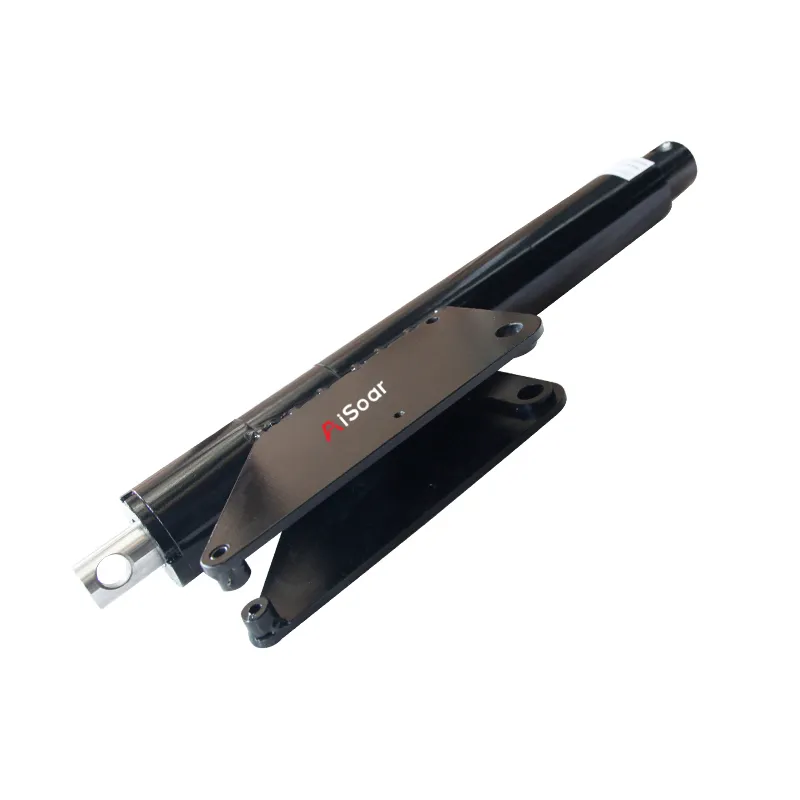
When a hydraulic cylinder begins leaking, drifting, or experiencing shorter seal life at high temperatures, the first reaction is often to replace the standard seals with FKM or PTFE seals.
However, selecting seals for a high-temperature hydraulic cylinder is not simply a matter of choosing the material with the highest temperature rating.
Cylinder seals must withstand temperature, pressure, movement speed, hydraulic fluid, extrusion clearances, piston rod condition, contamination, and side loading at the same time. If any of these factors is overlooked, even a high-temperature seal may soften, extrude, wear rapidly, or begin leaking again.
Confirm the Actual Operating Temperature
Before selecting a seal material, distinguish between several different temperatures:
- Summer ambient temperature
- Normal hydraulic oil temperature
- Stable oil temperature during continuous operation
- Short-term peak temperature during pressure shocks or rapid cycling
- Local contact temperature around the sealing lip
For example, the ambient temperature around a machine may be only 40°C, while the hydraulic oil becomes significantly hotter after several hours of operation.
Rod and piston seals also generate frictional heat during rapid reciprocating movement. The temperature directly at the sealing lip may therefore be higher than the oil temperature measured in the reservoir.
The maximum temperature shown in a seal catalogue is normally based on specific test conditions. It does not mean that the seal can operate continuously at its maximum temperature, pressure, and speed at the same time.
A suitable safety margin should always be retained for continuous high-temperature operation.
Select the Seal Material for the Complete Application
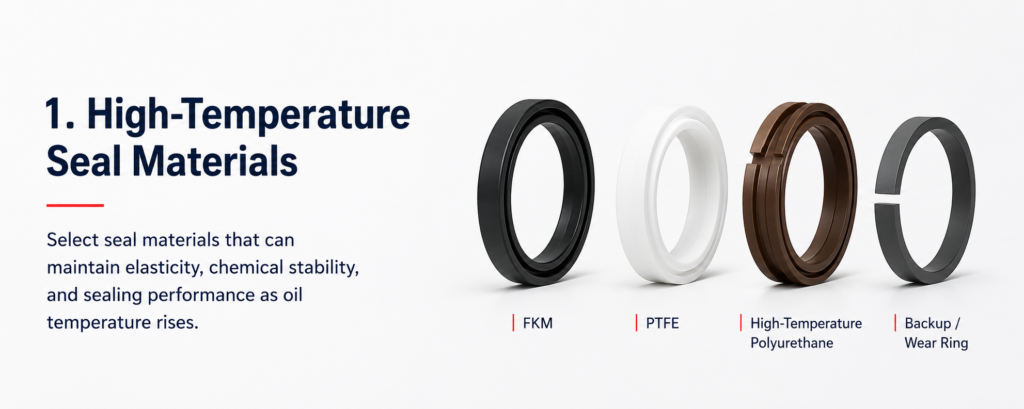
Different seal materials offer different combinations of temperature resistance, wear resistance, elasticity, friction, and fluid compatibility.
Polyurethane
Polyurethane seals provide good wear resistance, mechanical strength, and extrusion resistance. They are widely used for rod seals, piston seals, and wipers in mobile and industrial hydraulic cylinders.
However, not every polyurethane grade is suitable for continuous high-temperature operation. Some advanced hydraulic polyurethane materials may operate at temperatures around 110°C, depending on the compound and seal design.
When continuously used close to its temperature limit, polyurethane may soften, lose elasticity, or extrude into component clearances.
Nitrile Rubber
NBR is commonly used for O-rings, static seals, and energizing elements. It generally offers good compatibility with mineral-oil-based hydraulic fluids and is relatively economical.
Many standard NBR compounds are used at temperatures up to approximately 100°C, although the actual limit depends on the formulation and operating conditions.
Long-term exposure above the suitable temperature range may cause hardening, cracking, shrinkage, or compression set.
NBR is usually better suited to standard hydraulic applications than to continuously high-temperature equipment.
Hydrogenated Nitrile Rubber
HNBR provides improved heat resistance, aging resistance, and mechanical performance compared with standard NBR.
Depending on the compound and seal structure, some HNBR components may be suitable for temperatures around 150°C.
HNBR can therefore provide an intermediate option between NBR and FKM. However, compatibility with the exact hydraulic fluid and additives must still be confirmed.
Fluorocarbon Rubber
FKM is frequently used for high-temperature O-rings, static seals, and the energizing elements in PTFE seal assemblies.
Some FKM compounds may operate at temperatures approaching 200°C and offer good resistance to heat and aging.
However, FKM is not automatically the best choice for every high-temperature cylinder. Low-temperature flexibility, dynamic wear resistance, hydraulic fluid compatibility, and compound formulation must also be considered.
Replacing an NBR seal with FKM will not correct excessive clearances, rod damage, contamination, or cylinder misalignment.
PTFE
PTFE offers low friction, broad temperature capability, and good compatibility with many hydraulic fluids. It is often used in piston and rod seals for high-temperature, high-speed, or low-friction applications.
However, PTFE does not have the same elasticity as rubber materials. It normally requires an NBR, HNBR, FKM, or other elastomeric energizer to maintain contact pressure.
The temperature capability of the complete seal assembly therefore depends on every material in the combination, not only the PTFE sliding ring.
Treat the Cylinder Seals as a Complete System
A hydraulic cylinder normally contains several sealing and guiding components:
- Rod seal
- Piston seal
- Static seals
- Wiper
- Wear rings
- Backup rings where required
Each component performs a different function.
The rod seal controls external leakage. The piston seal separates the cylinder chambers. Static seals prevent leakage between assembled components. The wiper limits the entry of dust and moisture. Wear rings support side loads and prevent direct metal-to-metal contact.
If only the rod seal is upgraded while the piston seal, O-rings, wiper, or energizing elements remain unsuitable for the temperature, the cylinder may still develop internal leakage, external leakage, or premature seal failure.
All sealing and guiding materials should therefore be reviewed as one system.
Consider Pressure and Extrusion Risk
Many rubber and polyurethane compounds become softer as temperature rises.
Under high working pressure or pressure spikes, softened sealing material may be forced into the clearance between the piston, cylinder bore, rod, guide bushing, or seal groove.
This can cause:
- Seal extrusion
- Cut edges
- Tearing
- Permanent deformation
- Sudden leakage
For high-temperature and high-pressure cylinders, check:
- Normal working pressure
- Maximum and peak pressure
- Return-line backpressure
- Seal-groove dimensions
- Piston-to-bore extrusion clearance
- Rod-to-guide clearance
- Backup-ring requirements
- Seal extrusion resistance
The seal material, groove design, component tolerances, and supporting structure must be considered together.
Installing a higher-temperature material without controlling the extrusion gap may still result in rapid failure.
Consider Cylinder Speed and Cycle Frequency
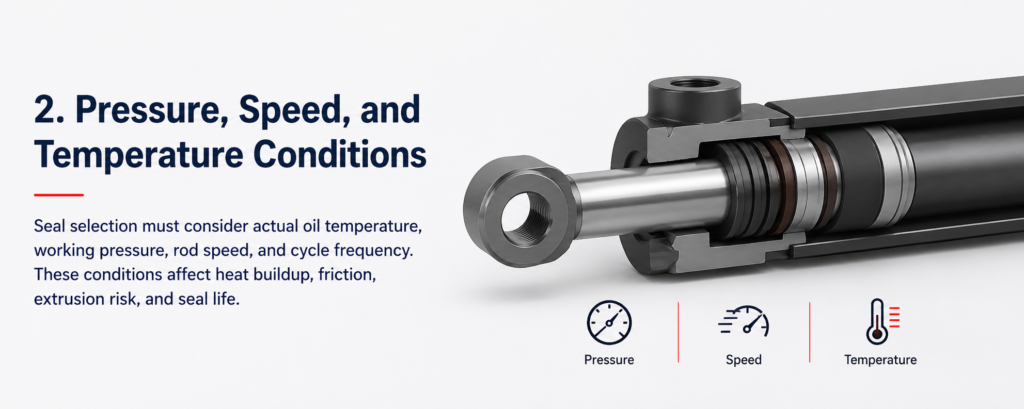
Cylinder speed and cycle frequency directly affect seal temperature.
Fast reciprocating movement generates friction around the rod seal, piston seal, and wear rings. Frequent cycling also reduces the time available for the cylinder to release heat.
A seal may withstand a high static temperature but perform poorly under high-speed dynamic conditions.
When high temperature, high pressure, and high speed occur together, the practical operating limit of the seal normally becomes lower.
Fast-cycling cylinders may require:
- Low-friction seal designs
- Suitable rod surface roughness
- Stable lubrication films
- Correct guide clearances
- Sufficient heat dissipation
- Proper port and pipe sizing
Increasing seal hardness alone may increase friction and generate additional heat.
Confirm Compatibility with the Hydraulic Fluid
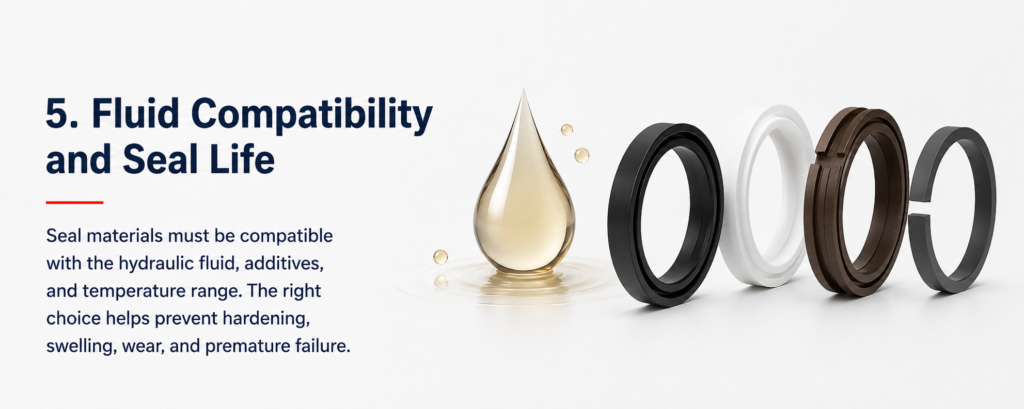
High temperature accelerates chemical reactions between hydraulic oil and sealing materials.
The system may use:
- Mineral hydraulic oil
- Synthetic hydraulic fluid
- Water-glycol fluid
- Phosphate-ester fire-resistant fluid
- Biodegradable hydraulic oil
- Other special fluids
A seal material suitable for mineral oil may not be suitable for water-glycol fluid or phosphate ester.
When the material and fluid are incompatible, the seal may swell, shrink, soften, harden, lose strength, or develop surface cracks.
Oil degradation, contamination, and additive depletion can also change seal performance over time.
The exact hydraulic fluid brand, product designation, viscosity grade, and fluid type should therefore be provided during seal selection. Describing the fluid only as “standard hydraulic oil” may not provide enough information.
Inspect the Rod, Bore, Guidance, and Mounting
Even the correct seal material can fail quickly if the surrounding cylinder components are damaged.
The piston rod should be checked for:
- Scratches
- Corrosion
- Pitting
- Chrome-plating damage
- Incorrect surface roughness
- Bending
The cylinder bore should also be inspected for scoring, corrosion, dimensional wear, and surface defects.
Misalignment, side loading, worn pins, damaged bushings, and worn guide rings can create uneven seal contact. This increases friction, local heat, and one-sided wear.
Before installing new high-temperature seals, inspect the rod, cylinder bore, wear rings, guide bushings, mounting points, and cylinder alignment.
Otherwise, the replacement seals may begin leaking again after only a short operating period.
What Information Is Required for Seal Selection?
Provide the cylinder or seal supplier with the following information:
| Selection Factor | Information Required |
|---|---|
| Temperature | Ambient temperature, continuous oil temperature, and peak temperature |
| Pressure | Normal pressure, peak pressure, and return backpressure |
| Hydraulic fluid | Brand, product designation, viscosity grade, and fluid type |
| Movement | Extension and retraction speed, cycle frequency, and daily operating time |
| Cylinder dimensions | Bore, rod diameter, stroke, and mounting orientation |
| Load | Push force, pull force, side loading, and impact loading |
| Environment | Dust, water, salt spray, chemicals, and outdoor exposure |
| Failure symptoms | External leakage, internal leakage, drift, extrusion, or rapid wear |
Accurate operating data helps the supplier select the seal material, profile, energizer, backup rings, and guiding components for the complete application.
Conclusion
Selecting seals for a high-temperature hydraulic cylinder requires more than comparing maximum temperature ratings.
The correct process begins with the actual continuous and peak oil temperatures. Pressure, fluid type, speed, cycle frequency, extrusion clearances, rod surface condition, cylinder bore, guidance, contamination, and mounting alignment must then be considered.
Polyurethane, NBR, HNBR, FKM, and PTFE each have suitable applications, but no single material is correct for every high-temperature cylinder.
The seal should always be selected as part of a complete sealing, guiding, lubrication, and thermal-management system.
AiSoar Hydraulics provides customized hydraulic cylinder and sealing solutions for high-temperature, heavy-load, rapid-cycle, and demanding industrial applications.