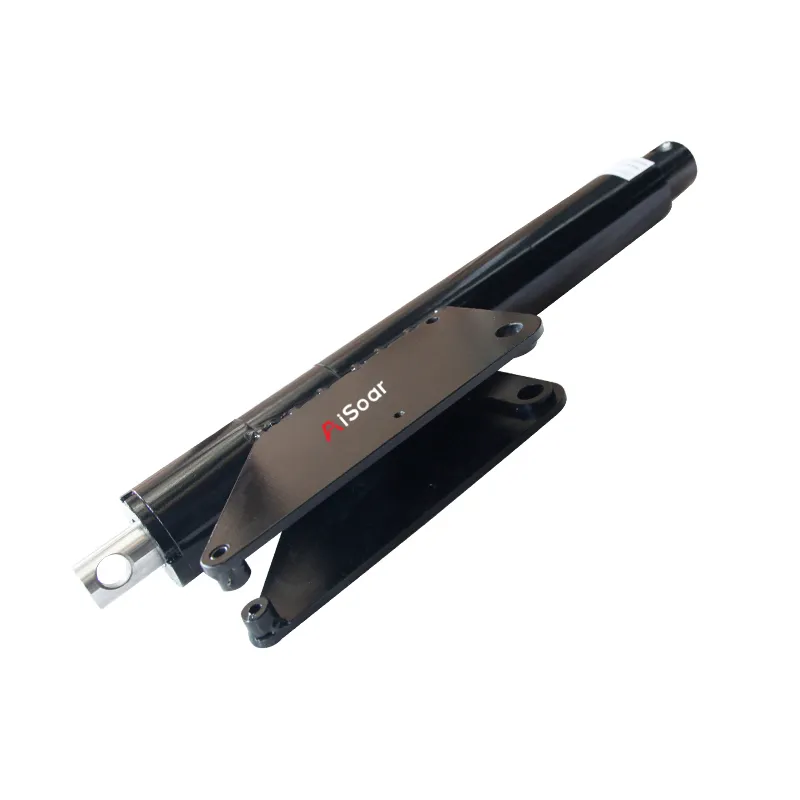
A high-temperature hydraulic cylinder is not created simply by replacing standard seals with “high-temperature seals.” Reliable operation in hot summer conditions, near radiant heat sources, during continuous cycling, or with high-temperature hydraulic oil requires the fluid, sealing system, clearances, guidance, surfaces, cooling, contamination control, and testing to work together.
Improving one component will not solve the problem if the system continues to overheat or the cylinder is exposed to side loading, contamination, excessive backpressure, or pressure spikes.
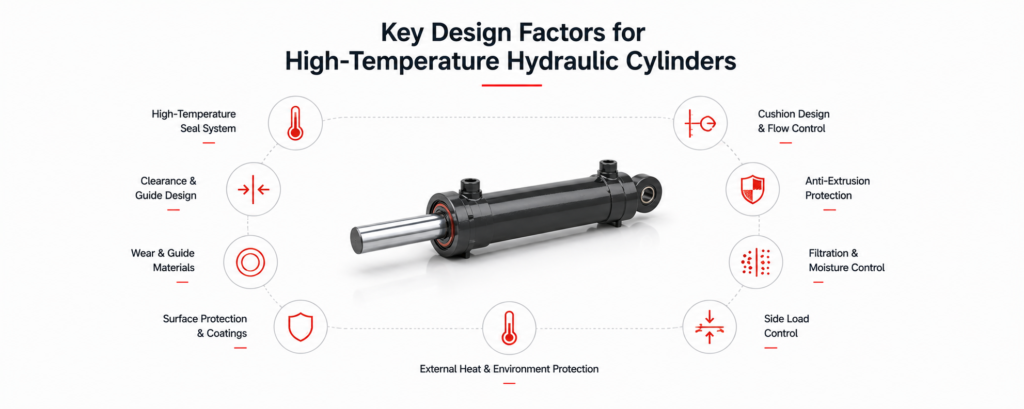
Define the Actual Temperature Conditions
The first step is to distinguish between ambient temperature, hydraulic oil temperature, cylinder surface temperature, and local seal-contact temperature.
The surrounding air may be 40°C, while the oil becomes much hotter after several hours of operation. Fast reciprocating movement creates frictional heat around rod and piston seals. Cylinders near engines, boilers, furnaces, exhaust systems, or dryers may also receive radiant heat.
Before design, confirm the continuous and peak temperatures, daily operating time, cylinder speed, cycle frequency, pressure, fluid type, and external heat sources.
A seal catalogue’s maximum temperature is normally an upper limit under specific conditions. It does not mean the seal can operate continuously at maximum temperature, pressure, and speed together. Continuous operation requires a suitable design margin.

Control Heat Generation in the Hydraulic System
The cylinder is rarely the only reason a system overheats.
Continuous relief-valve operation, throttling losses, high return backpressure, undersized pipes, a small reservoir, inefficient manifolds, and insufficient cooling can all generate or retain heat.
Review the reservoir volume, cooler capacity, airflow, return-line arrangement, pipe size, and valve pressure losses together. Continuously operating equipment may require an air-cooled or water-cooled heat exchanger.
Higher-temperature seals may delay failure, but they cannot correct a system that continuously operates above its intended temperature.
Select Oil by Its Viscosity at Operating Temperature
Hydraulic oil selection should not be based only on its ISO VG grade.
The oil must maintain suitable viscosity from the minimum starting temperature to the maximum continuous oil temperature. Oil that becomes too thin increases leakage through cylinder and valve clearances and weakens the lubricating film between moving surfaces.
Oil that is unnecessarily thick can create cold-start problems, higher suction resistance, and increased pressure loss.
Select the viscosity grade and viscosity index for the complete temperature range, and confirm compatibility with seals, coatings, and other system materials.
Design the Seals as a Complete System
A high-temperature sealing system includes the rod seal, piston seal, static seals, wiper, wear rings, and any required anti-extrusion rings.
Depending on the fluid, pressure, speed, and temperature, materials may include polyurethane, NBR, HNBR, FKM, or PTFE-based combinations.
PTFE provides low friction and broad temperature capability, but it normally requires an elastomer energizer. The complete assembly is only as temperature-resistant as all of its materials.
| Component | Main Design Considerations |
|---|---|
| Rod seal | Temperature, speed, backpressure, rod surface, and external leakage |
| Piston seal | Internal leakage, pressure spikes, pressure direction, and load holding |
| Static seals | Fluid compatibility, compression set, temperature, and extrusion clearance |
| Wiper | Dust, water, heat, corrosion, and rod contamination |
| Backup rings | Preventing softened seals from extruding into gaps |
| Wear rings | Supporting side loads and preventing metal contact |
Pressure, temperature, and speed ratings interact. Their maximum catalogue values should not all be treated as continuous operating conditions.
Check Clearances at the Hot Operating Condition
The cylinder tube, piston, rod, guide bushing, wear rings, seals, and grooves change dimension as temperature rises.
Clearances that are too small may cause friction, stick-slip movement, seal overheating, or seizure. Clearances that are too large may increase internal leakage and seal extrusion.
The piston-to-bore clearance, rod-to-guide clearance, groove dimensions, and extrusion gaps should therefore be checked at the maximum continuous temperature, not only at room temperature.
High-pressure applications may require backup rings or sealing structures with stronger extrusion resistance.
Improve Guidance and Reduce Side Loading
Side loading creates uneven contact on wear rings, guide bushings, seals, and the cylinder bore. This causes concentrated wear and additional frictional heat.
The design can be improved by increasing wear-ring width, increasing the distance between guide surfaces, optimizing pin or trunnion locations, and improving mounting alignment.
Pins, bushings, rod eyes, clevises, and brackets should also be checked for wear and deflection.
Better guidance keeps the piston and rod aligned and reduces one-sided seal wear.
Optimize Rod Surfaces and External Protection
The piston rod requires suitable hardness, roughness, wear resistance, and corrosion resistance.
A rough rod surface can quickly damage the rod seal, while an unsuitable finish may prevent a stable lubricating film from forming.
Select coatings and surface treatments according to temperature, humidity, salt spray, dust, chemicals, and outdoor exposure. The tube coating, wiper, and corrosion protection should also match the environment.
Near radiant heat sources, change the mounting position, add a reflective shield, or consider external cooling. Insulation should not trap heat around the cylinder.
Reduce Speed-Related Heat and Pressure Shock
Rapid cycling, sudden reversal, high return backpressure, and end-of-stroke impact increase seal loading and local temperature.
For frequently cycling cylinders, review port size, pipe diameter, valve flow capacity, and cushioning. Excessive restriction converts hydraulic power into heat.
Adjustable cushioning, controlled deceleration, suitable flow-control circuits, or accumulators may reduce pressure peaks and impact.
A seal that performs well at moderate pressure and speed may fail when high temperature, peak pressure, and rapid cycling occur together.
Strengthen Filtration and Moisture Control
High temperature lowers oil viscosity and weakens the lubricating film. Small particles can then contact rods, bores, seals, and wear rings more directly.
Water reduces lubrication, promotes corrosion, and accelerates oxidation. Air, moisture, and degraded oil may also contribute to foaming, deposits, unstable movement, and cavitation-related damage.
Use suitable return, pressure, or offline filtration. Filter new oil before filling, and clean cylinders, pipes, hoses, and manifolds before assembly.
Reservoir breathers should limit dust and moisture entry. Oil condition, water content, filter condition, and reservoir cleanliness should be monitored.
Validate the Cylinder with Hot-State Testing
A room-temperature pressure test cannot fully confirm high-temperature reliability.
Test the final design at oil temperatures, pressures, speeds, loads, and cycle frequencies close to the real application. Check:
- High-temperature cycling stability
- External and internal leakage
- Hot-state pressure and load holding
- Temperature around the rod, tube, head, and seals
- Cushioning, reversal, and low-speed movement
- Seal recovery after heating and cooling
- Wear, extrusion, scoring, or surface damage after disassembly
For continuously operating equipment, testing should simulate the expected daily running time. A few no-load strokes after reaching the target temperature are not enough.
Information Required for a High-Temperature Cylinder
Provide the cylinder manufacturer with:
- Ambient, continuous oil, and peak oil temperatures
- Working pressure and possible pressure spikes
- Bore, rod, stroke, and mounting arrangement
- Load direction and possible side loads
- Extension and retraction speed
- Cycle frequency and daily operating time
- Hydraulic fluid type and external heat sources
- Load-holding and leakage requirements
- Dust, water, corrosion, and washdown conditions
Accurate application data allows the cylinder, seals, oil, cooling system, and test procedure to be designed around the real operating conditions.
Conclusion
Reliable high-temperature operation depends on more than the temperature rating of one seal.
Heat generation must first be controlled at the system level. The oil must maintain suitable viscosity. Seals, hot-state clearances, guidance, rod surfaces, corrosion protection, contamination control, ports, and cushioning must then be designed as one system.
Finally, the cylinder must be validated through hot-oil, loaded, and continuous-cycle testing.
Only when the cylinder and hydraulic system are optimized together can leakage, drift, wear, sticking, and premature seal failure be reduced over the long term.
AiSoar Hydraulics provides customized hydraulic cylinder solutions for high-temperature, heavy-duty, frequent-cycle, and demanding industrial applications.