
The electric cylinder is an electric driving device that converts the motor rotary motion into the push rod linear reciprocating motion.
The principle of the electrical cylinder is: after the motor is decelerated by the gear, it drives a pair of screw nuts to turn the motor rotating motion into a linear motion. The push rod action is completed by using the forward and reverse rotation of the motor, such as rotating, shaking and other complex actions through various levers, rocker or connecting rod mechanisms. The stroke can be increased or increased by changing the length of the lever arm.
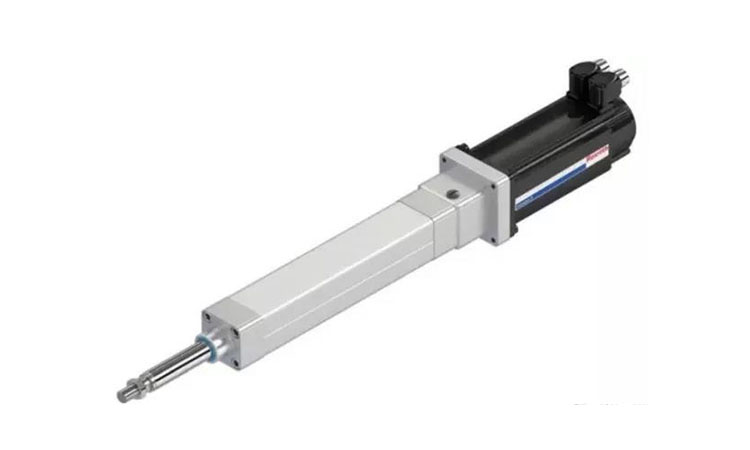
Electric cylinder structure and characteristics
The electric cylinder is mainly composed of motor, electric cylinder block, transmission device and position feedback device. From the appearance and structure, the electric cylinder can be divided into linear type and parallel type.
1. Linear electric cylinder
Linear electric cylinder. The motor of the electric cylinder and the screw spindle are installed on the same axis. It integrates servo motor, servo driver, high-precision ball screw or planetary ball screw, module design and other technologies. The whole electric cylinder has a compact structure.
2. Parallel electric cylinder
The motor of the parallel electric cylinder is installed in parallel with the cylinder block and connected with the transmission screw rod of the electric cylinder through the synchronous belt and synchronous belt wheel. In addition to the characteristics of the linear electric cylinder, due to its total length, it is suitable for occasions with relatively small installation position. At the same time, the synchronous belt selected for the parallel electric cylinder has the characteristics of high strength, small gap and long service life.
As a novel mechatronics product, the electric cylinder has the following characteristics:
1. Precision positioning: the electric cylinder can locate the position with high precision. If the servo motor is used, there are many control modes (speed mode, position mode and torque mode), which can meet different use needs; the servo electric cylinder with ball screw can complete the accurate positioning of about 0.01mm through servo control, which is suitable for applications with high precision requirements.
2. Terminal buffer control, no impact: the microprocessor can monitor the position in real time and accurately control the speed. When it moves to the top position, the electric cylinder can quickly reduce the speed to realize terminal buffer control
3. Flexible installation: the electric cylinder does not need complex power pipeline, and simple wiring is used for all point operations, which is convenient for installation; There are many kinds of installation accessories, and the best installation method can be selected according to the needs of the equipment;
4. Safety function: if the electric cylinder is powered off, the optional brake motor, automatic brake and screw rod device will lock automatically.
Will electric cylinders replace hydraulic cylinders?
Compared with hydraulic cylinder, electric cylinder has many advantages. Generally, for application scenarios with light load and high precision requirements, many manufacturers will give priority to electric cylinder. However, the electric cylinder also has some disadvantages:
1. The impact load will impact the screw rod and bearing of the electric cylinder, may affect the performance of the whole system, and may cause the locking position to be unable to maintain the locking position or there is a gap.
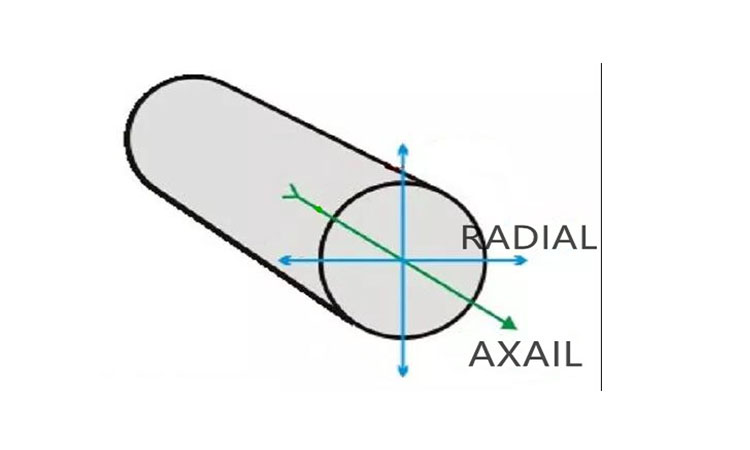
2. The electric cylinder cannot bear the force from the vertical direction, that is, the force direction of the electric cylinder can only be in the same direction as the axis.
3. At present, most of the electric cylinders on the market belong to light load applications in the automation industry. Many factors need to be considered for heavy-duty ones, which limits the development in the heavy-duty industry.
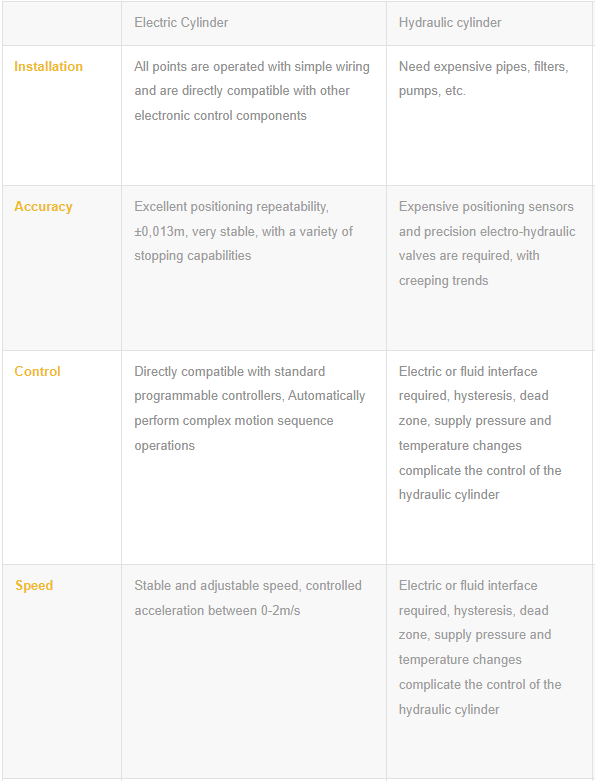
Whether the hydraulic cylinder will be replaced by the electric cylinder should be considered from many aspects.
First of all, compared with the electric cylinder, the hydraulic cylinder has absolute advantages in rated thrust. A large enough accumulator can be added to ensure that it can absorb pulsating hydraulic pressure and provide instantaneous high-power output. For occasions with heavy load and low precision requirements, we still focus on the selection of hydraulic cylinders.
Secondly, due to cost considerations, not all equipment should use electric cylinders. Although the later maintenance cost of electric cylinder is low, its early cost is high.
Everything has two sides. Hydraulic cylinder, air cylinder and electric cylinder have their own advantages and disadvantages. Choose the most appropriate one according to their own needs.