
The process of choosing the right hydraulic cylinder for your specific application may seem routine or even repetitive at times, but it’s important to maintain a fresh outlook when beginning this process and to always remember to consider several basic components.
1. Consider the Size
The process of choosing the right hydraulic cylinder for your specific application may seem routine or even repetitive at times, but it’s important to maintain a fresh outlook when beginning this process and to always remember to consider several basic components.
The first key piece of information to take into account when selecting a bore size Basic operating pressures are typically employed between 500 and 3000 psi. The NFPA medium and high pressure cylinders are compatible with these pressures. The choice of cylinder bore size will be influenced by your desired operating pressure.
The second key piece of information needed to select the bore size is the amount of force required for the application. The following formula can be used to quickly determine the cylinder’s approximate bore size for the extended direction:
F = force required (lbs.)
P = operating pressure (psi.)
D = bore diameter (in.)
D = F / (.7854 * P)
2.Consider the Mount
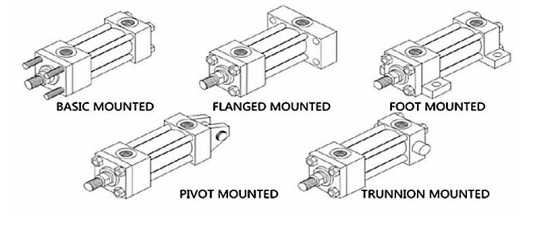
Cylinder mounts can be divided into two basic categories: pivoted and straight-line. Selecting the right mount for an application mainly depends on the desired movement of the load. Pivoted mounts can be used where a load needs to move through an arc and include mounts such as trunnion and clevis.
In comparison to pivoted mounts, straight-line mounts are used when the load only needs to move in a linear direction and include mounts such as the front head flange and side lug. It is necessary to consider the desired movement of the load specific to your application to ultimately determine the type of mount.
3. Environmental Conditions
Knowing where the cylinder will be used is critical for selecting the right materials, seals, and finishes. The cylinder’s material can be altered to satisfy certain environmental requirements. Choosing stainless steel components for corrosion resistance on wash-down food preparation equipment is a classic example. Cylinder seals can be replaced for a variety of reasons, including high or low temperatures or the use of specific operating fluids such as water glycol or phosphate ester fluids. To satisfy a variety of interior and outdoor uses, cylinder finishes can include unique metal plating or paint finishes.
What other steps would you add to this list? Leave a comment with your thoughts below.