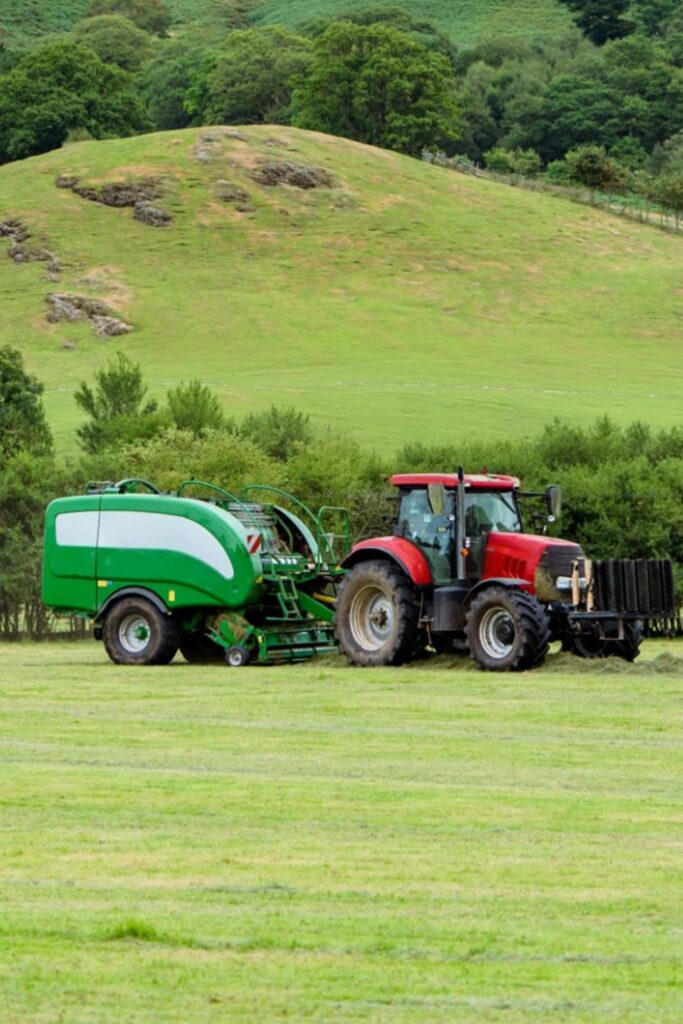
Harvesters use hydraulic cylinders to position working components, support header control, and assist with steering and unloading. The arrangement depends on the machine, header, crop, and installed options. Common applications on combine harvesters include header lifting, reel lifting, reel fore-and-aft adjustment, header tilt, steering, and unloading-auger positioning. The correct cylinder must match both the mechanical installation and the hydraulic circuit.
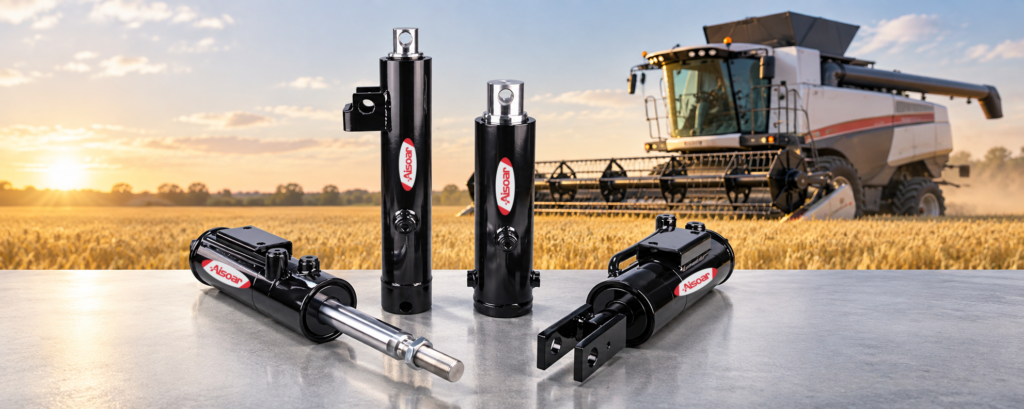
Where Are Hydraulic Cylinders Used on Combine Harvesters?
A combine and its header form an integrated harvesting system, but their cylinders perform different tasks. Some move heavy assemblies through a large range, while others make small adjustments during harvesting.
The following applications provide a useful starting point when identifying a replacement cylinder or developing a new design.
| Cylinder application | Typical installation area | Main function |
|---|---|---|
| Header lift | Between the machine frame and feederhouse | Raises and lowers the header assembly |
| Reel lift | At the header’s reel support arms | Adjusts reel height |
| Reel fore-and-aft adjustment | Along the reel support arms | Moves the reel forward and backward |
| Header tilt | At the feederhouse or header adapter | Adjusts the header’s lateral or cutting angle |
| Cutterbar flotation | Within selected flexible-header support mechanisms | Adjusts cutterbar support and ground pressure |
| Steering | At the steering axle and linkage | Changes wheel steering angle |
| Unloading-auger swing | Near the unloading tube pivot mechanism | Moves the unloading tube between positions |
These functions are not fitted to every machine. A grain header with a reel, for example, has different requirements from a corn header.
Main Hydraulic Cylinder Applications on Harvesters
Header Lift Hydraulic Cylinders
Header lift cylinders raise and lower the feederhouse and attached header. They help establish working height and provide clearance during headland turns or other permitted machine movements.
The required lifting force depends on the header’s mass, center of gravity, attachment geometry, and cylinder mounting position. Header weight alone is insufficient for determining cylinder bore because the linkage changes the mechanical advantage throughout its movement.
Where automatic header-height control is fitted, the cylinders operate with sensors, valves, and the machine controller. Smooth response therefore depends on the complete system, including hydraulic flow and control settings.
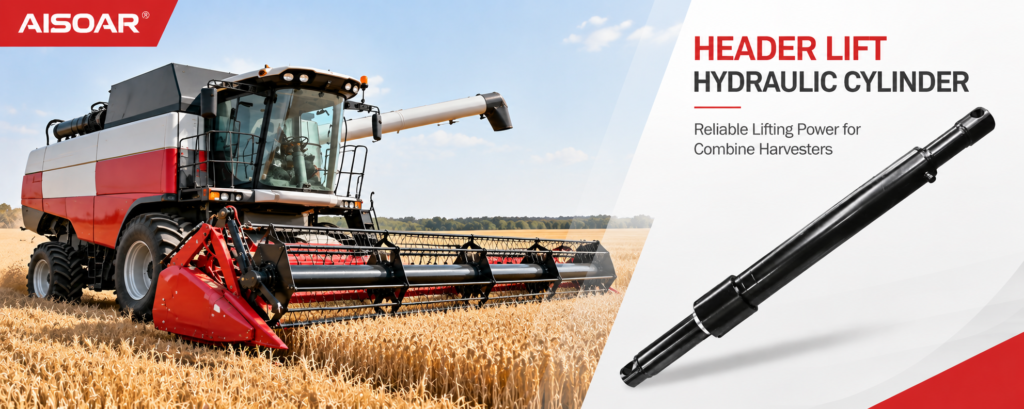
Replacement cylinders must also accommodate the original mechanical safety stops and service-support arrangements.
- Compatible with Case IH Combine(s) AFX8010, 7010, 7230, 7240, 8010, 8230, 8240, 9230, 9240
- Replaces Case IH OEM Number(s) 87728497, 84193227, 84263630
Reel Lift Hydraulic Cylinders
Reel lift cylinders adjust the reel vertically above the cutterbar. The appropriate position helps guide standing or lodged crop into the header without unnecessary disturbance.
Headers may use multiple cylinders to support the reel across its width. Depending on the design, their coordinated movement can rely on a series circuit, rephasing features, or another arrangement specified by the manufacturer.
A cylinder with matching external dimensions may still be unsuitable if its internal displacement or rephasing characteristics differ. Replacement selection should preserve the original circuit arrangement and adjustment procedure. Equipment manuals specifically distinguish reel-lift adjustment, rephasing, and bleeding procedures.
- Replaces Case IH OEM Number(s) 128723A1, 128723A2, 128723A3, 87045527
Reel Fore-and-Aft Hydraulic Cylinders
Reel fore-and-aft cylinders move the reel forward or backward relative to the cutterbar and crop-conveying area. This allows operators to adapt the reel position to crop height, lodging, and feeding conditions.
These cylinders usually act along the reel support arms or through the associated sliding mechanism. Stroke and mounting geometry determine the available positioning range.
The design must maintain appropriate clearances throughout the combined height and fore-and-aft adjustment ranges. Reel positioning and reel rotation are separate functions: hydraulic cylinders set position, while rotation may use a hydraulic motor. Manufacturer specifications list these as distinct systems.
- Compatible with John Deere Header(s) 600, 614F, 614R, 615F, 615R, 616F, 616R, 618F, 618R, 620F, 620R, 625F, 625R, 630F, 630R, 635F, 635R
Header Tilt Hydraulic Cylinders
Selected feederhouse and header-adapter arrangements provide hydraulic adjustment of the header’s angle. Lateral tilt changes its side-to-side orientation, while fore-and-aft tilt changes the cutting angle.
These movements help adapt the header to terrain and harvesting conditions. Their availability depends on the machine and attachment configuration.
Tilt cylinders may work through short linkages where small cylinder movements produce meaningful changes at the cutterbar. Pin clearances, mounting alignment, and controlled movement are therefore relevant to positioning performance.
The specification should identify which tilt function is required, rather than describing the part only as a “header adjustment cylinder.” Operator documentation distinguishes lateral tilt from hydraulic feederhouse fore-and-aft tilt.
- Compatible with Case IH Combine(s) AFX7010, AFX8010, 5088, 5130, 6088, 6130, 7010, 7088, 7120, 7130, 7230, 8010, 8120, 8230, 9120, 9230
- Replaces Case IH OEM Number(s) 87282645, 87387853, 87108710, 87281618
Cutterbar Flotation Hydraulic Cylinders
Some flexible headers use hydraulic cylinders within their flotation mechanisms to adjust support for the cutterbar. Changing hydraulic pressure alters how much weight the ground carries as the header follows uneven terrain.
This function differs from lifting the entire header. It concerns local support and ground contact within the header assembly.
The cylinder must be compatible with the flotation linkage, operating-pressure range, and pressure-control arrangement. Other header designs may use springs or different combinations of mechanical and hydraulic support.
This application should therefore be described as a feature of selected flexible headers. Official flexible-header specifications document pressure adjustment through float-arm hydraulic cylinders.
Steering Hydraulic Cylinders
On wheeled combines, steering cylinders act through the steering axle or linkage to turn the wheels. Their installation must accommodate the required wheel angles and movement of the axle assembly.
Cylinder stroke, mounting centers, joint articulation, and available force all affect compatibility. A replacement with an incorrect stroke can interfere with the intended steering limits.
Steering-cylinder selection should follow the original machine specification, including connections to any steering-position feedback equipment. Official combine equipment documentation identifies steering cylinders as part of the axle configuration.
Unloading-Auger Swing Hydraulic Cylinders
Some combines use a hydraulic cylinder to swing the unloading tube between its stowed and unloading positions. The cylinder acts through a pivot arrangement or linkage near the tube support.
Required force depends on tube geometry, mass, linkage position, and the operating conditions specified by the equipment manufacturer. Cylinder stroke must match the intended travel and stopping positions.
The swing cylinder positions the unloading assembly; it does not provide the auger’s continuous conveying rotation. Folding sections and adjustable discharge spouts, where fitted, may have separate actuators.
Manufacturer service instructions identify unloading-auger swing-cylinder adjustment as a specific task.
Which Cylinder Designs Are Suitable for Harvesters?
Geschweißte Hydraulikzylinder
Welded cylinders can provide a compact arrangement where installation space is limited. Mounting ends, port positions, and overall dimensions can be configured around the machine’s brackets and hose routing.
Suitability still depends on the load, pressure, stroke, and operating environment. A compact body does not remove the need to assess rod stability, mounting stresses, and service access.
Tie-Rod Hydraulic Cylinders
Tie-rod cylinders use external threaded rods to hold the end caps and barrel together. This construction can be considered where the available space and mounting arrangement accommodate it.
Tie-rod construction does not identify a particular harvesting function. A standard tie-rod cylinder should only replace another design after its dimensions, ratings, and circuit compatibility have been checked.
Single-Acting and Double-Acting Cylinders
Single-acting cylinders provide hydraulic force in one direction and rely on an external force for return. Double-acting cylinders provide powered movement in both directions.
The original mechanism and circuit determine which arrangement is appropriate. Ports alone should not be used to infer compatibility where the cylinder includes special internal features.
Mounting and Synchronization Features
Eye, clevis, cross-tube, and spherical-bearing connections suit different bracket arrangements. The connection must allow the intended articulation while avoiding unwanted side loading.
For paired cylinders, matching bore and stroke does not automatically ensure coordinated movement. Confirm whether the system requires rephasing, a particular displacement relationship, or other synchronization provisions.
What Information Is Needed to Specify a Harvester Cylinder?
Begin with the machine model, header model, and cylinder function. For replacement work, an original part number and installation drawing are more useful than appearance alone.
| Spezifikation | Information to provide |
|---|---|
| Equipment identification | Harvester model, header model, and relevant serial-number range |
| Anmeldung | Header lift, reel positioning, tilt, flotation, steering, or unloading |
| Hydraulic arrangement | Single-acting or double-acting; relevant control and synchronization features |
| Druck | Working pressure and expected pressure peaks |
| Main dimensions | Bore, rod diameter, and stroke |
| Installation dimensions | Retracted and extended mounting-center distances |
| Mounting details | Pin diameter, bracket width, bushings, and articulation |
| Connections | Port thread, orientation, and hose clearance |
| Operating conditions | Load, speed, cycle frequency, temperature, and contamination exposure |
| Additional features | Sensors, cushioning, integrated valves, or rephasing requirements |
Confirm both end positions and the available clearance throughout the movement. A cylinder that fits while retracted may still interfere with nearby components when extended.
Hydraulic Cylinders for Your Harvester Application
Harvester cylinders operate around crop residue, dust, moisture, and changing mechanical loads. Suitable rod protection, sealing, mounting alignment, and hose routing help the assembly perform consistently in these conditions.
For an AISOAR inquiry, provide the cylinder’s function, equipment details, installation dimensions, hydraulic requirements, and available drawings or sample information. These details support evaluation of a suitable standard cylinder or a customized configuration.