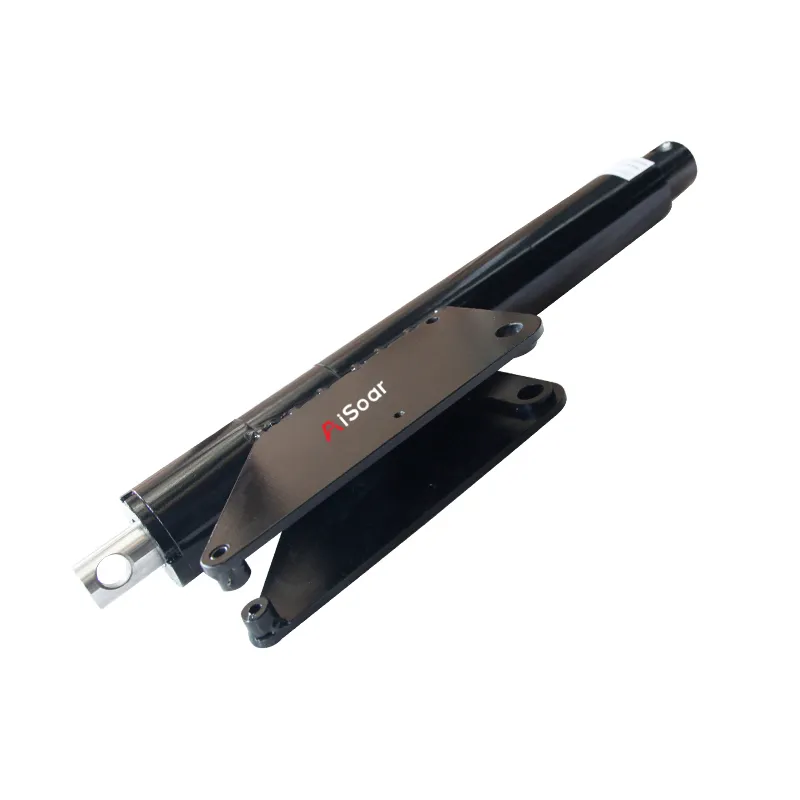
Hydraulic cylinder cushioning is used to reduce piston speed before the cylinder reaches the end of its stroke, helping reduce impact, vibration, and mechanical stress. Once cushioning is required, one of the main design decisions is whether to use a fixed or adjustable cushion.
What is the difference between fixed and adjustable hydraulic cylinder cushioning?
Fixed cushioning is usually better for stable, repeatable operating conditions, while adjustable cushioning is more suitable when load, speed, or machine conditions vary and the deceleration needs to be tuned.
How Do Fixed and Adjustable Hydraulic Cylinder Cushions Work?
Both fixed and adjustable cushioning use the same basic principle. Near the end of the cylinder stroke, the normal oil outlet path becomes restricted, causing pressure to build in the cushion chamber. This pressure creates a resisting force that decelerates the piston and the connected load before the cylinder reaches its mechanical end position.
The difference is mainly in how the oil restriction is created and whether it can be changed after the cylinder has been manufactured.
Fixed Cushioning
Fixed cushioning uses a predetermined restriction designed into the cylinder. The restriction may be formed by a fixed orifice, machined passage, annular clearance, or another geometry that controls how quickly oil can leave the cushion chamber.
Because the restriction is established during design and manufacturing, the cushioning effect normally cannot be adjusted during operation. This makes fixed cushioning particularly suitable for machines where load, speed, hydraulic flow, and operating conditions remain relatively consistent.
Once the cushion geometry has been correctly matched to the application, the cylinder can provide repeatable deceleration without requiring further adjustment by the operator.
Adjustable Cushioning
Adjustable cushioning uses a controllable restriction, commonly through a needle valve or adjustable throttle passage. Changing the opening changes the rate at which oil can leave the cushion chamber and therefore changes the amount of deceleration near the end of the stroke.
Reducing the opening generally creates more resistance and stronger deceleration, while opening it further allows the piston to move more freely through the cushion zone. This gives technicians the ability to fine-tune the stopping behavior after the cylinder has been installed on the machine.
Adjustable cushioning is especially useful when the real operating condition may differ from the original design assumption or when the machine works with different loads, speeds, attachments, or operating cycles.
Fixed vs Adjustable Cushioning: Key Differences
The main difference is not simply that one design is more advanced than the other. The real difference is how much flexibility the application requires after installation.
| 요인 | Fixed Cushioning | Adjustable Cushioning |
|---|---|---|
| Cushion restriction | Predetermined | Adjustable |
| Field adjustment | Normally unavailable | 제공 가능 |
| 구조 | Simpler | More complex |
| 가장 적합한 | Stable, repeatable conditions | Variable operating conditions |
| Commissioning adjustment | Usually unnecessary | Often useful |
| Operator influence | 낮은 | 더 높은 |
| Flexibility | 제한된 | 더 높은 |
| Cost and complexity | 일반적으로 낮음 | 일반적으로 높음 |
Fixed cushioning has the advantage of simplicity. There are fewer adjustment points, less risk of incorrect field settings, and the cushioning behavior can remain consistent across repeated machine cycles. For OEM equipment operating under a well-defined load and speed range, this can be a very effective solution.
Adjustable cushioning provides greater flexibility. It allows the machine builder or service technician to tune the deceleration after installation, which can be valuable when the actual payload, linkage geometry, hydraulic flow, or machine behavior varies from one application to another.
However, adjustability does not automatically mean better performance. A poorly adjusted cushion can be too restrictive or not restrictive enough, so the basic cylinder and cushion geometry still need to be designed correctly.
When Is Fixed Cushioning the Better Choice?
Fixed cushioning is usually the better choice when the cylinder operates under predictable and repeatable conditions.
Consider an industrial machine that performs the same movement hundreds of times each day with approximately the same load, speed, stroke, and hydraulic pressure. Once the correct cushion characteristics have been established, a fixed restriction can provide consistent stopping behavior without requiring operator adjustment.
This can also be useful for high-volume OEM production. If every machine has similar operating conditions, eliminating unnecessary adjustment points can simplify manufacturing, commissioning, and field service.
Fixed cushioning is therefore most suitable when the machine can be designed around one well-defined operating range and there is little need to change the deceleration behavior after installation.
When Is Adjustable Cushioning the Better Choice?
Adjustable cushioning becomes more useful when the cylinder must operate under changing conditions.
Material-handling equipment, agricultural machinery, construction equipment, and other mobile machines may work with different payloads, attachments, hydraulic flow rates, or operating speeds. The cushion setting that works well under a light load may not provide the same stopping behavior when the moving mass increases significantly.
Adjustability can also be valuable during machine commissioning. Even when the cylinder has been correctly designed, the final machine dynamics may be influenced by linkage geometry, hose routing, valve characteristics, system back pressure, and other factors that are difficult to reproduce perfectly before the complete equipment is assembled.
For OEM applications with application-specific load and speed requirements, 완벽한 신뢰성 can be designed with fixed or adjustable cushioning to match the actual operating conditions.
Adjustable cushioning is therefore most valuable when the machine manufacturer needs greater control over the final deceleration behavior rather than one permanently fixed setting.
Why Load and Speed Matter in Cushion Selection
Cushion selection is fundamentally related to the energy of the moving system.
A heavy load moving slowly and a light load moving quickly do not create the same stopping requirement. In particular, increasing piston velocity can significantly increase the kinetic energy that must be absorbed as the cylinder approaches the end of its stroke.
This is why cushioning should not be selected only from cylinder bore, stroke, or system pressure. Moving mass, piston speed, available cushion distance, mounting geometry, oil temperature, hydraulic circuit behavior, and duty cycle can all influence how the cylinder decelerates.
A cushion that is too weak may allow noticeable impact at the end of the stroke. A cushion that is too restrictive may cause the cylinder to slow too early, extend the machine cycle, or make the final part of the stroke appear hesitant.
The objective is not to create the strongest possible cushioning. Good cushioning should remove enough kinetic energy to control the stop smoothly while still allowing the cylinder to complete its stroke within the required cycle time.
For this reason, the cushion design should ideally be considered as part of the overall custom hydraulic cylinder design, rather than treated as an isolated option.
결론
Fixed and adjustable hydraulic cylinder cushioning use the same basic principle: restricting oil flow near the end of the stroke to reduce piston speed and control end-of-stroke impact. The main difference is that fixed cushioning uses a predetermined restriction, while adjustable cushioning allows the deceleration effect to be tuned after installation.
If the cylinder operates under stable and repeatable load and speed conditions, fixed cushioning is usually the simpler and more suitable choice. If load, speed, attachment, hydraulic flow, or other operating conditions vary, adjustable cushioning generally provides greater flexibility because the stopping behavior can be fine-tuned.
The final choice should still consider moving mass, cylinder velocity, cushion distance, operating pressure, duty cycle, and the overall hydraulic circuit. Cushion selection should therefore be based on the actual machine dynamics rather than simply choosing adjustable cushioning because it offers more features.
OEM 용도의 경우, Aisoar Hydraulics는 다음과 같은 제품을 개발할 수 있습니다. custom hydraulic cylinders with fixed or adjustable cushioning according to the required load, speed, stroke, mounting arrangement, and machine operating conditions.
자주 묻는 질문
Q:Does adjustable cushioning always perform better than fixed cushioning?
A: No. Adjustable cushioning provides greater flexibility, but a properly designed fixed cushion can provide stable and repeatable deceleration when the operating load and speed remain consistent. The better choice depends on how much the actual working conditions change.
Q:Can hydraulic cylinder cushioning be adjusted after installation?
A: Only an adjustable cushion is intended to be tuned after installation. Fixed cushioning normally uses a predetermined restriction designed into the cylinder and is not adjusted during normal operation.
Q:What information is needed to choose fixed or adjustable cushioning?
A: Important information normally includes cylinder bore, stroke, operating pressure, extension and retraction speed, moving load, mounting arrangement, duty cycle, and whether the load or speed changes during operation. The machine’s linkage and hydraulic circuit may also affect the final cushion design.
Q:Can a hydraulic cylinder have cushioning at both ends?
A: Yes. Cushioning can be designed at the rod end, cap end, or both ends depending on where controlled deceleration is required.