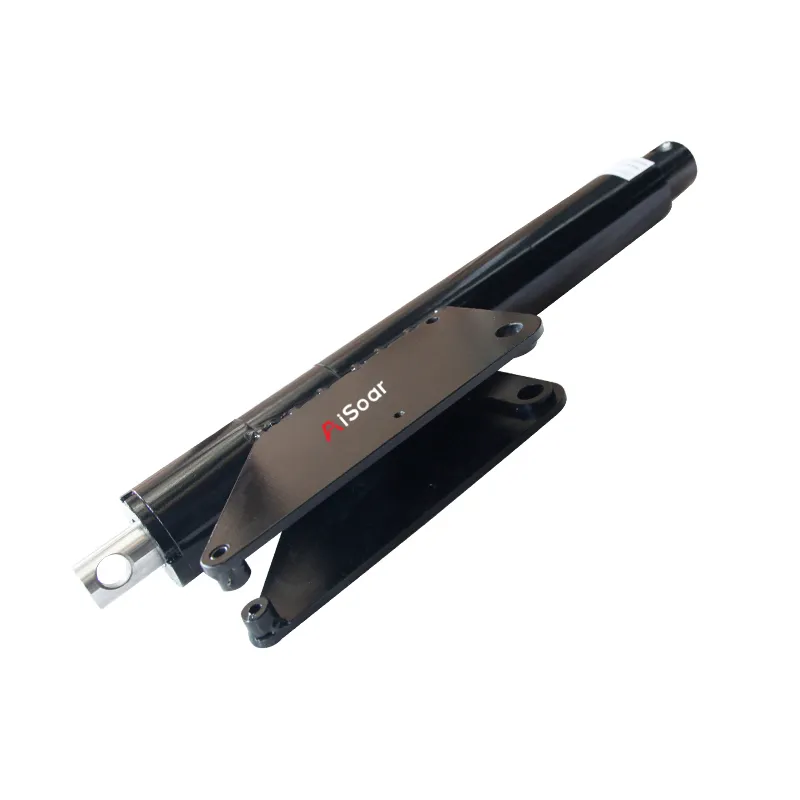
Hydraulic cylinder cushioning controls piston deceleration near the end of the stroke, but not every application needs cushioning in both directions. Some machines generate significant impact only during extension or only during retraction, while others have high-speed or high-inertia motion in both directions. Single-end cushioning is usually sufficient when only one direction creates significant end-of-stroke impact, while double-end cushioning is more suitable when both extension and retraction require controlled deceleration. The correct choice depends on moving mass, cylinder speed, load direction, machine cycle, and what happens at each end of the stroke.
How Do Single-End and Double-End Cushioning Work?
The basic cushioning principle is the same in both designs. As the piston approaches the end of its travel, the normal oil outlet path becomes restricted, causing pressure to build in the chamber that is exhausting oil. This resistance slows the piston and connected load before they reach the mechanical end of the cylinder.
The difference is simply where this controlled deceleration occurs.
Single-End Cushioning
A single-end cushion provides controlled deceleration at only one end of the cylinder stroke.
For a conventional double-acting cylinder, rod-end cushioning typically controls deceleration as the cylinder approaches full extension, because oil is being exhausted from the rod-side chamber. Cap-end cushioning typically controls deceleration as the cylinder approaches full retraction, when oil is leaving the cap-side chamber.
This arrangement is useful when one motion carries much more kinetic energy than the other. For example, a cylinder may extend rapidly while moving a heavy load but retract slowly with little external load. In that case, cushioning only the extension end may provide the required protection without adding unnecessary complexity to the return stroke.
Double-End Cushioning
Double-end cushioning provides controlled deceleration near both full extension and full retraction.
This means that the cylinder has a cushion arrangement at both the rod end and the cap end. Each cushion controls oil leaving its respective chamber as the piston approaches that end of the stroke.
Double-end cushioning is useful when both directions involve meaningful speed, load, or inertia. It is particularly common in machines that perform repetitive reciprocating motion where the cylinder repeatedly changes direction and both end positions need to be reached smoothly.
Single-End vs Double-End Cushioning: What Is the Difference?
The main difference is not the basic cushioning principle but how many motion directions require controlled stopping.
| Faktör | Single-End Cushioning | Double-End Cushioning |
|---|---|---|
| Cushioned directions | One | Both |
| Typical use | Significant impact in one direction | Impact or high inertia in both directions |
| Rod-end / cap-end options | Either end | Both ends |
| Yapı | Simpler | More complex |
| Ayar | Can be fixed or adjustable | Can be fixed or adjustable at each end |
| Setup | Usually simpler | May require separate tuning at each end |
| Maliyet | Genellikle daha düşük | Genellikle daha yüksek |
| En iyi şekilde uyan | One critical motion direction | Repetitive or high-energy two-way motion |
An important point is that single-end vs double-end cushioning and fixed vs adjustable cushioning describe two different design decisions.
Single-end or double-end tells you where cushioning is applied. Fixed or adjustable tells you whether the cushioning restriction can be tuned.
This means a cylinder can use:
single-end fixed cushioning,
single-end adjustable cushioning,
double-end fixed cushioning, or
double-end adjustable cushioning.
Which End of the Cylinder Needs Cushioning?
The correct end should be determined by what the cylinder and machine are doing near the end of each movement.
During extension, the piston normally moves toward the rod end of the cylinder. If the extending motion carries a heavy load or reaches a high velocity, rod-end cushioning may be required to control the final deceleration.
During retraction, the piston approaches the cap end. If the returning mechanism also carries significant mass or moves quickly, cap-end cushioning may be needed.
However, direction alone does not determine the answer. The external machine geometry can change the effective load considerably. A cylinder mounted vertically may experience gravity-assisted movement in one direction, while a linkage or boom may create very different effective loads during extension and retraction.
For this reason, cushion selection should consider the actual kinetic energy and mechanical behavior at each end of the stroke, not simply assume that extension and retraction require the same cushioning.
When Is Single-End Cushioning Enough?
Single-end cushioning is often sufficient when one direction is clearly more demanding than the other.
For example, a hydraulic cylinder may extend rapidly to lower or position a heavy component, creating significant inertia near full extension. The return stroke may be slower and lightly loaded, producing little end-of-stroke impact. In this case, adding cushioning to the return end may provide limited practical benefit.
Single-end cushioning can also be appropriate when the machine itself naturally slows the load in one direction. Mechanical geometry, gravity, flow control, or external resistance may already reduce velocity before the cylinder reaches one end of its travel.
Using cushioning only where it is required can simplify the cylinder, reduce cost, and make commissioning easier.
The key principle is:
If meaningful kinetic energy must be controlled at only one end of the stroke, single-end cushioning is usually sufficient.
When Is Double-End Cushioning Better?
Double-end cushioning is more appropriate when both directions involve significant speed, moving mass, or repeated end-of-stroke impact.
Automated production equipment is a good example. A cylinder may extend quickly to move a fixture or workpiece and then retract quickly to prepare for the next cycle. Repeated hard stopping at either end can increase noise, vibration, wear, and stress on cylinder mounts and machine structures.
Material-handling equipment, lifting systems, mobile machinery, and industrial automation may also benefit from double-end cushioning when loading conditions change during both extension and retraction.
Another reason to use double-end cushioning is operator or machine comfort. Even if the cylinder can mechanically tolerate the impact, smooth deceleration at both ends can improve motion quality and reduce shock transmitted into the rest of the equipment.
For applications with variable operating conditions, both ends can also use adjustable cushioning so that extension and retraction are tuned separately.
What Should You Consider Before Choosing?
Single-end or double-end cushioning should not be selected from cylinder bore and stroke alone.
The first consideration is moving mass. A heavy component contains more kinetic energy and generally requires more controlled deceleration than a lightly loaded mechanism.
Cylinder velocity is equally important. Even a moderate load can create substantial stopping energy when it moves quickly, so the expected extension and retraction speeds should be considered separately.
Load direction also matters. Gravity, machine linkage, external forces, and mechanical geometry may increase the effective load in one direction while reducing it in the other.
The machine cycle should also be reviewed. A cylinder operating occasionally may tolerate conditions differently from one performing thousands of extension-retraction cycles per day. Frequent impact at an end position can gradually increase wear on mounts, pins, seals, and surrounding structures.
A practical selection sequence is:
Extension load and speed → Retraction load and speed → End-of-stroke impact at each side → Duty cycle → Required deceleration → Single-end or double-end cushioning
For OEM applications, these conditions should ideally be evaluated together with the complete custom hydraulic cylinder design, including bore, rod diameter, stroke, mounting, ports, operating pressure, and cushion configuration.
Sonuç
Single-end and double-end cushioning use the same hydraulic principle but solve different motion-control requirements. Single-end cushioning provides controlled deceleration in one direction, while double-end cushioning protects both ends of the stroke.
If significant end-of-stroke impact occurs mainly during extension or mainly during retraction, single-end cushioning is usually the simpler and more appropriate solution. If both directions involve high speed, heavy loads, repeated cycling, or noticeable impact, double-end cushioning generally provides better control.
The final decision should consider the actual load and speed in each direction rather than automatically specifying cushions at both ends. Adding cushioning where it is not required can increase complexity without providing meaningful improvement.
For OEM equipment, Aisoar Hydraulics can develop custom cushion hydraulic cylinders with rod-end, cap-end, or double-end cushioning, using fixed or adjustable designs according to the actual load, speed, stroke, mounting, and machine cycle.