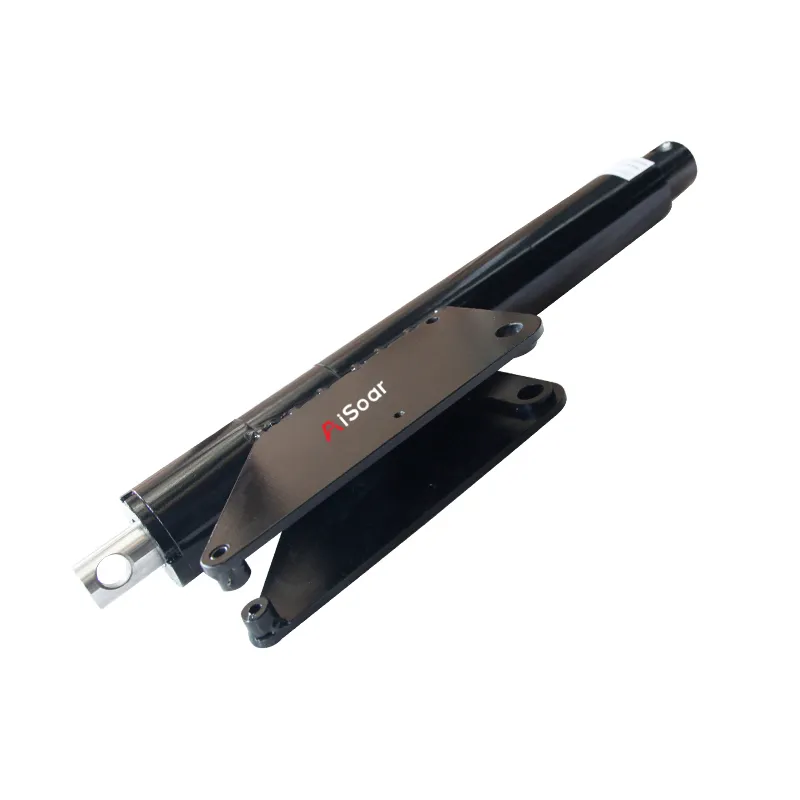
A hydraulic cylinder is designed primarily to generate force along its centerline. When the cylinder, load, or machine linkage is misaligned, part of that force acts sideways on the piston rod, rod bearing, seals, piston, and barrel instead of remaining purely axial. Side loading can cause excessive friction, uneven bearing and seal wear, rod or barrel scoring, leakage, jerky movement, and eventually mechanical damage. The most effective prevention is to keep the cylinder aligned with the load, select the correct mounting arrangement, and use the machine structure or external guides to support lateral forces rather than relying on the cylinder itself.
What Is Side Loading in a Hydraulic Cylinder?
Side loading occurs when a force acts across the piston rod instead of along the cylinder’s longitudinal axis. In a properly installed cylinder, the piston rod mainly pushes or pulls in a straight line. If the load is offset, the mounting points are misaligned, or the driven mechanism moves in a different plane, the rod is forced against one side of the gland and the piston against the opposite side of the barrel.
This is different from piston rod buckling. Buckling is primarily a stability problem caused by axial compression on a long, slender rod, while side loading introduces a lateral force and bending moment. In real machinery, however, misalignment and compression may occur together, which can make the resulting damage more severe.
Poor alignment between a hydraulic cylinder and its load can create side loading on the piston rod and rod bearing. In most applications, the cylinder should primarily provide linear push or pull force, while the machine structure, rails, bearings, or linkages guide the external load.
What Causes Hydraulic Cylinder Side Loading?
Incorrect mounting is one of the most common causes. A fixed-mounted cylinder may be securely bolted to the machine, but if the mounting face is not aligned with the direction of travel, the rod is forced sideways as soon as it begins to move. Pivot-mounted cylinders can develop the same problem when the base and rod-end pins are not parallel or when the linkage moves outside the intended plane.
Wear in the machine can create side loading even when the original design was correct. Worn pins, bushings, clevises, spherical bearings, brackets, or structural joints can allow the load path to shift over time. A flexible machine frame may also deflect under full load, creating an alignment problem that is not obvious when the equipment is unloaded.
Another common cause is an inadequately guided external load. A hydraulic cylinder should normally provide the push or pull force while rails, slides, bearings, rollers, or the machine linkage control the load’s path. If the cylinder rod is expected to guide a large platform, boom, fixture, or carriage by itself, lateral forces can be transferred directly into the rod bearing and piston.
How Does Side Loading Damage a Hydraulic Cylinder?
Side loading first increases contact pressure between the piston rod and the rod bearing or gland. Instead of sharing the load evenly around the bearing surface, one side carries a much higher load. This can accelerate guide wear, increase friction, and eventually affect the rod seal.
As wear develops, the piston rod may no longer remain centered. The seal lip can then experience uneven loading, which may lead to repeated external leakage even after new seals have been installed. One-sided wear on the rod bearing or rod seal is a common indication that the cylinder may be experiencing persistent lateral loading or misalignment.
The piston can also be forced against the opposite side of the cylinder bore. This may damage wear rings, score the barrel, increase friction, and contaminate the hydraulic oil with wear particles. In more severe cases, the piston rod may bend, mounting pins may wear unevenly, or brackets and welds may be subjected to loads they were not designed to carry.
Side loading can therefore appear first as a motion or leakage problem before it becomes an obvious mechanical failure.
What Are the Warning Signs of Side Loading?
A cylinder affected by side loading does not always fail immediately. The symptoms can develop gradually as alignment, bearings, seals, and mounting components deteriorate.
| مراقبة | Possible Side-Load Mechanism | How to Check | Recommended Action |
|---|---|---|---|
| Rod seal repeatedly leaks | Uneven gland or rod-bearing load | Inspect rod, bearing and alignment | Correct alignment before replacing seals again |
| Rod or bearing wears mainly on one side | Persistent lateral force | Check mounting centerlines and load path | Realign cylinder and external load |
| Rod surface shows one-sided scoring | Rod forced against bearing | Inspect rod through full stroke | Check guides, pins and brackets |
| Cylinder moves slowly or binds at certain positions | Friction increases as geometry changes | Compare movement through full stroke | Inspect linkage and load guidance |
| Jerky or stick-slip movement | Misalignment creates changing friction | Check mount and load alignment | Correct mechanical cause before tuning hydraulics |
| Pins or bushings wear unevenly | Linkage is not rotating freely | Inspect pin clearance and bracket geometry | Repair mounting components |
Before inspecting mounting or linkage components, the equipment should be shut down, hydraulic pressure released, and any suspended or moving load mechanically supported according to the machine’s safety procedure.
How Does Mounting Type Affect Side Loading?
The mounting style must match the way the machine moves.
Fixed mounts such as flange or foot mounts are suitable when the cylinder and driven load remain accurately aligned along a straight path. They provide little ability to compensate for changing angular geometry, so the external load generally needs good guidance.
Pivot mounts such as clevis, cross-tube, tang, trunnion, or spherical-bearing arrangements allow the cylinder to rotate as the machine linkage moves. However, a pivot mount does not automatically eliminate side loading. The pivot axes still need to match the linkage geometry, and the cylinder must be able to move through its complete operating arc without being forced sideways.
A spherical bearing can accommodate limited angular misalignment, but it should not be used to compensate for fundamentally incorrect machine geometry. Your existing أنواع تثبيت الأسطوانة الهيدروليكية موضحة article already covers the differences between fixed and pivot mounting arrangements in more detail.
How Can You Tell If Misalignment Is the Real Cause?
Diagnosis should focus on whether the cylinder follows the same load path throughout its complete stroke.
Look for unequal wear on the rod bearing, seals, piston guides, pins, and bushings. One-sided wear is an important clue because normal axial loading should not continually force the internal components toward the same side.
Alignment should also be checked at more than one cylinder position. A linkage may appear correctly aligned when fully retracted but move out of plane halfway through the stroke or near full extension. Cylinder-to-load alignment should be checked at multiple positions throughout the stroke, especially near full extension and full retraction. A linkage may appear correctly aligned in one position but move out of plane as the mechanism travels, increasing wear on the gland, rod bearing, piston, or cylinder bore.
If the cylinder moves smoothly without load but begins to bind, slow down, or move erratically when the real machine load is applied, frame deflection or poor external guidance should also be investigated.
How to Prevent Hydraulic Cylinder Side Loading
The first design priority is to keep the load path as close as practical to the cylinder centerline. The cylinder mounting points, rod-end connection, and driven mechanism should work together so that the actuator mainly experiences axial push and pull forces.
The external load should also have its own guidance where necessary. A long carriage, platform, mold, boom, or lifting structure may need rails, bearings, rollers, bushings, or linkage supports to control lateral movement. The hydraulic cylinder should provide motion and force rather than replace a mechanical guide system.
Mounting style should follow machine geometry. A mechanism that moves through an arc normally needs suitable pivoting connections, while a fixed-mounted cylinder requires a rigid and accurately guided straight-line load. Pins and bushings should also be maintained because excessive clearance can gradually change the load path.
Machine deflection under load must not be ignored. A frame that is aligned during assembly may distort when the cylinder develops maximum force. Checking the real working geometry is therefore more useful than checking alignment only with the machine unloaded.
Finally, simply increasing piston rod diameter is not a complete solution. A larger rod can improve bending stiffness, but it does not remove the lateral force that caused the problem. The root solution is correct alignment, appropriate mounting, and proper external load guidance.
الخاتمة
Hydraulic cylinder side loading occurs when the load is not transmitted along the actuator centerline. The resulting lateral force pushes the rod, bearings, seals, piston, and barrel sideways, increasing friction and creating uneven wear.
The most effective prevention is not simply a stronger rod or a new seal. The cylinder and external load must remain correctly aligned throughout the entire stroke, the mounting arrangement must match the machine’s motion, and lateral loads should be carried by appropriate guides or structural components.
When recurring seal leakage, one-sided wear, rod scoring, slow movement, or stick-slip appears together with alignment problems, the machine geometry should be investigated before repeatedly repairing the cylinder.
الأسئلة الشائعة
Q:Can side loading cause a hydraulic cylinder to leak?
A: Yes. Side loading can force the piston rod against one side of the rod bearing, causing uneven bearing and seal wear. Replacing the rod seal without correcting the alignment problem may result in the new seal failing again.
Q:Can a spherical bearing eliminate hydraulic cylinder side loading?
A: No. A spherical bearing can accommodate limited angular movement and help the cylinder follow a linkage, but it cannot correct poor machine geometry, large lateral offsets, or an external load that is not properly guided.
Q: Can a thicker piston rod solve a side-loading problem?
A: larger rod has greater bending stiffness and may tolerate some additional mechanical load, but it does not remove the cause of side loading. Correct alignment, mounting geometry, and external load guidance should be addressed first.
Q: Is side loading the same as piston rod buckling?
A: No. Side loading is caused by lateral force or misalignment, while buckling is primarily caused by axial compression on a slender rod. A long-stroke cylinder can experience both problems at the same time if it is highly loaded and poorly aligned.
Q: Why does a side-loaded cylinder sometimes move slowly or jerk?
A: Side loading increases friction between the rod, bearing, seals, piston, and barrel. Because this friction may change as the linkage moves, the cylinder can slow down, bind, or develop jerky or stick-slip motion at certain positions.